

In one week Adobe had its green-card pipeline frozen by Washington, watched one developer clone seven of its flagship apps with AI, and remained a top holding of an investor whose other contrarian longs have cratered. The moat is not breached. It is merely shallower than the share price once assumed.
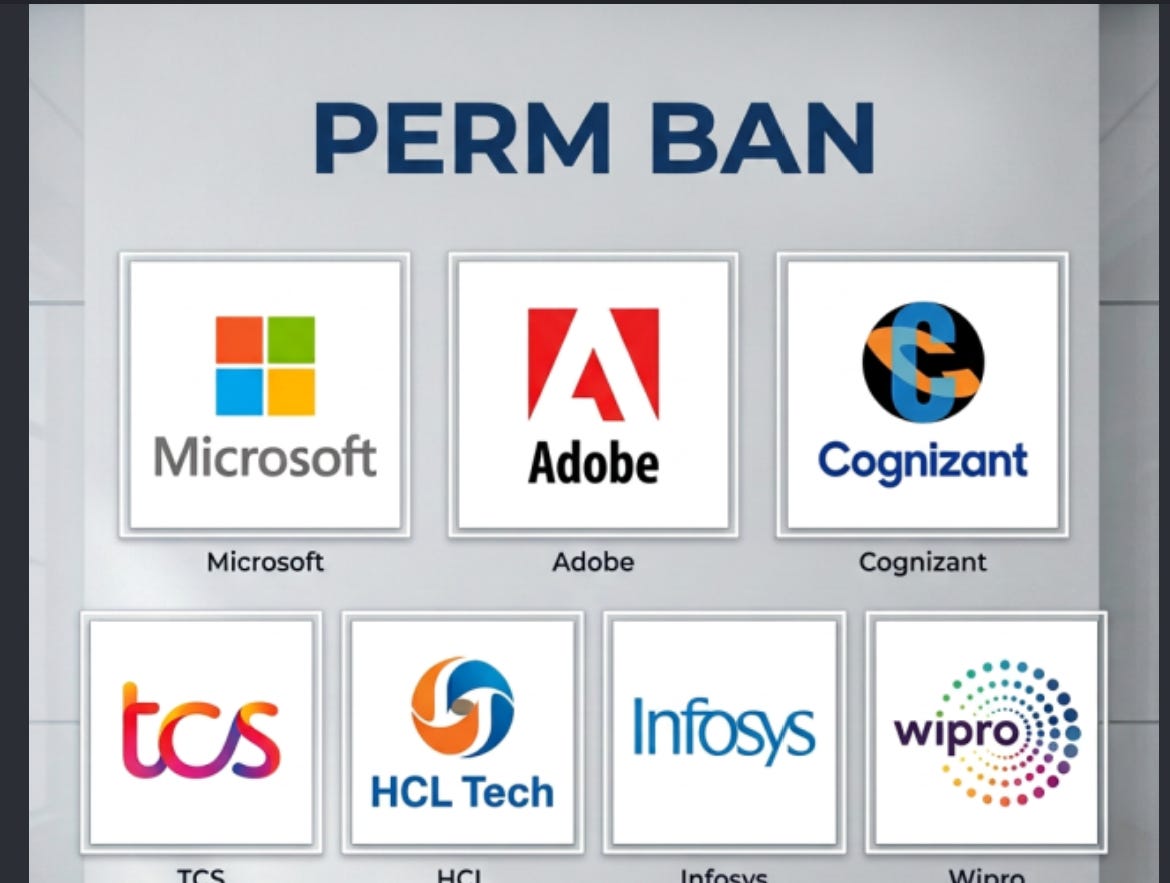
I. Washington discovers PERM
On 8 October, Labor Secretary Keith Sonderling suspended eight companies from the PERM green-card programme: six IT outsourcers (Cognizant, Infosys, TCS, Wipro, HCL, Capgemini) plus Microsoft and Adobe, the latter pair “due to multiple active federal investigations.” New applications will not be accepted, and pending ones will not be processed. Subpoenas have been served; no end date has been given.
For Adobe, that means H-1B engineers stuck in a frozen queue during an AI hiring war, and an open-ended risk factor. It also stacks neatly on a $75m DOJ settlement over hidden cancellation fees, a UK CMA probe and a revived US class action.
II. One man, many agents, seven clones
Developer Brandon Thomas says he “vibe coded” open-source Rust replacements for Photoshop, Illustrator, Premiere, Lightroom, After Effects, InDesign and Acrobat. His motive: Adobe’s cancellation fee. Corporate karma rarely arrives so neatly.
The flagship, PhotoCraft, reads PSD files and exposes 500+ commands to AI agents. It is also early alpha, reportedly under 50% Photoshop-compatible, its one-month parity promise already walked back, and a plausible trade-dress target. Nobody cancels Creative Cloud on Monday.
The point is the cost curve. What once took a funded team years took one person weeks. Good enough at zero is awkward for a subscription priced like a gym membership, and AI agents have neither muscle memory nor brand loyalty. Goldman and Oppenheimer downgraded on similar logic earlier this year.
III. Beats that no longer matter
Fiscal Q3 (Jun–Aug): revenue up 13% to $6.76bn, ARR of $27.5bn, a beat and a raise. The shares fell almost 4% to about $239, far below a 52-week high of $370.86, on marginally soft Q4 guidance. When a beat-and-raise sells off, the market is pricing terminal value. Add a CEO succession and $6.82bn of buybacks in nine months, which flatter EPS without deepening the moat. On the forum: the company buying its own bags.
IV. The Burry problem
Burry’s Adobe stake, made public in April near $227, has gone roughly nowhere. Elsewhere, Lululemon, his largest holding, is down more than 50% this year; he calls it the “trickster” of his book. Flutter, bought in July, fell 11% on a guidance cut and CEO exit before he sold the lot. By his own test, a stock falling on fear is a buy and one falling on fundamentals is not. A federal freeze plus collapsing clone costs looks like fundamentals.
Disclaimer:
All views expressed are my own and are provided solely for informational and educational purposes. This is not investment, legal, tax, or accounting advice, nor a recommendation to buy or sell any security. While I aim for accuracy, I cannot guarantee completeness or timeliness of information. The strategies and securities discussed may not suit every investor; past performance does not predict future results, and all investments carry risk, including loss of principal.
I may hold, or have held, positions in any mentioned securities. Opinions herein are subject to change without notice. This material reflects my personal views and does not represent those of any employer or affiliated organization. Please conduct your own research and consult a licensed professional before making any investment decisions.