

Asia’s AI trade cracked again this week, but not every AI stock went down with it. On Thursday, chipmakers dragged Seoul, Hong Kong and Tokyo sharply lower. In Shanghai, humanoid-robot maker Unitree Robotics finished the week up more than 46%, capped by its first 20% limit-up since listing.
The split suggests investors are not abandoning AI so much as moving down the stack: from the chips that train models to the machines meant to put them to work.
Chips take another hit
Thursday’s selling started in Asia. Korea’s Kospi fell 3.52% to 5,533.77, with Samsung Electronics down 4.03% and SK Hynix down 5.49%. Hong Kong’s Hang Seng dropped about 3%, and Japan’s Nikkei 225 lost 2.6% to 62,907.84.
The trigger was a fresh round of doubt about AI spending. Mixed results from US tech giants, Meta’s in particular, revived the question of whether data-center budgets will pay off. The selling reached Wall Street later that day, where the Nasdaq fell 2.6%.
This was an aftershock, not the main quake. The week before, from October 12 to 15, the 20 most valuable AI and semiconductor stocks lost more than $1 trillion in market value as rate-hike fears, AI debt and Chinese memory competition hit at once. By October 15, the Kospi sat about 21% below its September high.
Unitree leads the robot rebound
Robotics moved the other way, and Beijing gave it the push. On Monday, October 19, China’s Ministry of Commerce and eight other departments called for more supply of smart goods, robots included, and for embodied AI in home services and commercial logistics. Traders read it as the first-time embodied AI had appeared in national commerce policy.
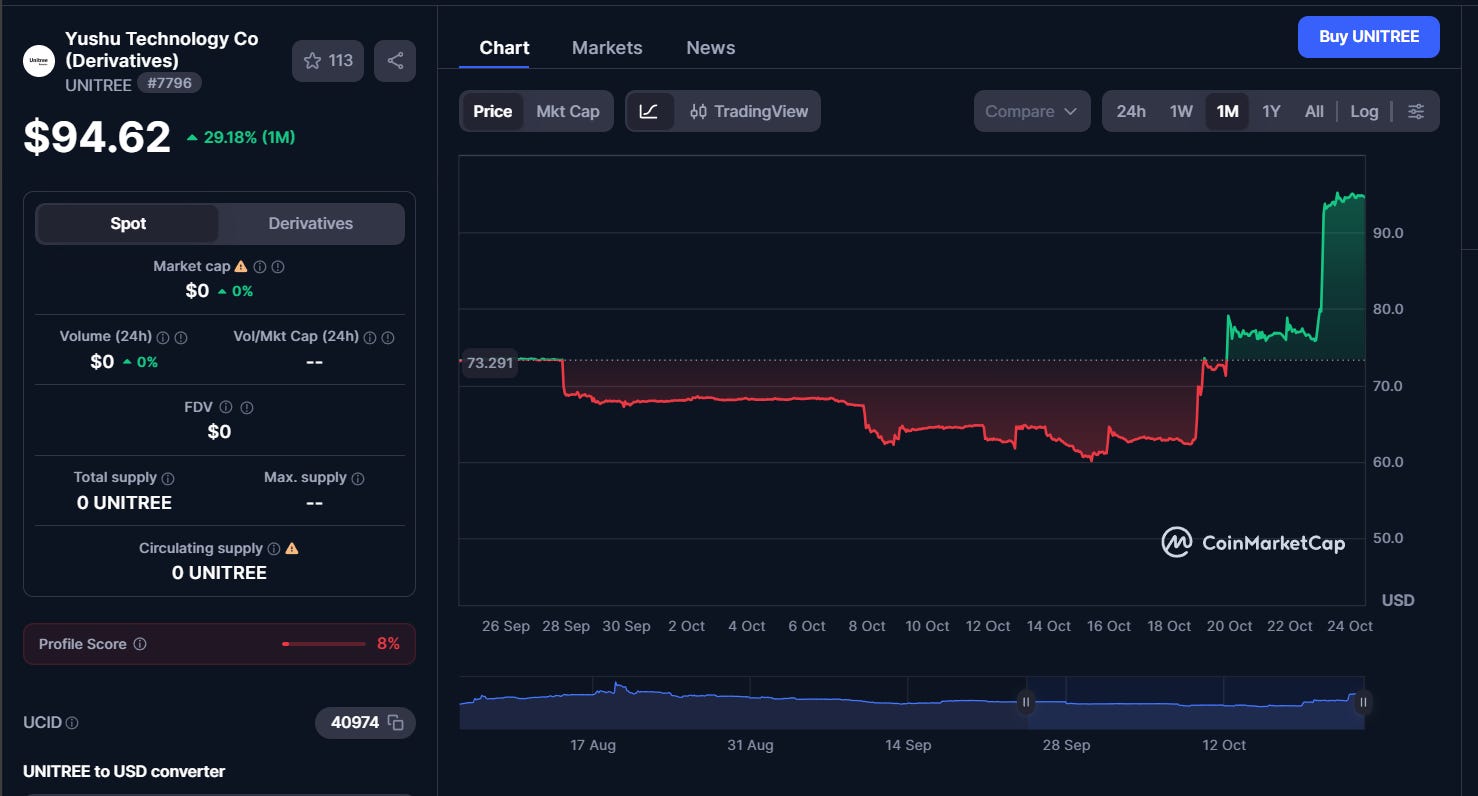
Unitree jumped 16.15% to ¥495.92 that day, its best session since its August 19 debut, excluding the first day of trading. Its market value climbed back above ¥200 billion.
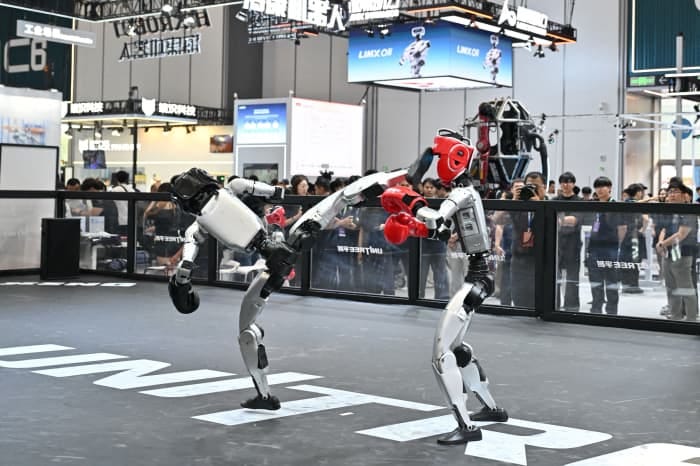
The rally kept building. At a partner conference in Hangzhou on Thursday, chairman Wang Xingxing laid out plans to scale up manufacturing, build AI models for Unitree’s own hardware and invest in computing clusters. The company also unveiled the H2-X, a humanoid pitched as a personal bodyguard. On Friday the stock hit its 20% daily limit at ¥624, valuing Unitree at ¥252.4 billion (about $37.9 billion). The wider sector rose with it: the Wind Humanoid Robot Index gained 6.16%.
The joint makers split
The money did not flow evenly down the supply chain. Harmonic Drive Systems, the Tokyo-listed maker of the strain-wave gears that act as robot joints, fell about 9.6% on Thursday to ¥4,875. It sold off with the chip stocks, not with the robot makers.
Part of the reason is who buys its gears. Harmonic’s reducers go into industrial robots but also semiconductor equipment, so the stock tends to trade with the chip cycle. It now sits about 47% below its July high of ¥9,150, yet still trades at roughly 160 times trailing earnings.
Its biggest Chinese rival had a very different Friday. Suzhou Leader Harmonious Drive Systems, known as Leaderdrive, jumped 12.05% to ¥290 as the humanoid rally spread to suppliers. J.P. Morgan estimates it holds 30% to 40% of China’s harmonic-reducer market, with humanoid makers UBTech and Agibot among its customers. Investors are treating Leaderdrive as a domestic humanoid play. For now, they are not treating Harmonic that way.
Safe haven or the next bubble?
The bull case is that robotics has what the chip trade lacks right now: direct policy support and earlier-stage growth. China built 794,781 industrial robots in the first nine months of 2026, up 29.1% from a year earlier. Unitree’s first-half revenue rose 48.54% to ¥1.152 billion, and unlike loss-making rival UBTech, it turns a profit.
The bear case is valuation and volatility. Unitree’s net profit excluding one-off items fell 19.34% to ¥244 million in the first half. Bank of America rates the stock Underperform with a ¥350 target, and the average analyst target of about ¥486 sits well below Friday’s close. The shares already went from a ¥150.80 IPO price to a peak near ¥1,100, then slid to ¥404 before this rebound. Leaderdrive and Harmonic both trade at triple-digit earnings multiples too.
So robots are not a safe haven in the way bonds are. They are a different bet on AI, and just as exposed to swings in sentiment.
Earnings will start to answer it
Three reports over the next three weeks will test whether the robot rotation rests on sales or on sentiment.
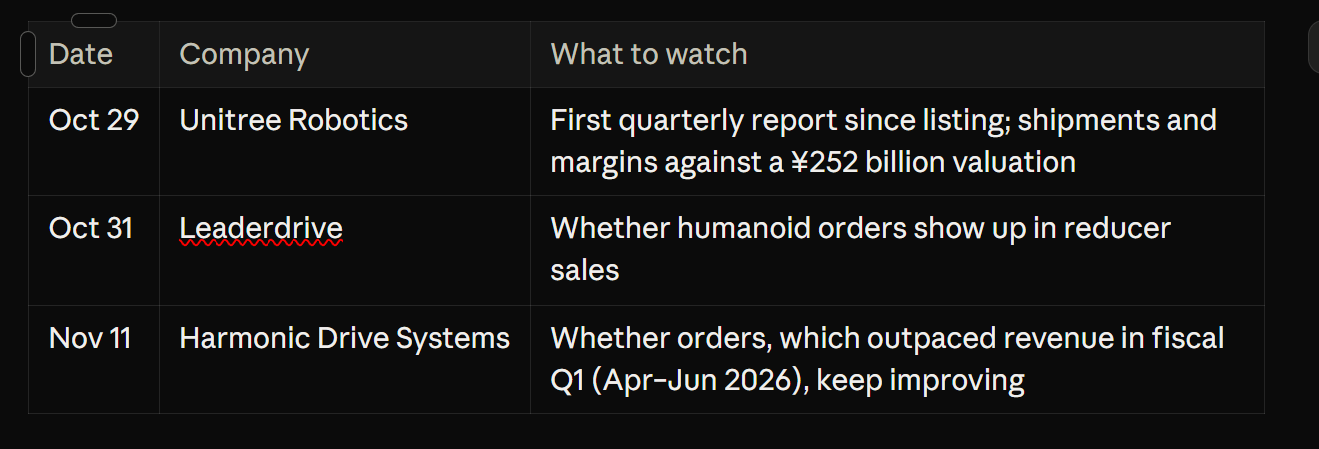
For Harmonic Drive, the slide has opened a wide gap to analysts’ average target of ¥7,597, about 55% above Friday’s ¥4,895 close. That is the buy-the-dip case. It holds only if the November numbers show robot demand reaching Japan’s joint maker, not just China’s.
Disclaimer:All views expressed are my own and are provided solely for informational and educational purposes. This is not investment, legal, tax, or accounting advice, nor a recommendation to buy or sell any security. While I aim for accuracy, I cannot guarantee completeness or timeliness of information. The strategies and securities discussed may not suit every investor; past performance does not predict future results, and all investments carry risk, including loss of principal.
I may hold, or have held, positions in any mentioned securities. Opinions herein are subject to change without notice. This material reflects my personal views and does not represent those of any employer or affiliated organization. Please conduct your own research and consult a licensed professional before making any investment decisions.