

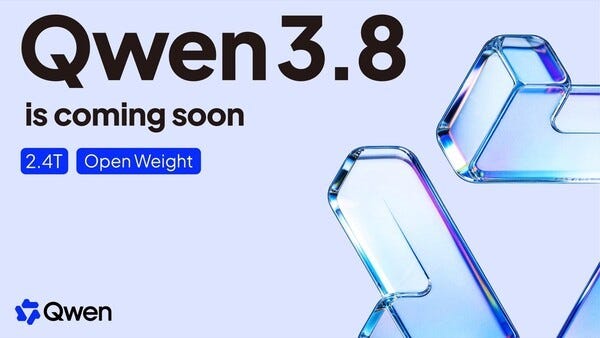
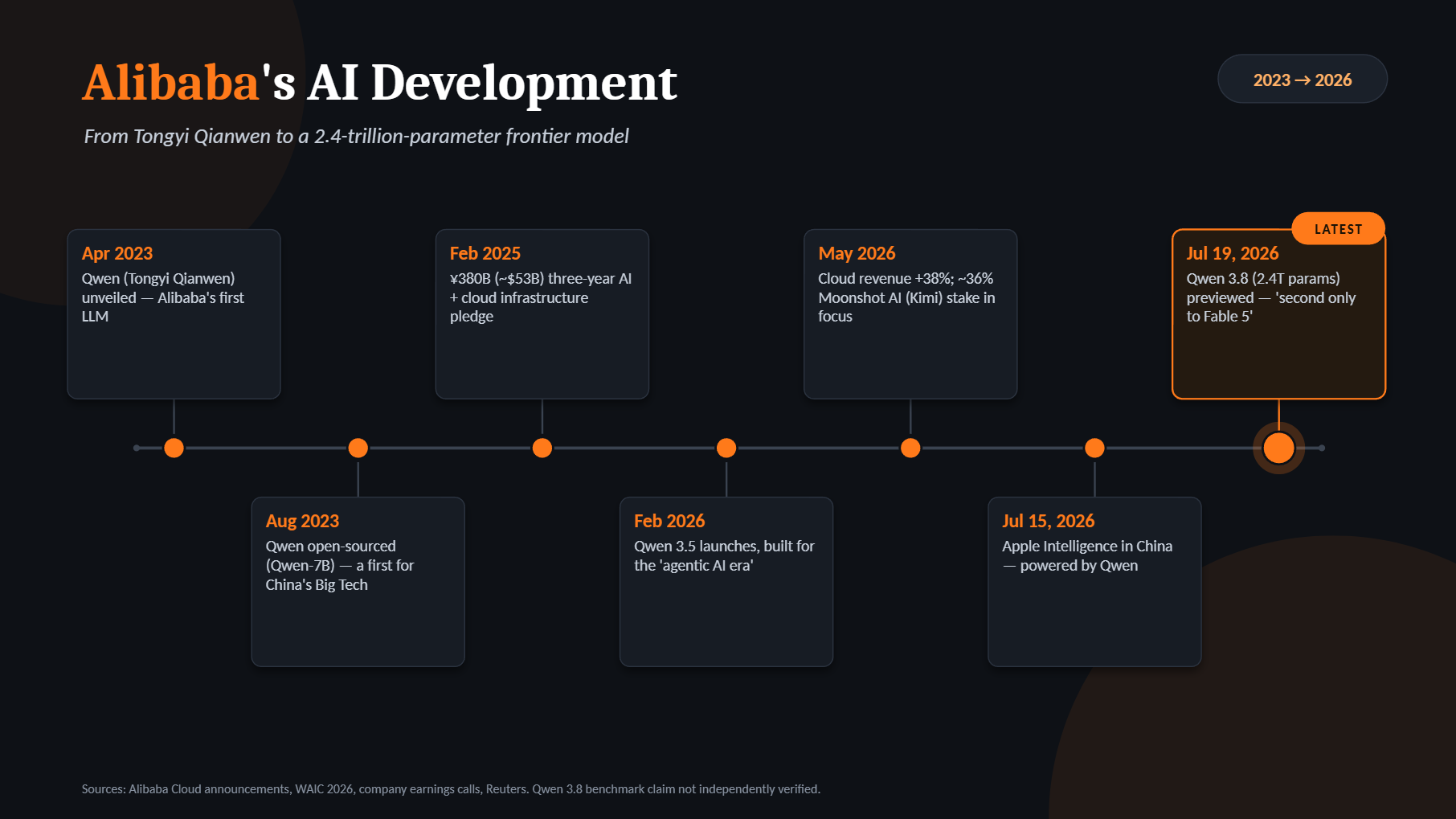
Alibaba has spent two years telling the market it is a dedicated AI company. The company made that case hard to ignore on July 19, 2026. During the World Artificial Intelligence Conference in Shanghai, Alibaba revealed Qwen3.8. This new 2.4-trillion-parameter flagship is the company’s first multimodal model to cross the trillion-parameter threshold. It processes text, images, video, and documents natively. Alibaba promised to release the model weights openly in the near future. Delivering on that timeline would make Qwen3.8 the largest open-weight model ever shipped. It is roughly 1.5 times bigger than any competing open model available today.
Qwen 3.8 Benchmarks and Performance Claims
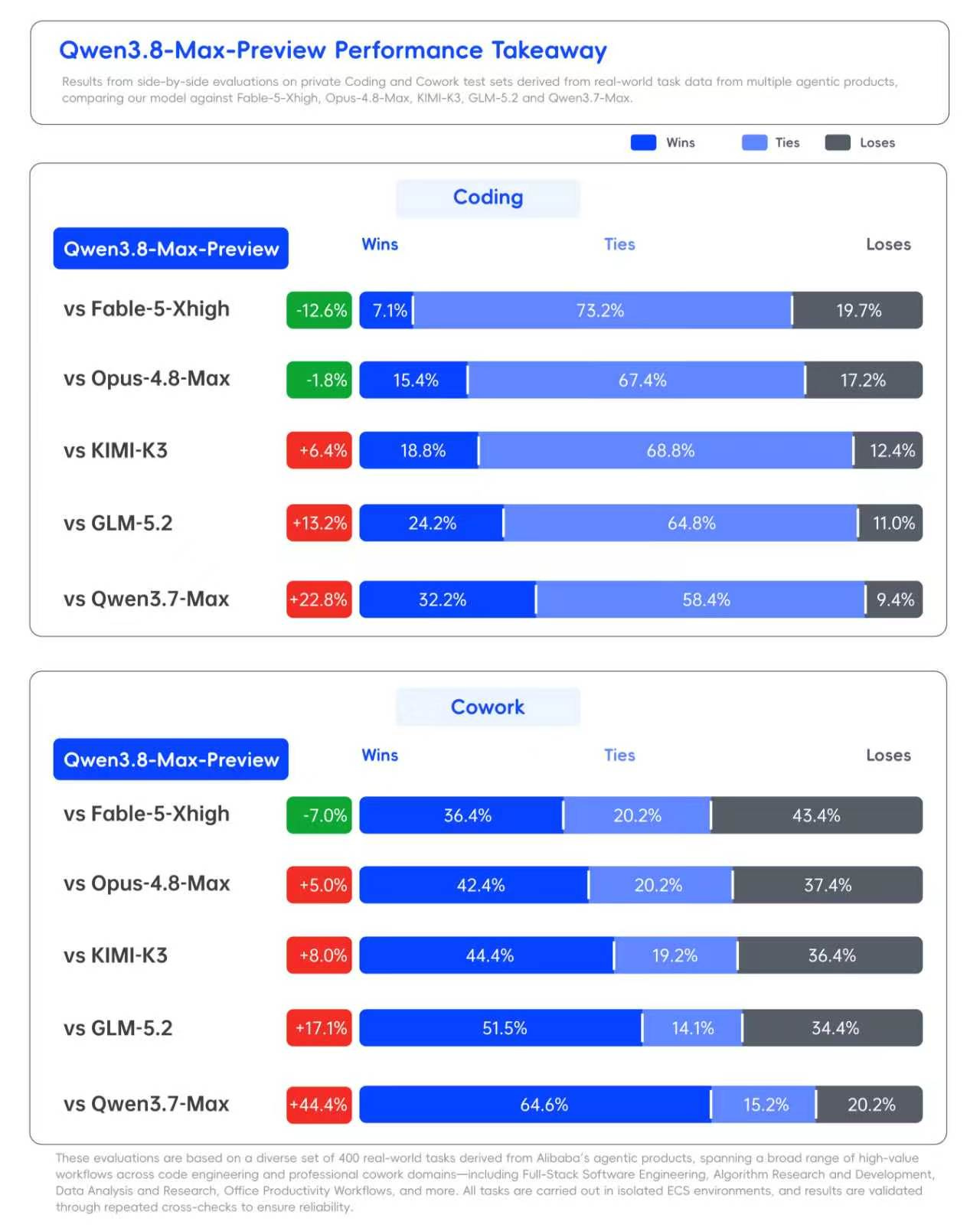
Company executives position Qwen3.8 as second only to Fable 5, the frontier model from Anthropic. That specific ranking requires some context. Alibaba has not yet published an official benchmark table, a model card, or an active-parameter count for the new release. The current claim relies entirely on internal testing.
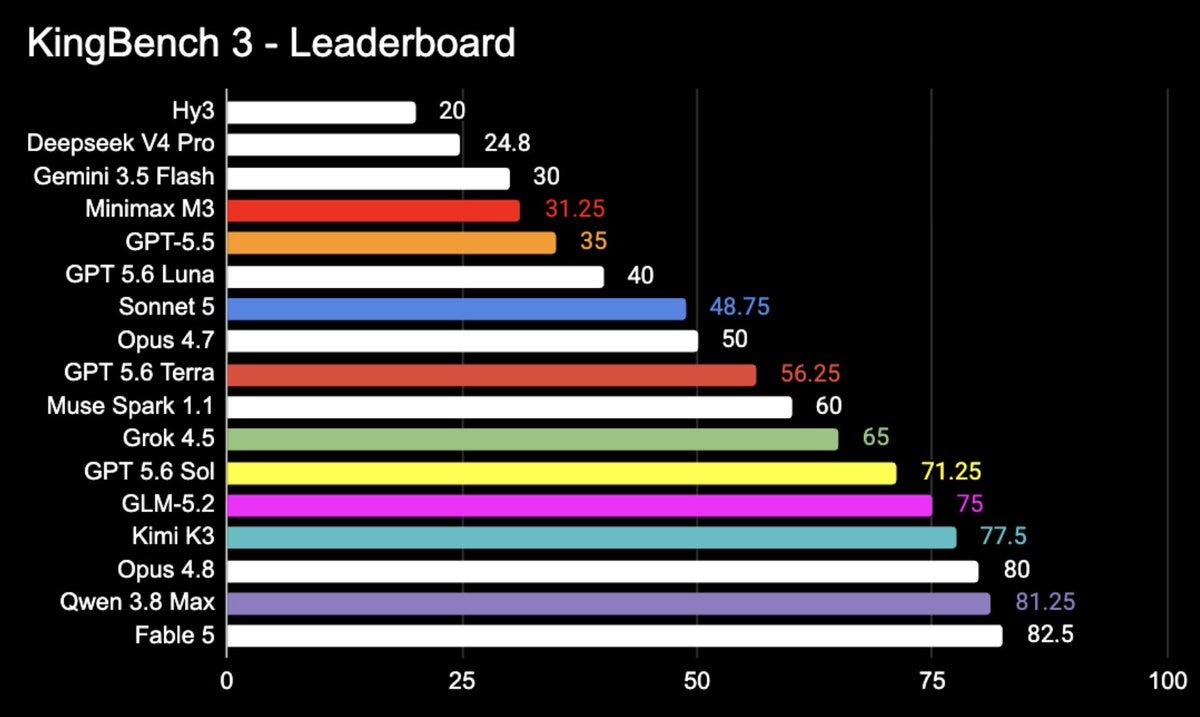
We do have verified baseline numbers for its predecessor, Qwen3.7-Max. That version scored 80.4% on SWE-bench Verified, 92.4 on GPQA Diamond, and 69.7 on Terminal-Bench 2.0. For the new 3.8 model, early independent data remains scarce. A single blind StackPerf run recently scored the Qwen3.8-Max-Preview at 80. The competing Kimi K3 scored 83 in that same test. Alibaba states the new architecture heavily outperforms older versions across coding, full-stack development, data analysis, and standard office workflows. Independent evaluations should clarify these exact scores in the coming days.
Hedging the AI Race with Moonshot and Kimi K3
The Qwen announcement arrived just days after a major move by Moonshot AI. That startup released its own 2.8-trillion-parameter open-weight K3 model to massive market attention. The release was significant enough to trigger a brief selloff in semiconductor stocks.
Alibaba sits in a highly strategic position here. The company disclosed a roughly $800 million investment in Moonshot during fiscal 2024. That capital secured an equity stake of about 36%. Moonshot is now preparing for a Hong Kong IPO with an estimated valuation above $30 billion. Alibaba is building a powerful in-house model while simultaneously holding a massive stake in its most aggressive domestic rival.
A $52 Billion AI Cloud and Data Center Investment
Hardware and infrastructure form the next major pillar of this strategy. Alibaba committed more than 380 billion yuan, or about $52 billion, to AI and cloud data centers in February 2025. That massive capital expenditure covers a three-year span.
CEO Eddie Wu recently noted that the budget might actually be on the small side. Server deployment simply cannot keep up with client demand. The company has also reached scale production for its proprietary T-Head AI chips to help ease bottlenecks. Cloud Senior Vice President Liu Weiguang summed up the infrastructure goal clearly. He stated the company is actively building China’s AI factory.
Apple Intelligence and the iOS China Strategy
A major commercial victory followed on July 15. China’s cyberspace regulator officially approved Apple Intelligence for local iPhones. The approval rests on a software deal that integrates Qwen directly into iOS, iPadOS, macOS, and visionOS. Apple is also using Baidu as a second regional partner. Placing Qwen technology inside millions of Chinese Apple devices provides an unmatched level of consumer distribution.
Q4 2026 Earnings and Shifting to Commercialization
Leadership is now focused heavily on enterprise sales over pure research spending. Chairman Joe Tsai and Eddie Wu highlighted this operational shift in their May 2026 shareholder letter. They declared Alibaba has moved past the initial investment phase and into full-scale commercialization.
The financial results support that timeline. Cloud external revenue growth accelerated to 40% in the fiscal fourth quarter. AI-related products drove 30% of that total cloud revenue. Wu dismissed concerns about a broader AI market bubble. He emphasized that the company is currently unable to fulfill the massive growth in incoming customer orders.
The Road Ahead for Qwen Updates
The Qwen3.8 model on display in Shanghai is still a work in progress. Alibaba described the software as a continuously evolving preview rather than a final, locked release. The public is still waiting on the weights, licensing details, official benchmarks, and API pricing.
The engineering team has already shipped three distinct Qwen updates in the past three months alone. That rapid release schedule highlights a broader shift in the global market. Alibaba is moving away from chasing the technology frontier and is now actively helping set it.
Disclaimer:
All views expressed are my own and are provided solely for informational and educational purposes. This is not investment, legal, tax, or accounting advice, nor a recommendation to buy or sell any security. While I aim for accuracy, I cannot guarantee completeness or timeliness of information. The strategies and securities discussed may not suit every investor; past performance does not predict future results, and all investments carry risk, including loss of principal.
I may hold, or have held, positions in any mentioned securities. Opinions herein are subject to change without notice. This material reflects my personal views and does not represent those of any employer or affiliated organization. Please conduct your own research and consult a licensed professional before making any investment decisions.