

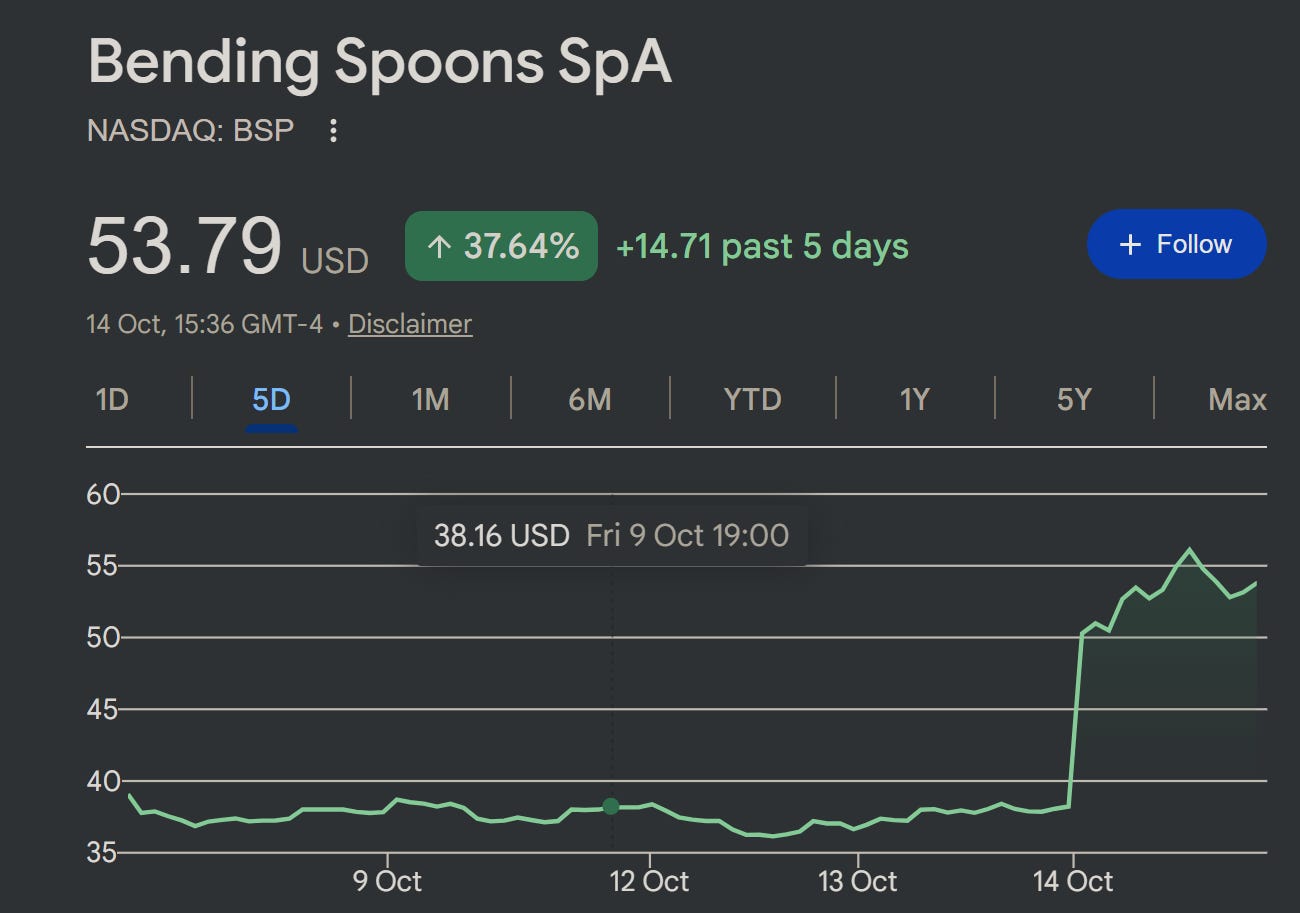
Luca Ferrari likes the comparison. Around its July Nasdaq listing, he told Forbes that Bending Spoons (BSP) is “the best of both worlds” of Berkshire Hathaway and a technology company. Public investors now have to price that claim. It does not hold.
Ferrari has himself conceded the key difference: Berkshire buys businesses it likes as they are and lets their managers run them (Milano Finanza). Bending Spoons does close to the opposite.
Moats versus lock-in
A moat is a durable advantage, such as a brand customers love or a rail network no rival can copy, that protects profits for decades. Berkshire buys those at See’s Candies or BNSF, keeps the managers and lets the business compound.
Buffett’s test goes further. A great business is one so strong that it needs only competent management, not brilliant management: in his words, businesses “so wonderful that an idiot can run them” (Fortune). Bending Spoons inverts that. Its returns depend on exceptional operators, and on paying the right price for the right target, deal after deal. Ferrari says the magic is “almost completely operating” (Sequoia). That is closer to venture capital than to Berkshire: a string of bets, each of which must be won. And the formula is young. Its buying spree began in earnest only in 2023 (Forbes); Berkshire’s has been tested for six decades.
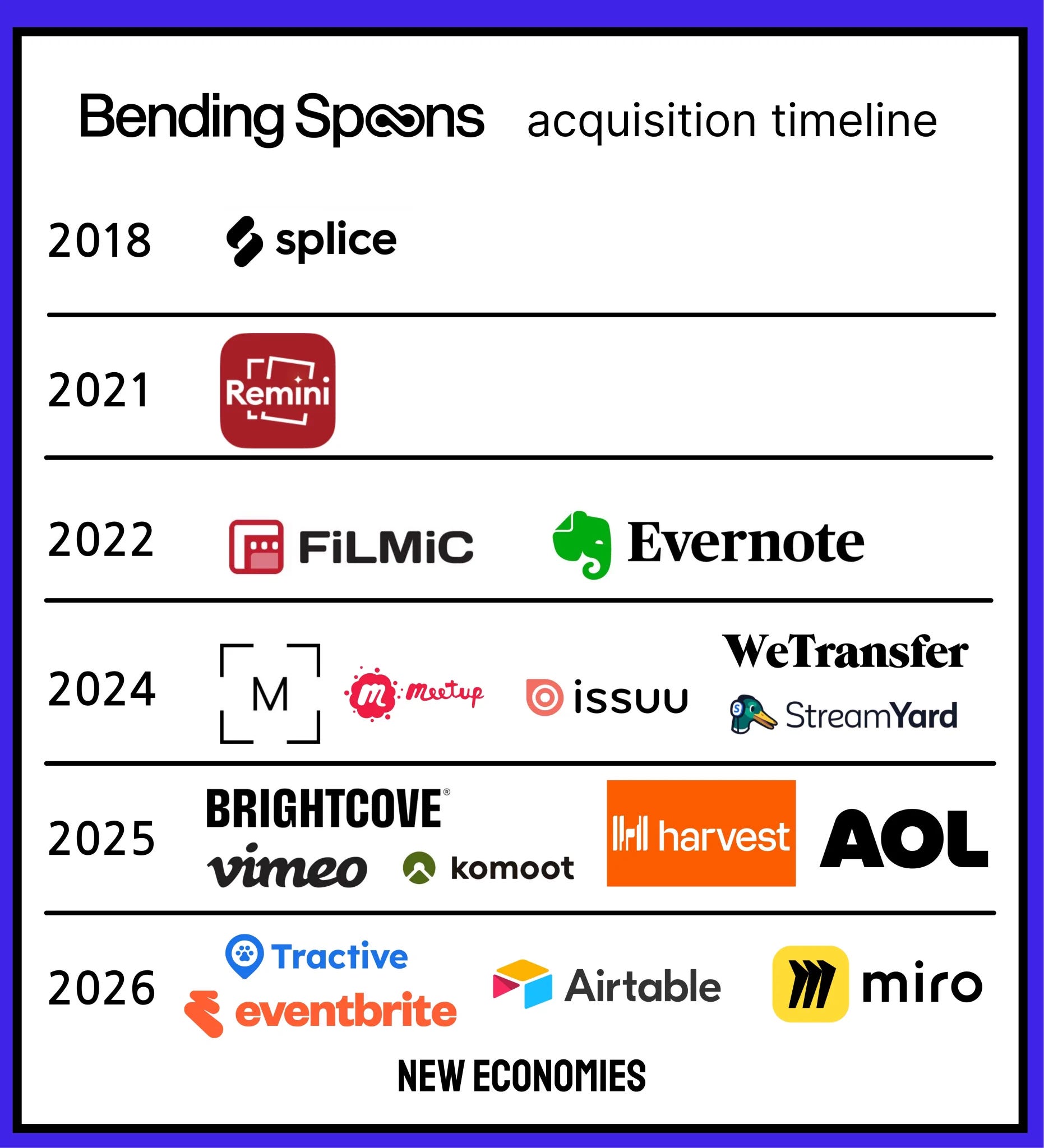
Bending Spoons buys users who find it costly to leave. Meetup is the playbook in miniature. Bought in January 2024, its US team was cut and operations moved to Europe (Silicon Republic). Organiser prices then rose. Appfigures estimates Meetup’s mobile revenue climbed from about $55,000 a month to $291,000 by January 2026, while downloads barely moved. A beloved but stagnant community, harvested rather than grown.
The pattern repeats. Evernote’s annual personal plan nearly doubled and its free tier was capped at 50 notes (Carly). WeTransfer lost 75% of its staff weeks after the deal. Vimeo, bought for $1.38bn, shed a large part of its workforce within months of closing.
The arithmetic of a melting ice cube
Pay $100m for an app that yields $20m a year after the cuts. If price rises cannot fully offset churn and cash flow shrinks 10% a year, the deal pays back in year seven and returns $200m in total, undiscounted. At a 20% annual decline it never quite pays back; at 25% it returns only $80m. Pricing power built on lock-in is not a moat. It is a countdown, and churn sets the clock.
The treadmill also speeds up. Second-quarter revenue rose 126% to $704m, but organic growth, meaning growth from the same businesses year on year, was just 3%, down from 13% in 2025 (Q2 results, prospectus). To move the needle BSP must buy ever bigger: AOL for $1.5bn, Tractive for $759m, Airtable for $1.29bn and, pending, Miro for $1.36bn. Net debt reached $4.09bn at June. Quarterly interest expense roughly tripled to $109m, against $240m of operating income.
Can it grow what the founders couldn’t?
That is the real test. These products were sold because their builders had stopped growing them, mostly for market reasons rather than cost. Vimeo spent years struggling against YouTube (TechCrunch); Evernote had struggled for years before its sale (TechCrunch). Leaner teams do not fix lost markets. And BSP lays off the people who knew each product best, then claims it can grow it better.
So far the evidence leans towards extraction. Remini grew on more monthly users, which is real organic growth. But in Q2, Remini and Splice shrank. Appfigures estimates Evernote’s revenue rose 39% while its downloads fell 64%. Fewer users paying more is not growth in Berkshire’s sense.
The counterargument is serious. BSP does rebuild: it rewrote Evernote’s ageing software (IBTimes) and cut Vimeo’s stability incidents by about 90%. It has never sold a material business, and revenue per employee reached $2.57m in 2025. Some of these apps might otherwise have died. Constellation Software, a permanent owner of niche software, is the fair comparison, not Berkshire.
The verdict: for now, Bending Spoons is a superb harvester, not yet a compounder. Airtable, which Ferrari says is still growing, is its first real test.
What to watch
Investors who want to know which story is true should watch five numbers. The first is organic growth split into more users versus higher prices: BSP reported 3% organic growth in Q2 but does not disclose the split. The second is churn and retention by product, which set how long each ice cube lasts and are also undisclosed.
The third is leverage. Net debt was 2.4 times adjusted EBITDA, a measure that counts cost savings BSP still expects to make. The fourth is interest cover: Q2 operating income covered interest expense only about 2.2 times. The fifth is the price paid against cash flow on each deal. Airtable cost about 2.7 times its revenue, and bigger targets mean fewer bargains.
Figures are from BSP’s Q2 2026 results unless linked. Appfigures data are mobile-only estimates. The size of the Meetup layoff and Meetup’s purchase price have not been disclosed.
Disclaimer:
All views expressed are my own and are provided solely for informational and educational purposes. This is not investment, legal, tax, or accounting advice, nor a recommendation to buy or sell any security. While I aim for accuracy, I cannot guarantee completeness or timeliness of information. The strategies and securities discussed may not suit every investor; past performance does not predict future results, and all investments carry risk, including loss of principal.
I may hold, or have held, positions in any mentioned securities. Opinions herein are subject to change without notice. This material reflects my personal views and does not represent those of any employer or affiliated organization. Please conduct your own research and consult a licensed professional before making any investment decisions.