

TSM 0.00%↑
ASX 0.00%↑
AMKR 0.00%↑
For decades, the semiconductor industry followed a single, reliable rule. Shrink the transistor to boost the power. But that era of front-end scaling is slowing down. Today, the real battleground has moved to the back end of the supply chain. Advanced packaging is the new frontier of computing. It is also the single biggest chokepoint for global artificial intelligence hardware.
Right now, the AI boom rests largely on the shoulders of Taiwan Semiconductor Manufacturing Company (TSMC). Demand for their specialized packaging, specifically Chip-on-Wafer-on-Substrate (CoWoS), has completely outpaced their physical ability to build it. Companies like NVIDIA, AMD, and Apple rely heavily on CoWoS. The process involves placing high-performance computing processors side by side with High-Bandwidth Memory (HBM) on a foundational silicon layer called an interposer, wiring them together with extreme density.
Orders for this process are growing at a staggering 80% every year. As a result, TSMC’s internal assembly lines have hit a hard physical ceiling.
This creates a massive logistical headache. TSMC is building a massive new foundry in Arizona to spread out global production. Yet, as it stands, chips stamped out in the American desert must fly all the way back to Taiwan just to be packaged. To clear this geographic traffic jam, TSMC is spending billions on new facilities. But factories take years to build. To buy time, TSMC is handing off simpler tasks, such as basic redistribution layer (RDL) wiring jobs, to specialized outside assembly firms.
ASE Technology Steps Up
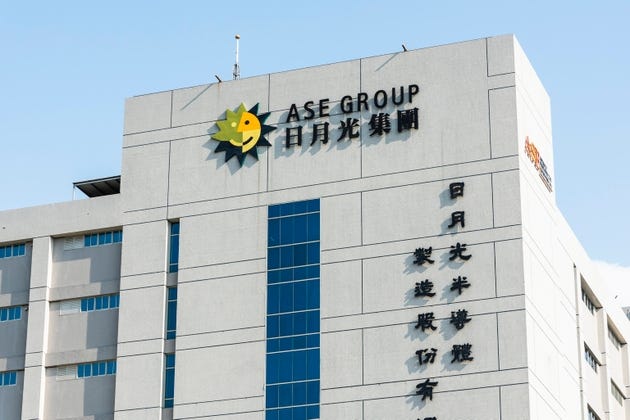
ASE Technology Holding is catching the bulk of this overflow. As the world’s largest outsourced semiconductor assembly and test (OSAT) provider, ASE claimed nearly 45% of the top-tier market in 2024. Through a tight partnership with TSMC, ASE is on track to handle up to half of the foundry’s outsourced CoWoS-S packaging by 2025.
This volume is incredibly lucrative. ASE expects its advanced packaging revenue to jump by more than $1 billion in 2026, marking a 60% surge over previous years. Knowing exactly how valuable their production lines are, the company is preparing to raise prices by 5% to 20% early that same year.
ASE is not just acting as a spillover option. They are pushing the engineering forward. Take their FOCoS-Bridge technology. Power delivery is a major hurdle when you pack several power-hungry AI chips tightly together. By using Through Silicon Vias (TSVs), which are essentially vertical copper highways punched straight through the silicon, ASE shortens the path power must travel. This drops power loss by three times. It also slashes electrical resistance by 72% and inductance by 50%, keeping the chips running smoothly.
They are also rethinking the physical shape of production. Historically, chips are packaged on round silicon wafers. This wastes a lot of usable space along the curved edges. ASE is shifting to panel-level packaging (FOPLP). This moves the process to large rectangular substrates to fit more chips into a single run and drive down costs. By late 2026, they plan to open a fully automated, 310 by 310 millimeter panel facility.
Designing these complex layouts is incredibly difficult. To help engineers out, ASE launched an Integrated Design Ecosystem (IDE). This software platform cuts the design time for complex modules in half, dropping a 90 day cycle down to just 45 days.
Amkor and the Localized Supply Chain
On the other side of the globe, Amkor Technology is acting as a vital pressure valve for Western markets. Late in 2025, the company posted record sales of $1.89 billion, with advanced packaging driving over 80% of that total. Amkor is moving aggressively, sketching out a capital budget between $2.5 billion and $3.0 billion for 2026. That is nearly three times their usual spending.
Much of that money is pouring into Peoria, Arizona. Ground broke on the new campus in late 2025, designed specifically to create a complete domestic packaging loop. Soon, chips built at nearby TSMC or Intel plants can be finished right down the road. This simple change completely cuts out the trans-Pacific flight.
Amkor expects revenue from its high-end packaging segments to triple in 2026. A big driver behind this is their S-SWIFT technology. Traditional high-end packaging relies on expensive, fragile silicon interposers to connect chips. S-SWIFT skips the silicon. Instead, it builds high-density wiring directly into an organic foundation. This makes the package cheaper to produce, reduces signal loss, and keeps electrical impedance tightly controlled.
The Foundry 2.0 Era
The entire industry is entering what experts call the Foundry 2.0 model. The old line between making a chip and packaging it is disappearing. The combined global market for this integrated approach hit $320 billion last year, growing 16% as AI hardware lifted the entire supply chain.
To solve the hardest physical limits, such as keeping massive chip assemblies from warping under intense heat, TSMC, ASE, and 34 other partners formed the 3DIC Advanced Manufacturing Alliance. A major goal for this group is perfecting a technique called hybrid bonding.
Normally, chips connect to one another using tiny copper solder bumps. Hybrid bonding removes the bumps entirely. It fuses flat copper pads directly together at microscopic scales, with gaps smaller than 10 micrometers. This creates an incredibly dense, lightning-fast connection. It allows engineers to stack chips vertically, turning separate components into what looks and acts like a single giant megachip.
The Great Divide
The back end of chipmaking is no longer an afterthought. It is now the most valuable real estate in the semiconductor world. Researchers expect the global packaging market to hit $90 billion by 2030, growing at a steady 10% clip every year.
As the money flows, we are watching a deep split in the industry. Giants like ASE and Amkor have the massive capital required to build pristine, multi-billion dollar cleanrooms for AI packaging. Their revenues and profit margins are surging as a result. Meanwhile, smaller companies without deep pockets will likely be left behind, forced to compete over cheap, commoditized legacy wire-bonding jobs.
For the leaders, the path is clear. By pairing heavy factory investments in Taiwan and Arizona with smart, proprietary technology like FOCoS and S-SWIFT, they are actively breaking the global bottleneck. In doing so, they are laying the physical tracks for the next decade of AI growth.
Disclaimer:
All views expressed are my own and are provided solely for informational and educational purposes. This is not investment, legal, tax, or accounting advice, nor a recommendation to buy or sell any security. While I aim for accuracy, I cannot guarantee completeness or timeliness of information. The strategies and securities discussed may not suit every investor; past performance does not predict future results, and all investments carry risk, including loss of principal.
I may hold, or have held, positions in any mentioned securities. Opinions herein are subject to change without notice. This material reflects my personal views and does not represent those of any employer or affiliated organization. Please conduct your own research and consult a licensed professional before making any investment decisions.