

NVDA 0.00%↑
TSM 0.00%↑
ASX 0.00%↑
AMKR 0.00%↑
The artificial intelligence revolution has crowned new kings in the semiconductor world. It is driven by an insatiable demand for generative models and large-scale computing. While NVIDIA designs the brains and TSMC manufactures the silicon, a critical bottleneck has appeared in the supply chain. This bottleneck is advanced packaging. Amkor Technology sits at the center of this pivotal shift. Amkor is the largest Outsourced Semiconductor Assembly and Test, or OSAT, provider headquartered in the US. Its stock valuation has soared, rising over 80% in the past year. Investors recognize its central role in resolving the “packaging crunch” that threatens to throttle the AI boom.
The "Taiwan Loop" and the US Supply Chain Gap
To understand Amkor’s surging relevance, one must look at the current state of American semiconductor manufacturing. NVIDIA and TSMC recently celebrated a historic milestone with the production of the first Blackwell AI accelerator wafers at TSMC’s Fab 21 in Arizona. This achievement realizes a major goal of the CHIPS Act. It means fabricating the world’s most advanced logic on US soil. However, a significant logistical and strategic gap remains.
Once these Blackwell wafers are processed in Arizona, they cannot simply be shipped to a customer. Currently, they must be flown back to Taiwan for the final, critical stage of production known as advanced packaging. This phenomenon is called the “Taiwan Loop.” It exists because the capacity for Chip-on-Wafer-on-Substrate, or CoWoS, is almost entirely concentrated in Taiwan. This specific 2.5D packaging technology is required to bond NVIDIA’s GPUs with High Bandwidth Memory, also known as HBM.
This reliance on offshore packaging undermines the concept of a self-sufficient US supply chain. If geopolitical tensions were to disrupt logistics across the Pacific, the fact that the silicon was etched in Arizona would matter little. Without packaging, the chips are unusable. Amkor Technology is racing to fill this precise gap.
Amkor’s Arizona Expansion: A $7 Billion Bet
Amkor has positioned itself as the domestic solution to this vulnerability. The company recently broke ground on a massive advanced packaging and test campus in Peoria, Arizona. It is located strategically near TSMC’s front-end fabs. This project represents a staggering commitment. Planned investments are expanding from an initial $2 billion to $7 billion.
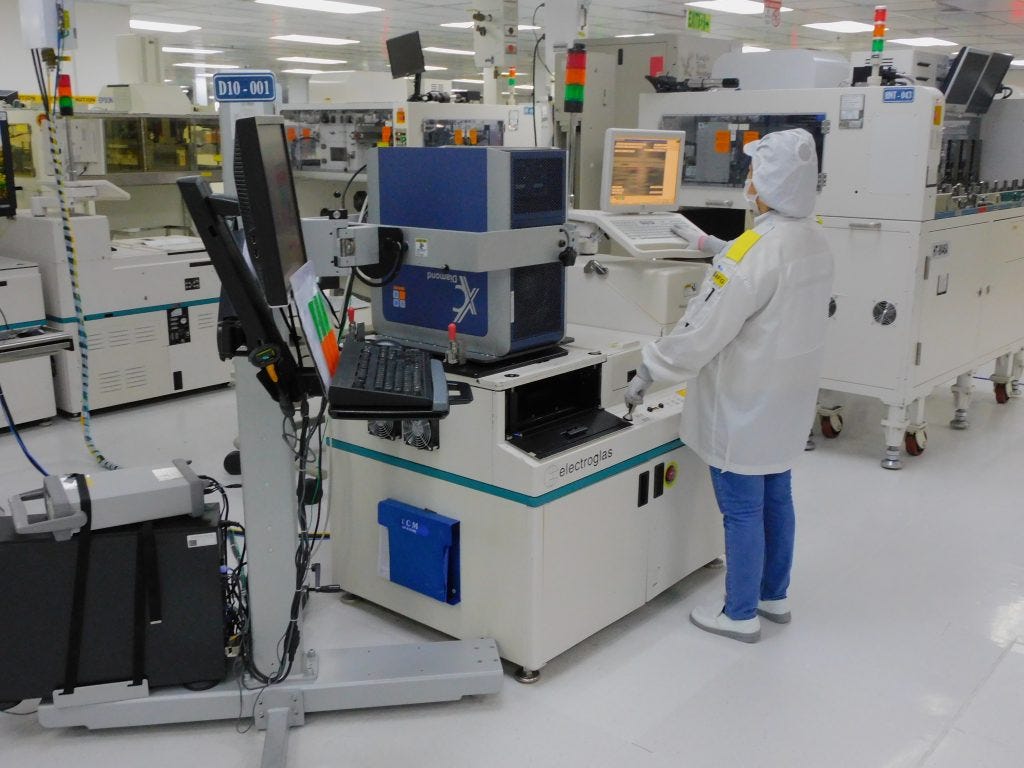
Upon completion of its first phase, which is expected in 2027, the facility will feature over 750,000 square feet of cleanroom space. It will serve as the largest outsourced advanced packaging facility in the United States. Crucially, this facility is designed explicitly to handle the high-volume advanced packaging needs of the AI era. Amkor has secured commitments from both Apple and NVIDIA to be foundational customers. This ensures that the facility will have immediate utilization for high-performance computing workloads.
The strategic intent is to close the manufacturing loop. By establishing CoWoS-class capabilities in Peoria, Amkor aims to take wafers directly from TSMC’s nearby fab. They will package them with memory stacks and ship finished systems without the hardware ever leaving American soil.
The Technology of Integration: 2.5D and S-SWIFT
Amkor’s value proposition lies in its mastery of heterogeneous integration. This is the art of combining different silicon dies into a single, cohesive package. In the age of AI, the package is the computer. Modern AI chips are no longer monolithic slabs of silicon. They are complex systems composed of logic dies, memory stacks, and interconnect bridges.
Amkor specializes in 2.5D packaging, which is a technique essential for AI accelerators. In a 2.5D configuration, logic dies like GPUs and memory stacks like HBM are placed side-by-side on an interposer. An interposer is a silicon or organic bridge that facilitates ultra-fast communication between them. This proximity is vital. Moving memory closer to the processor minimizes latency and power consumption, which are the primary constraints in training large language models.
To compete with and complement TSMC’s proprietary CoWoS technology, Amkor has developed its own suite of high-density solutions. This includes S-SWIFT, or Substrate Silicon Wafer Integrated Fan-out Technology. S-SWIFT is designed to bridge the gap between organic substrates and silicon interposers. It utilizes fine-pitch copper redistribution layers, or RDL, to achieve the high-density interconnects required by AI chips. This offers a compelling alternative for integrating HBM and logic dies.
Furthermore, Amkor has signed a memorandum of understanding with TSMC to bring specific TSMC packaging technologies to the Arizona facility. These technologies include InFO, or Integrated Fan-Out, and CoWoS. This collaboration is unprecedented. Historically, TSMC has kept its most advanced packaging tightly held within its own Taiwan facilities. By licensing or collaborating on these processes in Arizona, Amkor effectively becomes the western extension of the AI supply chain’s most critical node.
Breaking the AI Bottleneck
The urgency of Amkor’s expansion is driven by a stark industry reality. Packaging is currently a harder limit on AI scaling than chip manufacturing itself. Major industry players have confirmed that CoWoS capacity is sold out through 2026. The complex process of stitching together GPUs with fragile stacks of HBM3e memory suffers from yield challenges. It also requires specialized equipment that is in short supply globally.
NVIDIA’s Blackwell architecture has exacerbated this bottleneck. It demands even more complex packaging than its predecessor due to its dual-die design and massive memory bandwidth. The “CoWoS Crunch” has left hyperscalers like Microsoft and Meta waiting for allocation. By bringing significant new capacity online in the US, Amkor is not just onshoring production. It is adding vital capacity to a starved global market. The Arizona facility will focus on these exact bottlenecks. It will provide domestic capacity for 2.5D packaging and testing that is currently unavailable outside of Asia.
Financial Strength and Market Position
Amkor’s strategic pivot toward advanced packaging for AI has been rewarded by Wall Street. The company’s stock has appreciated significantly. This rise is driven by a 12.5% expected revenue growth and a favorable outlook for the semiconductor sector. While it remains the second-largest OSAT globally behind Taiwan’s ASE Technology, Amkor is the largest headquartered in the US. This gives it a unique political and economic advantage in the era of the CHIPS Act.
Financially, the company is robust. It has a strong balance sheet and a focus on high-margin advanced packaging, which now accounts for a significant portion of its revenue. As the “industrial revolution” of AI touted by Jensen Huang unfolds, the volume of wafers requiring advanced packaging is projected to explode. Amkor’s investments today position it to capture the value of this transition. It is transforming from a backend service provider into a critical enabler of the AI economy.
Conclusion
The narrative of semiconductor sovereignty often focuses on the fabrication of nanometer-scale transistors. But the reality is that a chip is useless until it is packaged. NVIDIA and TSMC have proved that cutting-edge fabrication is possible in the Arizona desert. Amkor Technology is taking on the arguably more complex challenge of finishing the job. By closing the “Taiwan Loop” and deploying advanced 2.5D and S-SWIFT technologies domestically, Amkor is securing the final mile of the American AI supply chain. In doing so, it has transformed itself from a quiet industry stalwart into a linchpin of national technological security.
Disclaimer:
All views expressed are my own and are provided solely for informational and educational purposes. This is not investment, legal, tax, or accounting advice, nor a recommendation to buy or sell any security. While I aim for accuracy, I cannot guarantee completeness or timeliness of information. The strategies and securities discussed may not suit every investor; past performance does not predict future results, and all investments carry risk, including loss of principal.
I may hold, or have held, positions in any mentioned securities. Opinions herein are subject to change without notice. This material reflects my personal views and does not represent those of any employer or affiliated organization. Please conduct your own research and consult a licensed professional before making any investment decisions.