

NBIS 0.00%↑
CRWV 0.00%↑
IREN 0.00%↑
BTDR 0.00%↑
RIOT 0.00%↑
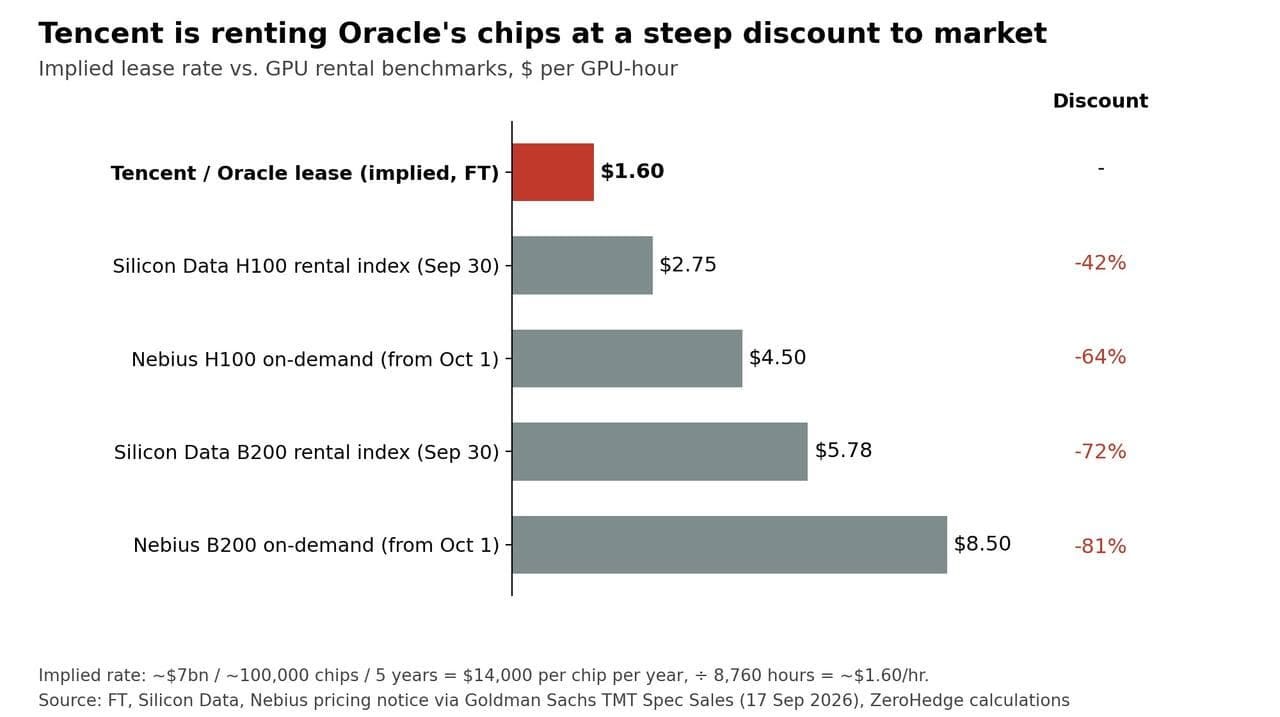
A single rental contract may have just told investors what an AI chip is really worth, and the answer is not flattering for the neoclouds. Oracle has reportedly agreed to rent Tencent roughly 100,000 AI chips for about $1.60 per GPU-hour. Neoclouds like Nebius and CoreWeave are valued on the belief that GPU-hours stay scarce and expensive. A hyperscaler-scale deal at that price challenges the premise just as prominent investors are warning the AI trade has run too far.
A $1.60 price tag
According to the Financial Times, as summarized by Tom’s Hardware, Tencent signed a five-year, roughly $7 billion lease for chips in Oracle’s Southeast Asian data centers, paying about 30% upfront. Spread over five years, that works out to about $1.60 per chip-hour. That is roughly 43% below Semi Analysis’s ~$2.80 one-year H100 rate and about 48% below a $3.09 three-year B200 contract Data section disclosed in 2025.
Neither company has named the chips, and Tom’s Hardware argues the math fits older Hopper-class hardware. But that is cold comfort for neoclouds. Their fleets were largely debt-financed on the assumption that rents would hold well above that level. If the market-clearing price for a 100,000-GPU, five-year commitment is $1.60, those assumptions look generous. Oracle has its own reasons to discount: its free cash flow was deeply negative last fiscal year, and upfront cash helps. A cash-hungry hyperscaler willing to undercut on price is exactly the competitor neoclouds cannot match.
Venture veterans see a bubble
The deal lands as some of venture capital’s most experienced investors are sounding alarms. Doug Leone, who led Sequoia Capital for nearly three decades, has said plainly that we are in an AI bubble.

Insight Partners co-founder Jerry Murdock went further on the 20VC podcast, as reported by BigGo Finance. He predicted that, if the Iran conflict keeps festering, a credit dislocation could burst the bubble between late October 2026 and March 2027. Murdock’s point is that the infrastructure is real but the debt funding it is fragile. Hyperscalers, he argued, are best placed to survive a shock. Neoclouds are not: he expects at least half of them to disappear within 36 months.

Burry doubles down
Michael Burry is putting money behind the same view. He disclosed a short on Nebius in August and, after its earnings, questioned the pricing of its compute contracts and its move to stretch server depreciation from four years to five. On September 28 he swapped his Nebius short for June put options with double-digit strikes, far below the roughly $240 share price. He said he was moving his timelines up and wanted more leverage, a bet that only pays on a steep fall.
The Oracle-Tencent price is exactly the kind of evidence Burry’s thesis needs. If rental rates fall faster than neoclouds depreciate their chips, the profits on paper never turn into cash.

Nebius’s COO cashes out
Then came Nebius’s own insiders. On October 5, Chief Operating Officer Ophir Nave sold 500,000 Class A shares at roughly $231 to $244 each, about $118 million in total, according to his Form 4 filing. That cut his directly held stake from about 955,000 shares to 454,685, more than half.
The filing offers context. The sale ran under a Rule 10b5-1 plan adopted May 22, and Nave says it equals about 17% of his total granted equity. Pre-scheduled plans weaken the signal. Still, timing is hard to ignore: the sale landed days after Burry’s bigger bet and the same week the Oracle-Tencent price became public.

What to watch
None of this proves the bubble is popping. Demand is still strong: Oracle reported 97.9% GPU utilization in September, and BNP Paribas recently upgraded Nebius with a $399 target. But the bear case now has a price point, a timeline and an insider sale attached to it.
The next test comes fast. Oracle holds its Investor Day on October 28, where it could reveal which chips Tencent is renting. That lands inside Murdock’s October-to-March window. If the hardware turns out to be newer than Hopper, $1.60 an hour stops being a discount on old chips and becomes the new market rate. For neoclouds priced for scarcity, that would be the pin.
Disclaimer:
All views expressed are my own and are provided solely for informational and educational purposes. This is not investment, legal, tax, or accounting advice, nor a recommendation to buy or sell any security. While I aim for accuracy, I cannot guarantee completeness or timeliness of information. The strategies and securities discussed may not suit every investor; past performance does not predict future results, and all investments carry risk, including loss of principal.
I may hold, or have held, positions in any mentioned securities. Opinions herein are subject to change without notice. This material reflects my personal views and does not represent those of any employer or affiliated organization. Please conduct your own research and consult a licensed professional before making any investment decisions.