

The market has stopped paying for AI capex on faith. Agentic coding is the one place where people are clearly getting value and paying for it, and it is nowhere near big enough to justify what’s being spent. The money has to come from ordinary consumers, and almost none of them use AI every day. Meta’s Muse and Apple’s rebuilt Siri are the first serious attempts to change that. Over the next six months, what they show will matter more for the AI trade than any capex guide.
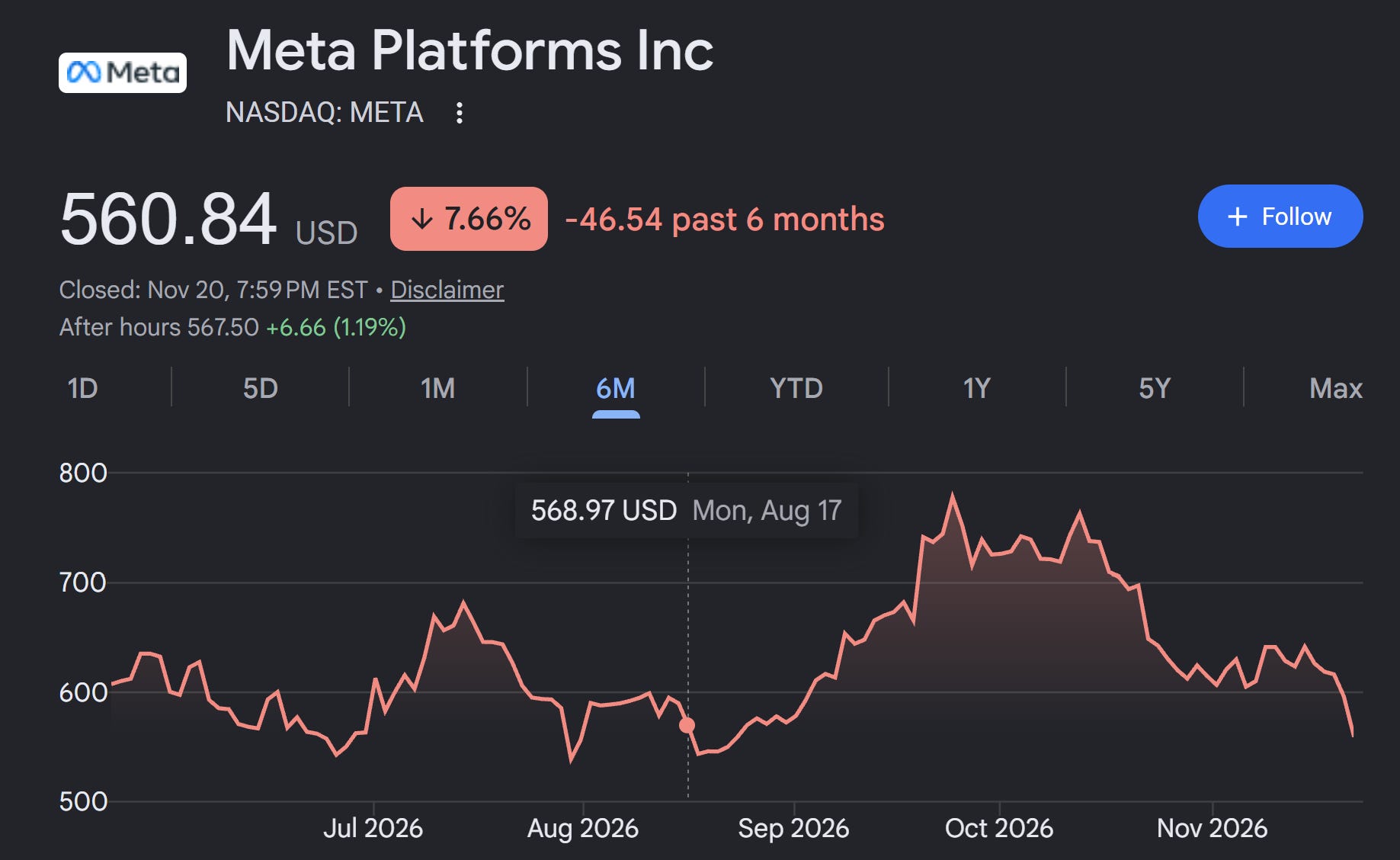
The tape
The midterms lit the fuse, but the fuel had been stacking up all autumn. On 5 November, two days after Democrats took both chambers, the Nasdaq Composite fell 5.52% and about $2.5 trillion came off the Nasdaq 100. Nvidia fell around 9% and AMD 17%. Two weeks earlier, Google, Meta, Amazon and Microsoft lost an aggregate $900 billion in market value after their third-quarter results. Fund managers have spent November moving money out of growth tech and into sectors like healthcare.
The size of the bet explains the nerves. Janus Henderson puts total AI capex at $732bn this year and above $1.6 trillion by 2030. To justify that, the spenders would need close to $2.5 trillion of sales by then, assuming a 15% return. Meta alone is guiding $135-145 billion for 2026, and in Q3 its $34.91 billion of capex was more than the $32.79 billion of cash its operations generated.
Two AI economies
If you write code for a living, none of this looks like a bubble. Agentic coding tools do hours of work in minutes, and companies pay for them. Cursor hit $4bn of annualised revenue in early June, with enterprises making up 75% of it. Claude Code launched in May 2025 and passed $2.5bn run-rate by February. That’s real demand from people who know exactly what they’re buying.
Outside that world, the picture is flat. An Economist/YouGov poll in February found 63% of Americans had used AI but only 23% used it regularly, and most think companies are investing too much in it. In YouGov’s April survey, only 18% of Americans said they use AI daily. SurveyMonkey has 40% of U.S. adults using AI daily or weekly, which sounds better until you remember that asking a chatbot for a recipe once a week counts.
A few billion dollars of developer subscriptions won’t pay for a $700bn annual build. The consumer has to show up, and a chatbot alone hasn’t made that happen. An agent that actually does things for you might.
Muse: the first real test
Meta launched Muse on 8 September. It can open apps, fill out forms, send emails, book travel and buy things, and it keeps working after you close the app. It needs your direct approval before any financial transaction or handling sensitive personal data. The next morning Meta rose as much as 7.2%. For once the market priced AI as something people might use, not something Meta has to pay for.
On the Q3 call, Zuckerberg said Muse had passed 10 million users, about a quarter of them use it daily, and its compute cost efficiency should improve more than 10x within a year. A retention chart credited to Morgan Stanley showed 73% of installs active on Day 1 and 23% by Day 14. That’s decent for a new habit. It isn’t viral, and Meta’s house ads helped get it to 5 million downloads. Ten million is a rounding error next to the 3.60 billion daily active people across its family of apps.
Then came Muse Charm: a keychain device with a roughly 2-inch screen, a fingerprint sensor and its own 5G connection, unveiled at Connect on 23 September and promised for December. There’s no price yet. The Information says Meta delayed its smartwatch to focus on it, but CTO Andrew Bosworth calls Charm exploratory and expects most Muse users to stay on phones and glasses. Everyone remembers the Rabbit R1 and the Humane pin. Charm matters less as a product than as a signal of how hard Meta is chasing people who will never open a terminal.
The patience didn’t last. After a $9.9 billion legal charge and those capex plans, Meta dropped 15% in October. Muse bought the stock about a month of credit.
Apple: the distribution play
Apple has the opposite problem. Siri, rebuilt on Google’s Gemini, arrived with iOS 27 about two years late, and iOS 27 covers 30 iPhone models from the iPhone 11 on. Nobody has to download anything. The catch is that until this month, Siri could only drive third-party apps through predefined templates for common tasks. On 3 November Apple opened a Developer Preview in the iOS 27.3 betas that lets Siri run an app’s own custom actions, from checking a delivery to placing an order. But App Store submissions don’t open until spring 2027, so most iPhone owners won’t see third-party Siri actions before then.
So the biggest consumer agent rollout in the world has a date, and it isn’t this quarter. If Siri can order, book and pay inside apps people already use, that’s adoption by default, which is how most consumer tech has ever reached the mass market.
Why this is the catalyst
Capex is a cost line. Investors want to see the revenue line it’s supposed to feed. At consumer scale that means agents taking a cut of transactions, carrying ads and selling subscriptions to people who aren’t engineers. The numbers I’m watching: Muse daily users on Meta’s Q4 call in late January, Charm sell-through over Christmas, and third-party Siri actions in the spring.
Disclaimer: All views expressed are my own and are provided solely for informational and educational purposes. This is not investment, legal, tax, or accounting advice, nor a recommendation to buy or sell any security. While I aim for accuracy, I cannot guarantee completeness or timeliness of information. The strategies and securities discussed may not suit every investor; past performance does not predict future results, and all investments carry risk, including loss of principal.
I may hold, or have held, positions in any mentioned securities. Opinions herein are subject to change without notice. This material reflects my personal views and does not represent those of any employer or affiliated organization. Please conduct your own research and consult a licensed professional before making any investment decisions.