

V 0.00%↑
MA 0.00%↑
PYPL 0.00%↑
The Warning from Frankfurt and Brussels
The warning was stark. It was not delivered in a dry policy paper but over the airwaves of Irish radio. In an interview in April 2025, European Central Bank President Christine Lagarde issued a clear call for the continent to break its “critical dependence” on American payment infrastructure. Her message was blunt. Virtually every time a European taps a card or smartphone to buy coffee or book a train, the transaction data flows through servers owned by United States giants.
“It’s important for us to have digital payment under our control,” Lagarde told The Pat Kenny Show. She noted that whether you use a card or a phone, the payment typically goes through Visa, Mastercard, PayPal, or Alipay. She pointed out that these companies come from either the US or China.
Lagarde warned that this reliance is no longer just an economic inconvenience. It is a strategic vulnerability. Every swipe sends European consumer data across the Atlantic and outside the jurisdiction of the EU. However, a coalition of 16 major banks believes it finally has the answer.
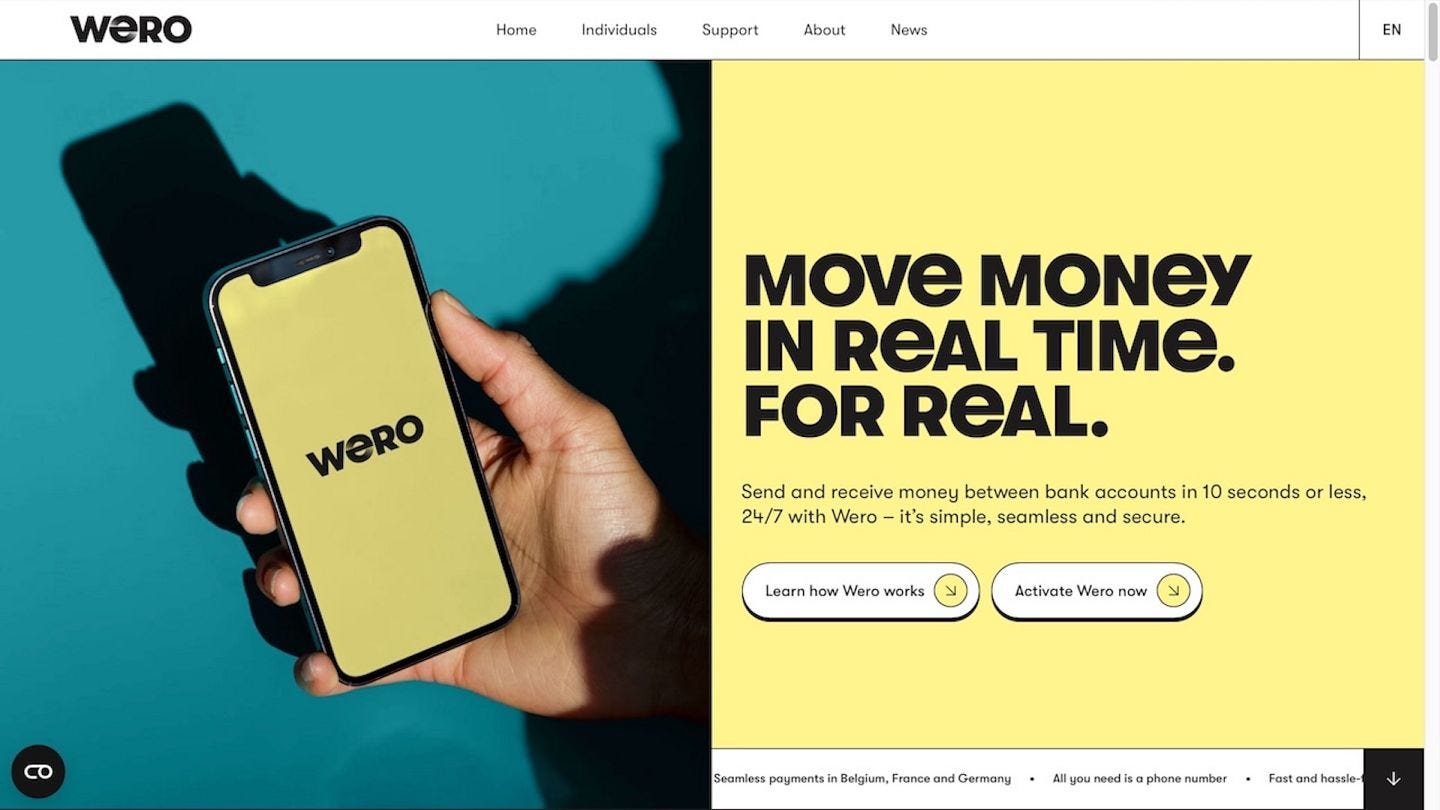
The “Wero” Wallet: A Continental Champion
That answer is Wero. This is the flagship digital wallet created by the European Payments Initiative, or EPI. It is backed by a heavyweight consortium of 16 financial institutions, including BNP Paribas, Deutsche Bank, ING, and Société Générale. Wero represents the most ambitious attempt yet to build a sovereign payment firewall for the continent.
Unlike previous failed attempts at European unification, such as the Monnet Project, Wero has moved beyond the drawing board. It is designed to be the single, unified digital wallet for 400 million Europeans. It aims to consolidate a fractured landscape of national apps like France’s Paylib and the Netherlands’ iDEAL under one roof.
Bypassing the Rails: How It Works
The revolutionary aspect of Wero lies in its plumbing. Traditional card payments rely on the “card rails” owned by Visa and Mastercard. This is a four party model that charges interchange and scheme fees for every transaction.
Wero bypasses these American middlemen entirely. It utilizes SEPA Instant Credit Transfer technology to execute account to account payments. When a user scans a QR code or selects Wero at an online checkout, funds are pushed directly from their bank account to the merchant’s account. This happens in under ten seconds, 24/7.
By cutting out the card networks, Wero offers a dual advantage. First is sovereignty, as the transaction settles over European owned infrastructure and keeps data within the EU. Second is efficiency. Merchants receive funds instantly, improving cash flow while bypassing the fees associated with US card schemes.
The Geopolitical Angle: Data and “Weaponized Interdependence”
While the economic case is strong, the primary driver behind Wero is geopolitical. European policymakers have grown alarmed by the risk of “weaponized interdependence.” As Lagarde noted, relying on foreign infrastructure means Europe’s ability to process its own retail transactions could be compromised by changes in US policy or diplomatic ruptures.
The risks are not theoretical. The 2022 exclusion of Russian banks from Visa and Mastercard networks demonstrated how quickly payment systems can be used as instruments of statecraft. If transatlantic relations were to deteriorate, or if US surveillance laws conflicted with European privacy standards like GDPR, Europe could find itself vulnerable.
“We are highly dependent on international payment solutions,” warned Martina Weimert, CEO of EPI. She stated that if independence is crucial, “we need action urgently.” This push for autonomy is about ensuring that even if the transatlantic digital cable were cut, Europeans could still buy groceries and pay bills using a system they own and govern.
Current Progress: A Pan-European Rollout
Wero is live. As of late 2024 and early 2025, the service rolled out for peer to peer payments in Germany, France, and Belgium. Users can send money instantly using just a phone number or email address, which bypasses the need for complex IBANs.
The momentum is accelerating. By late 2025, Wero reported over 14 million users enrolled and 8 million transactions processed. The roadmap for 2026 includes a massive expansion.
The Netherlands and Luxembourg are joining, with the Dutch national champion iDEAL set to rebrand and migrate entirely to Wero in 2026. Retail integration is also moving forward. Online payments are already live with major German retailers like Lidl and Decathlon. In store payments are scheduled for 2026 to directly challenge Apple Pay at physical registers.
In a landmark move on February 2, 2026, EPI signed a Memorandum of Understanding with the EuroPA Alliance. This group comprises Italy’s Bancomat, Spain’s Bizum, and Portugal’s MB WAY. This creates an interoperable network covering 130 million users across 13 countries. It effectively unifies Southern and Northern Europe’s payment systems.
The Fintech Frontier: Revolut and Adyen
To achieve ubiquity, Wero must bridge the gap between traditional banking and the agile fintech sector. In a significant coup, Revolut, the global financial super app, officially joined EPI as a member. Starting in July 2025, Revolut customers in France, Belgium, and Germany began using Wero directly within the app. This partnership is critical. It signals that Wero is not just a legacy bank project but a modern standard capable of serving the digital native generation.
However, challenges remain in the merchant processing space. For Wero to succeed at the checkout, it needs the support of major acquirers and processors. Worldline, a founding shareholder of EPI, has already launched Wero for its merchants to drive adoption.
Yet the role of other giants like Adyen remains a key variable. Adyen, a Dutch company and one of the world’s leading cross border payment processors, is not a shareholder in EPI. While processors like Adyen generally integrate popular local payment methods to serve their merchants, Wero must prove it has the consumer volume to become a “must have” option for Adyen’s global client base.
As the digital euro project also advances in parallel, a public sector initiative by the ECB, Europe is firing on all cylinders to secure its financial borders. With Wero, the continent is betting that the future of payments isn’t just about going cashless. It is about going independent.
Disclaimer:
All views expressed are my own and are provided solely for informational and educational purposes. This is not investment, legal, tax, or accounting advice, nor a recommendation to buy or sell any security. While I aim for accuracy, I cannot guarantee completeness or timeliness of information. The strategies and securities discussed may not suit every investor; past performance does not predict future results, and all investments carry risk, including loss of principal.
I may hold, or have held, positions in any mentioned securities. Opinions herein are subject to change without notice. This material reflects my personal views and does not represent those of any employer or affiliated organization. Please conduct your own research and consult a licensed professional before making any investment decisions.