

Roblox got the model right
Roblox got the business model of modern gaming right, and the rest of the industry is now converging on it. The bet was simple: games would stop being finished products shipped by studios and become worlds hosted on a platform, then built, remixed and modded by the people who play them.
The formula has five parts: one portal, one persistent identity and avatar, user-made games, a virtual currency, and a revenue share. Together they form a flywheel. Creators attract players, players buy Robux, and Robux pay creators to build more. Roblox never has to fund the next hit; it just hosts it, and the next hit can come from anyone. In Q3 2025, seven experiences passed 10 million daily users at some point, and five of them were less than a year old.
The numbers show the flywheel spinning. Creators earned more than $1.5 billion through the Developer Exchange in 2025, and Roblox estimates its share of global gaming spending rose from 2.3% to 3.2% in a year. The model is also aging up: daily users over 18 grew 32% year over year in Q2 2026, and Roblox now pays creators 42% more on spending by verified U.S. adults to keep them.
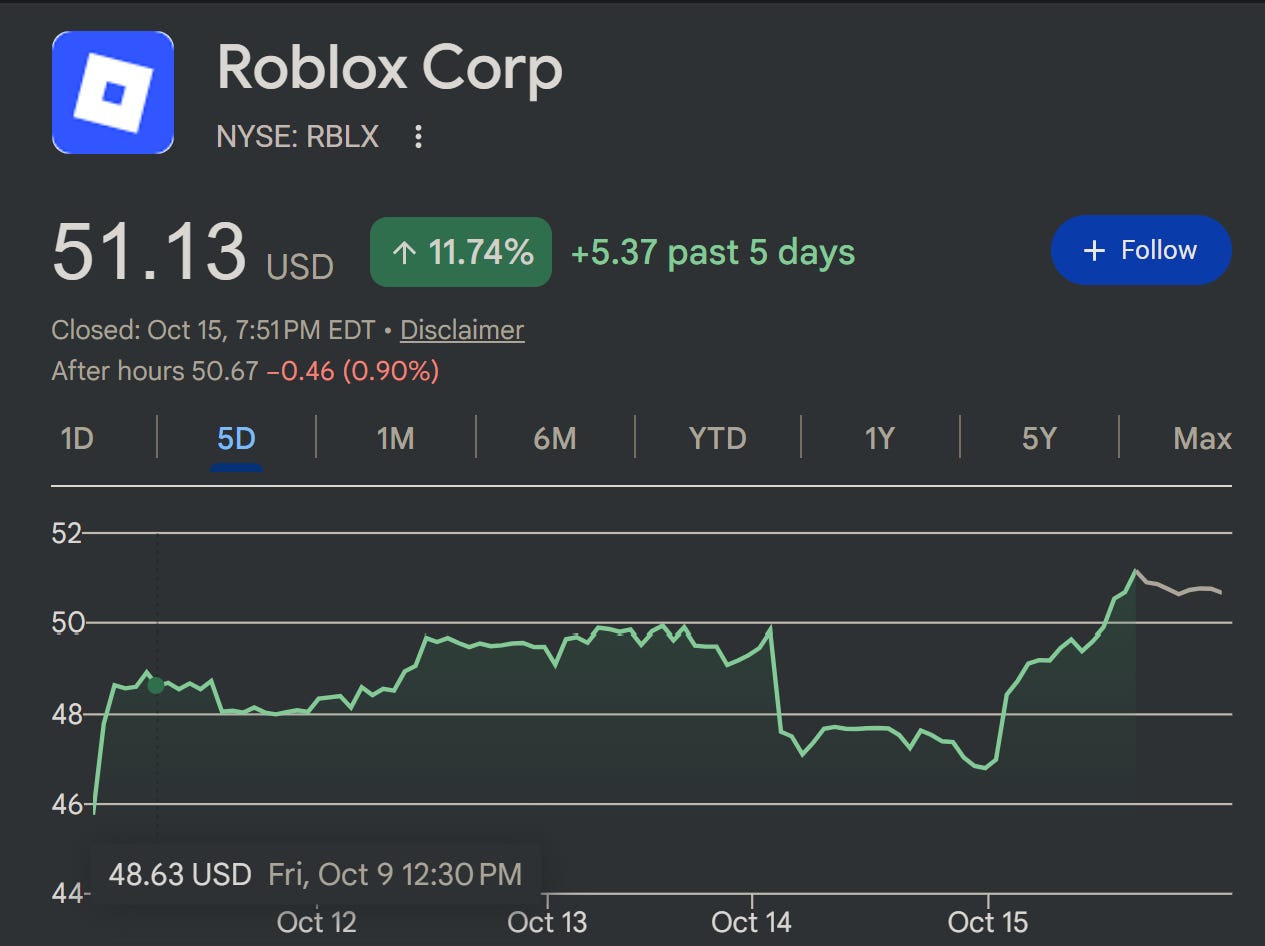
The rivals are copying it
Epic has built the most faithful copy. Since launching Unreal Editor for Fortnite (UEFN) in 2023, it has paid creators over $1 billion. Creator-made islands now draw 47% of Fortnite playtime, up from 38% a year earlier, and more than 75% of in-game transactions happen outside battle royale. In January, Epic added in-island purchases, Roblox’s other revenue stream, and more than 3,000 islands now earn more from them than from engagement payouts. Unreal Engine 6 will fold UEFN into the professional engine, so a hobbyist’s island and a studio’s game will share one toolchain. Fortnite is no longer a game. It is a portal.
Microsoft is turning its catalog into raw material. Its Muse model, trained on seven years of Bleeding Edge play, generates gameplay and controller input, and Microsoft has released its weights to developers. On October 13, Xbox CEO Asha Sharma launched Xbox Labs, a small team led by CTO Scott Van Vliet, after fans used AI to decompile classic games and run them in browsers and on new hardware. Her stated goals are to make games easier to reach, give old ones new life, and let more players become creators. That is the Roblox pitch applied to the Xbox back catalog. What Microsoft still lacks is a single portal to host it.
Google is building the creation layer. DeepMind’s Genie models went from 2D worlds in March 2024 to Genie 3, which generates explorable 3D worlds at 720p and 24 frames per second. Project Genie, opened in January to U.S. subscribers of Google’s $250-a-month AI Ultra plan, lets anyone sketch a world from a prompt or photo and walk through it. Sessions last only 60 seconds, and Google says it is not a game engine. It is a creation engine still looking for a portal, an economy and creators to pay.
Sony is the holdout, still betting on the finished blockbuster. Its 2026 business report dropped its pledge to bring first-party games to PC, and Ghost of Yotei, Saros and Marvel’s Wolverine are reportedly staying on PlayStation. But the community is converging without Sony: modders have built a fan PC “remaster” of Demon’s Souls, a game Sony never released on PC. Its catalog is becoming remix material whether Sony blesses it or not.
AI makes the model inevitable
Fans already use AI to decompile and rebuild classics: the original Halo has been recompiled to run 128-player matches, and other projects mash franchises together into new games. Roblox’s Cube model has produced 1.8 million 3D assets since March 2025, and its 4D tool lets players conjure drivable cars and flyable planes inside a game. Epic now lets AI agents operate the UEFN editor directly.
This is why AI strengthens the Roblox model rather than threatening it. When making a game gets cheap, games become abundant, and value moves to what stays scarce: an audience, discovery, a shared identity, and a way to get paid. A platform owns all four. Every AI breakthrough adds supply to platforms like Roblox; none of them replaces the platform.
The open questions are real. Generated worlds remain short and glitchy, and 52% of developers in GDC’s 2026 survey say generative AI is hurting the industry. Nobody has settled whether original developers consented to their games becoming training data, or who gets paid when a remix borrows their assets. Reverse-engineering sits in a legal gray zone, and Microsoft has so far promised only to treat IP responsibly.
The three-way race
If everyone is building the same model, the winner will be decided on three fronts.
• Infrastructure: a persistent world for tens of millions of players at once is a hosting problem first. Roblox is adding server authority and custom matchmaking so competitive shooters and racers can run on it. Epic already runs one of the largest live games on earth. Microsoft and Google own hyperscale clouds but no portal to fill them.
• Tools: the winner needs a ladder from prompt to professional engine. Roblox Studio plus Cube covers the bottom rungs. Epic’s UE6 covers the top, built on its Verse language and open to outside AI models. Google has the most impressive world generator but nothing to ship it into.
• Creator economics: payouts decide where talent goes. Epic routes about 40% of Fortnite’s shop revenue into a pool split by engagement. Roblox raised its cash-out rate 8.5% in September 2025 and adds 42% on adult spending. Both economies are lopsided: the median Roblox DevEx creator earned $1,440 in the year to June 2025. Whoever spreads the money wider wins the middle class of creators.
The verdict
Roblox was right about the model, and the scale gap proves it: Roblox paid creators $1.5 billion in 2025 alone, while Epic has paid $1 billion across three years of UEFN. But being right doesn’t guarantee winning.
My bet is Epic, the only copycat strong on all three fronts: servers proven by a global hit, a path from Fortnite islands to a professional engine, payouts already past $1 billion, and licensed worlds like Star Wars for creators to build in. Microsoft has the catalog without the portal, Google has the AI without the platform, and Sony is building walls. Whoever wins, gaming’s future will run on Roblox’s blueprint, and it will belong to whoever makes creators richest.
Disclaimer:
All views expressed are my own and are provided solely for informational and educational purposes. This is not investment, legal, tax, or accounting advice, nor a recommendation to buy or sell any security. While I aim for accuracy, I cannot guarantee completeness or timeliness of information. The strategies and securities discussed may not suit every investor; past performance does not predict future results, and all investments carry risk, including loss of principal.
I may hold, or have held, positions in any mentioned securities. Opinions herein are subject to change without notice. This material reflects my personal views and does not represent those of any employer or affiliated organization. Please conduct your own research and consult a licensed professional before making any investment decisions.