

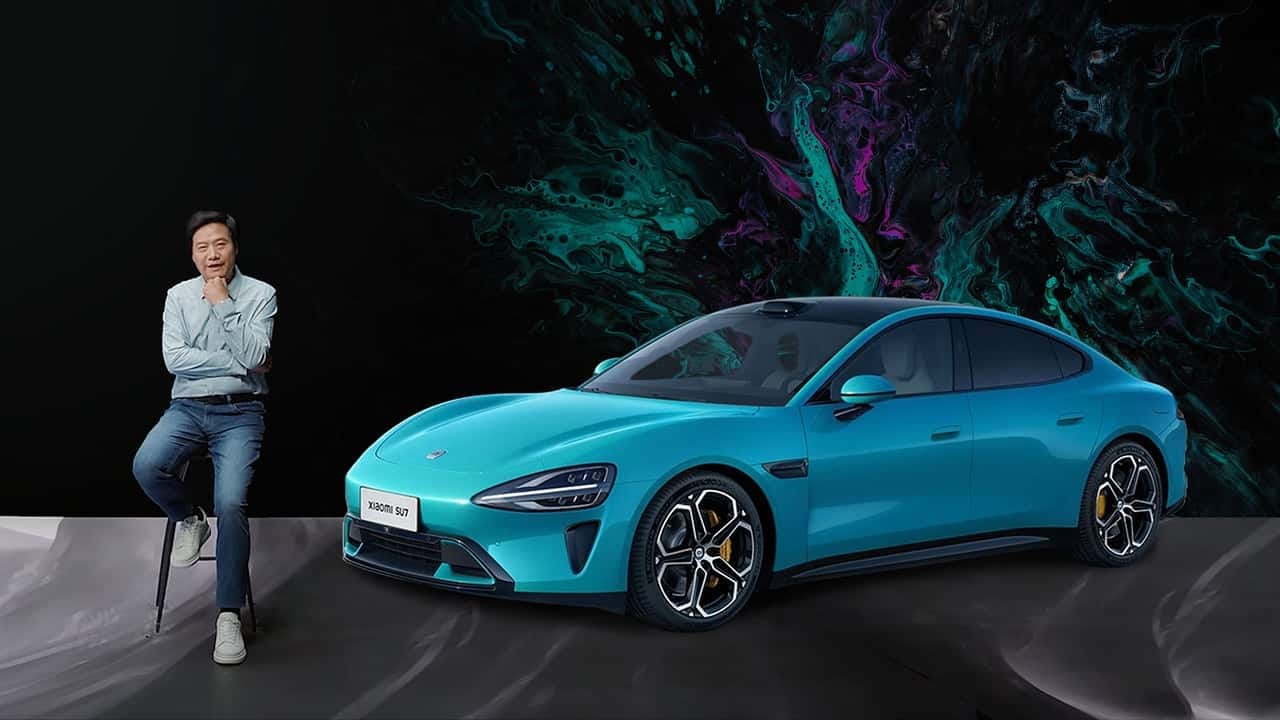
In a Mi Home store in Beijing, the display tables still hold the usual small things: phone cases in tidy rows, earbuds in plastic cradles, a tower fan turning slowly under bright retail lights. A few steps past the smart locks and air purifiers, a sedan sits on the showroom floor. Its paint catches the overhead LEDs the way a new handset used to, glossy and slightly unreal. A laminated placard rests against a tire. People who came in for cables drift toward the Xiaomi SU7. They lift their phones for photos. They tap the center screen through the open driver’s door, testing it with the same quick, skeptical pokes they use on demo tablets.
A staffer in a gray polo shirt answers questions in short bursts. He talks about trims the way phone salespeople talk about storage tiers. Standard. Pro. Max. He switches between colors and delivery windows without pausing. When someone asks about timing, he does not talk about shipping containers or port delays. He says the wait can stretch into months, and the app will show it. Reuters reported wait times of up to fifty-one weeks at points in 2025, a number that feels less like a dealership estimate and more like a preorder for a hyped gadget.
The SU7 launch landed in China as more than a novelty because it did not arrive priced like a vanity project. Xiaomi placed it directly in the mass market sedan fight. When the SU7 debuted, its pricing ran from 215,900 to 299,900 yuan, the band where shoppers already compare spec sheets line by line and talk about value with a kind of practiced seriousness. In Xiaomi’s corporate language, the car also arrived as part of a wider system. In its 2024 annual report, the company described the smart EV business alongside its broader ecosystem, using the “Human x Car x Home” framing that connects phones, devices, and now vehicles. The pitch is familiar to anyone who has watched consumer tech expand into adjacent categories. The difference is weight, and consequence.
The move looks cleaner if you remember how Xiaomi learned to compete in phones. It built a reputation on pace. New models arrived quickly. Software updates came often. There was a constant trickle of tweaks based on what users complained about in forums and group chats. Xiaomi got good at shipping consumer tech at scale and then continuing to work on it after purchase, through updates that arrived while the device sat on a nightstand. The company already lived in people’s pockets. The SU7 asks to become the new screen they sit inside.
China’s EV market does not leave much room for romance. Prices shift quickly. Model names blur. Features that sounded futuristic six months ago become defaults. Buyers compare driver-assistance packages the way they compare camera sensors. Tesla’s Model 3 sits in the background as a benchmark for the category and a kind of reference price. Xiaomi’s traction showed up in the monthly scoreboard. Reuters reported that the SU7 has outsold the Model 3 in China in monthly sales since December 2024, which is the sort of sentence that spreads fast online because it looks neat on a chart.
In the store, that context shows up in the conversations. One shopper mentions the Model 3 without hostility, like someone naming a standard. Another asks about range, then asks about software. A young couple argues quietly about whether “Max” is worth it, as if the car were a phone with an upgraded chip and a longer warranty. They move through the cabin like careful renters. Sit. Adjust the seat. Swipe the screen. Look for a familiar menu layout. Step out. Let the next person slide in.
Xiaomi’s entry looks easiest to understand through the first wave of buyers, the ones who were already inside the brand’s orbit. Many came from Xiaomi phones and the company’s sprawling smart home catalog. They already had the app. They were used to the logic of accounts and devices and firmware updates. Their shopping path looked digital first. Browse on the phone, pick a trim, put down a deposit, watch delivery estimates stretch out, post screenshots into group chats. In the phone business, a screenshot can function as proof of status. In the car business, it doubles as a coping mechanism.
For an EV entrant, attention is cheap. Shipping cars is expensive. Xiaomi’s first-year numbers were the part that separated spectacle from reality. In its 2024 annual report, the company reported total deliveries of 136,854 SU7 series vehicles by December 31, 2024. The phrasing is corporate and calm. The implication is physical. That many cars had to pass quality checks, get loaded onto trucks, and find their way into owners’ hands. That many owners had to find flaws or fail to find them, and then talk about it online.
Success in the EV business often looks like unglamorous work, done fast. Production ramps. Supplier bottlenecks. Hiring sprees. Delivery scheduling. Beijing became the physical anchor. In June 2025, Reuters reported that a Xiaomi unit won a tender to lease a large plot of land near its existing car factory in Beijing for 635 million yuan, tied to a smart connected car and components project. In the language of city regulators and planning commissions, the story reads like industrial logistics. For Xiaomi, it signaled that the car project was not designed to stay small, even if small might have been safer.
There is an easy analogy people reach for when a phone company builds cars: factories full of robots, production lines that resemble electronics assembly. The analogy works for a moment, especially in a place like Yizhuang, where modern manufacturing zones can feel like diagrams made real. Then the car parts take over. The paint shop. The stamping. The heavy, slow steps that do not tolerate consumer electronics timelines. A phone can be replaced every two years with a shrug and a trade-in promotion. A car sits in sun and snow and road salt. It demands service networks, parts inventories, and collision repair relationships that do not fit neatly into app updates.
Lei Jun, Xiaomi’s founder and public face, treated the SU7 debut with the choreography of a tech keynote. At the launch event, competitors sat in the audience, a detail noted with the kind of amused attention usually reserved for celebrity sightings. The applause lines were familiar to anyone who has watched consumer tech launches for the past decade. Product names sounded clean. Slides made the complex feel simple. In the crowd’s reaction, you could see how the phone era trained people to treat new hardware as an event worth attending, even when the hardware is big enough to change your commute.
Xiaomi’s ecosystem story stayed close to the surface. In its annual report, the company put numbers to the scale behind the pitch: 702.3 million global monthly active users as of December 2024, and 904.6 million connected IoT devices on its AIoT platform, excluding phones, tablets, and laptops. In daily life, that scale shows up in small scenes. A driver pairs the car to the same account used for smart lights. A route starts on a phone and reappears on the car screen. The gestures stay consistent: tap, swipe, confirm. The comfort comes from sameness. The risk comes from assuming sameness is enough.
Owning a car, even a well-designed one, drags people into the unglamorous middle of the business. Service appointments. Parts delays. Insurance paperwork. The difference between replacing a cracked screen and replacing a damaged door panel is not philosophical. It is weeks of logistics and money. For a company known for shipping lots of affordable hardware, the car business adds a new kind of patience test. It also exposes the brand to a harsher version of customer anger. A phone freezes and you restart it. A car freezes and you call a tow truck.
Safety and regulation became a sharper chapter in 2025. After a fatal SU7 crash in March 2025, Xiaomi said it was cooperating with police and sharing driving and system data. Reuters reported that the vehicle had been operating in Navigate on Autopilot mode at 116 kph before the driver intervened, and that the crash occurred at about 97 kph. Later that year, Reuters reported that Xiaomi would issue an over-the-air software update for more than 115,000 SU7 sedans under China’s recall rules, tied to concerns about assisted-driving behavior and warning timing. Around the same period, Reuters reported on China’s draft safety rules for Level 2 driving assistance systems, including requirements around driver engagement detection and tighter constraints on marketing language, with adoption expected in 2027. The shift was visible in how people talked about the feature set. Less bragging. More questions about edge cases. More attention to what the car asks of the driver, and what the driver expects of the car.
All of this played out inside a market shaped by pressure from every direction. China’s auto industry has lived through price wars and overcapacity fears, with regulators and executives warning about a coming shakeout among the many EV brands. Reuters described the strain in 2025 as overcapacity deepened and competition turned harsher. Xiaomi entered that environment late, and still chose to expand. The decision reads, from one angle, as confidence. From another, as a refusal to wait for calmer weather.
The company also moved quickly beyond the first model. In June 2025, Reuters reported Xiaomi’s launch of the YU7 SUV, priced to undercut Tesla’s Model Y, and described the pace of early preorders. The sequence looked like a standard automaker rhythm learned in public: sedan first, then an SUV, then the harder work of sustaining demand across cycles, warranty claims, and winter test drives that do not care about brand mythology.
Back in the Mi Home store, closing time approaches. A worker wipes fingerprints off the SU7’s screen with the same microfiber cloth used on tablet displays. The overhead lights dim slightly. Near the entrance, a customer holds a new phone case in one hand and scrolls through the Xiaomi app with the other, looking at delivery windows and trim options. The store still sells small objects meant to be replaced quickly. The car in the middle of the floor asks for a longer relationship, and for Xiaomi it asks for a different kind of consistency than the phone business ever required.
Disclaimer:
All views expressed are my own and are provided solely for informational and educational purposes. This is not investment, legal, tax, or accounting advice, nor a recommendation to buy or sell any security. While I aim for accuracy, I cannot guarantee completeness or timeliness of information. The strategies and securities discussed may not suit every investor; past performance does not predict future results, and all investments carry risk, including loss of principal.
I may hold, or have held, positions in any mentioned securities. Opinions herein are subject to change without notice. This material reflects my personal views and does not represent those of any employer or affiliated organization. Please conduct your own research and consult a licensed professional before making any investment decisions.
Bullish outlook