

Q4 guidance was not. Data center revenue grew 78% and Intel still can’t build enough server chips to sell. Three days before results, it agreed to pay a reported $2.3bn for a quantum software start-up its chief executive had once backed personally. The market has started pricing Intel as a policy instrument rather than a chipmaker, and that discount may last.
On Friday Intel had its worst day in more than half a century. The shares fell close to 29 per cent from Thursday’s close of $92.07, taking more than $100bn of market value with them. The only comparable session in the company’s history is 5 July 1974, when the stock dropped 29.9 per cent.
The odd thing is that the quarter was fine. Revenue rose 21 per cent to $16.5bn, and adjusted earnings of 52 cents a share comfortably beat the 40 cents analysts expected. The guidance did the damage. Intel forecast fourth-quarter revenue of $15bn to $16bn against roughly $17bn expected, adjusted EPS of 25 cents against about 43 cents, and a 38 per cent gross margin where the Street had penciled in 42.
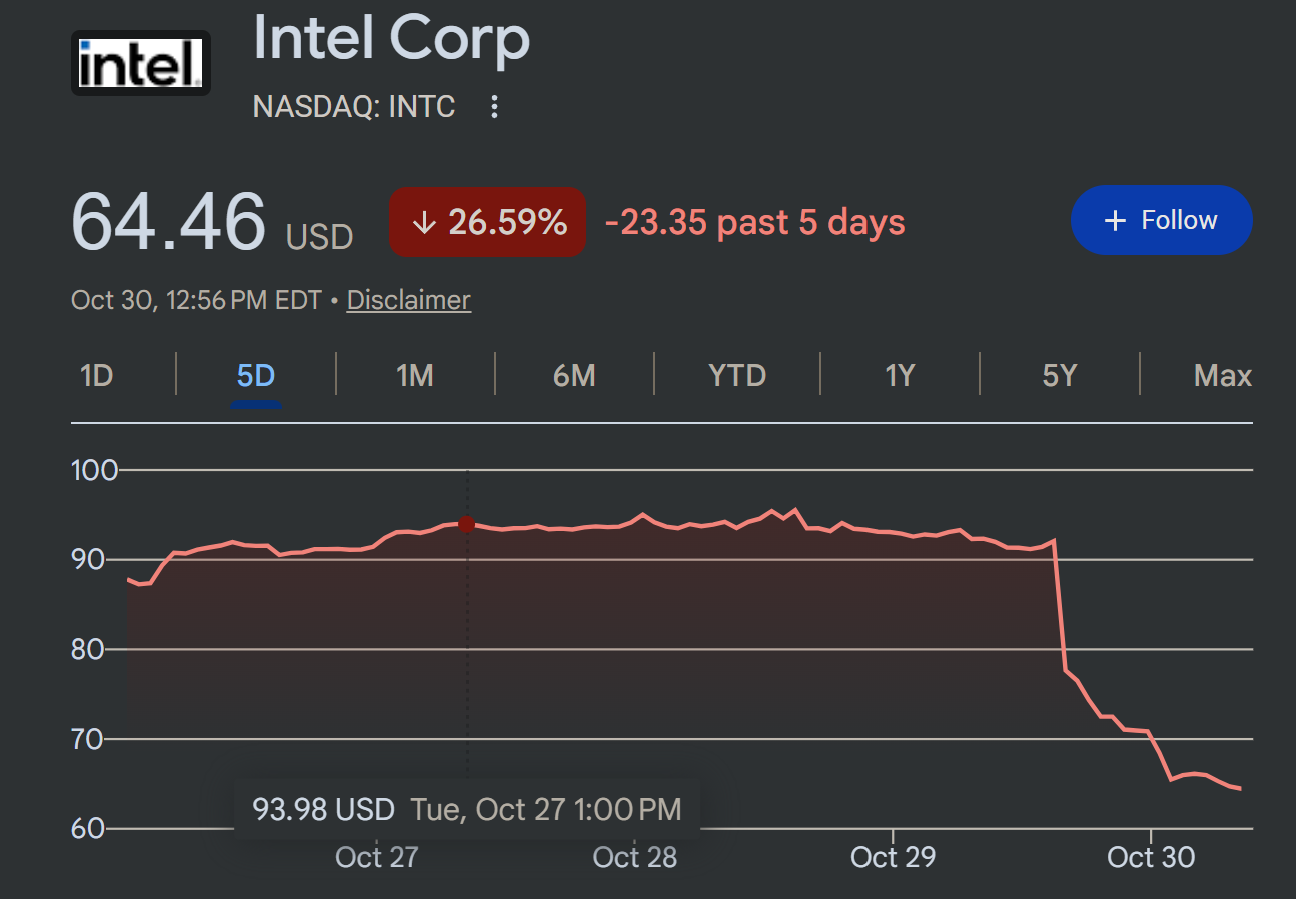
The bull case has arrived, and it is sold out
Data center and AI revenue reached $7.3bn, up 78 per cent on the year. That is the division’s fastest growth in 15 years, and it brought in about $3bn of operating profit. Management says its immediate priority is unlocking supply for its Xeon server processors, for which it calls demand “extraordinary”. So Intel is guiding revenue down while its best product is rationed.
Some of the shortfall is beyond Intel’s control. It expects client computing revenue to fall more than 20 per cent quarter on quarter, and management warned the PC slowdown will last through at least the first half of 2027. An accident at Fab 28 in Israel will take roughly $300m off the quarter. Most of Friday’s broker notes lead with the PC numbers, and that is fair: they are the immediate cause.
They are not the whole explanation. A stock that rose 278 per cent in the first half of the year was not priced on laptop shipments. It was priced on the belief that Intel would turn AI infrastructure demand into earnings. Friday’s guidance said the factory still limits that, so investors started asking where management’s attention is going.
Then came the quantum detour
On 26 October Intel signed a definitive agreement to buy Classiq, a Tel Aviv company that writes software for quantum computers. Intel kept the price to itself. Calcalist reported about $2.3bn in cash and stock, which would be the largest quantum acquisition yet, for a company of roughly 150 people that was valued at well under $1bn in its last funding round.
Two details got less attention than they should have. Lip-Bu Tan invested personally in Classiq before he ran Intel, joining its 2022 Series B. Calcalist says he recused himself from the talks, but Intel’s announcement did not mention his stake. Nobody at Intel claims the deal pays off soon, either. Tan calls quantum part of the company’s strategy for the next five to 10 years, and its chief technology officer admitted it won’t be a high-margin business from day one. Tan has also said quantum could be ten times bigger than AI.
He may be right, and $2.3bn is small next to a $16bn quarter. What matters is the signal. A chief executive who can’t meet demand for his server chips is spending capital, and scarcer management time, on a market that doesn’t exist yet, and he is buying a company he once backed with his own money. Shareholders don’t have to give that the benefit of the doubt. On Friday they didn’t.
Washington on the share register
The US government owns about a tenth of Intel. In August 2025 the administration converted $11.1bn of Chips Act grants and pledges into 433.3m shares at $20.47 apiece. With the stock down roughly $26 on Friday, my arithmetic puts the taxpayer’s one-day paper loss at around $11bn. There’s an accounting twist too. Benzinga estimates that because of how part of the government deal is structured, Friday’s fall could give Intel a pre-tax gain of about $3.4bn. When a company’s reported profit goes up as its shares go down, you are not looking at an ordinary equity.
Here is the thesis. A sovereign shareholder changes what management gets rewarded for. National champions are expected to build fabs at home, keep leading-edge manufacturing onshore and stake claims in strategic technologies such as quantum. Those are reasonable national goals, but they are different from earning a return on capital this decade. When the two conflict, a chief executive with Washington on the register has every incentive to choose the first. Friday’s selling looks like investors adjusting for that, valuing Intel less as a cash-flow business and more as a listed research institution with a state backstop.
Disclaimer: All views expressed are my own and are provided solely for informational and educational purposes. This is not investment, legal, tax, or accounting advice, nor a recommendation to buy or sell any security. While I aim for accuracy, I cannot guarantee completeness or timeliness of information. The strategies and securities discussed may not suit every investor; past performance does not predict future results, and all investments carry risk, including loss of principal.
I may hold, or have held, positions in any mentioned securities. Opinions herein are subject to change without notice. This material reflects my personal views and does not represent those of any employer or affiliated organization. Please conduct your own research and consult a licensed professional before making any investment decisions.