

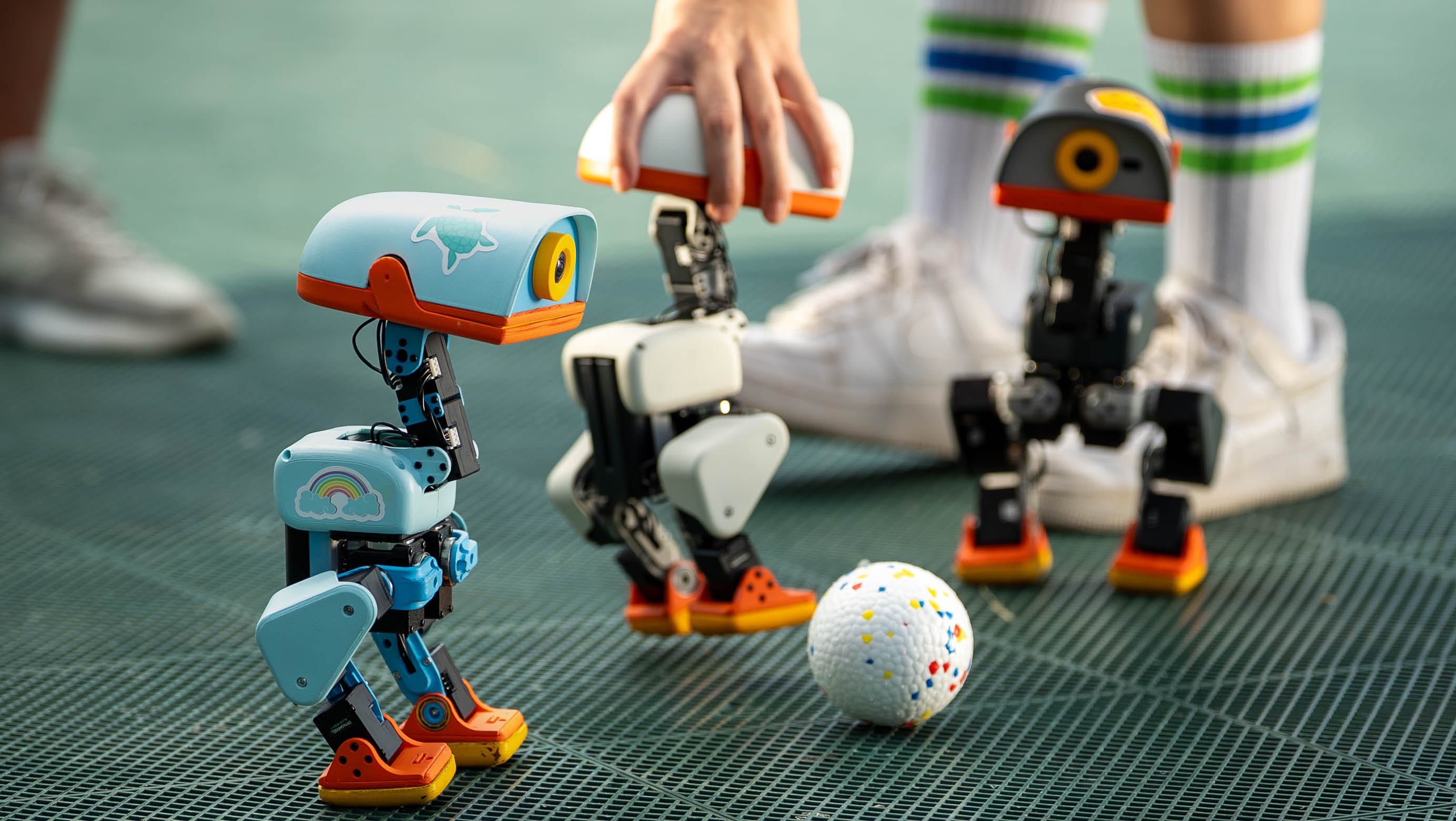
Jensen Huang ended his GTC Berlin keynote on October 21 not with a new chip but with four 25-centimeter robot ducks. At the Tempodrom, he asked them to walk, sit, nap and somersault. Most obeyed; one wandered off facing the wrong way, and Huang told it to stay focused. Business Insider called the finale charming “but not entirely obedient.”
The clip went viral. Two days later, Hugging Face CEO Clem Delangue posted that total Microduck preorders were about to cross 20,000, possibly making it the best-selling robot of 2026. That is on top of the more than 10,000 units sold in the first week after preorders opened on August 27.
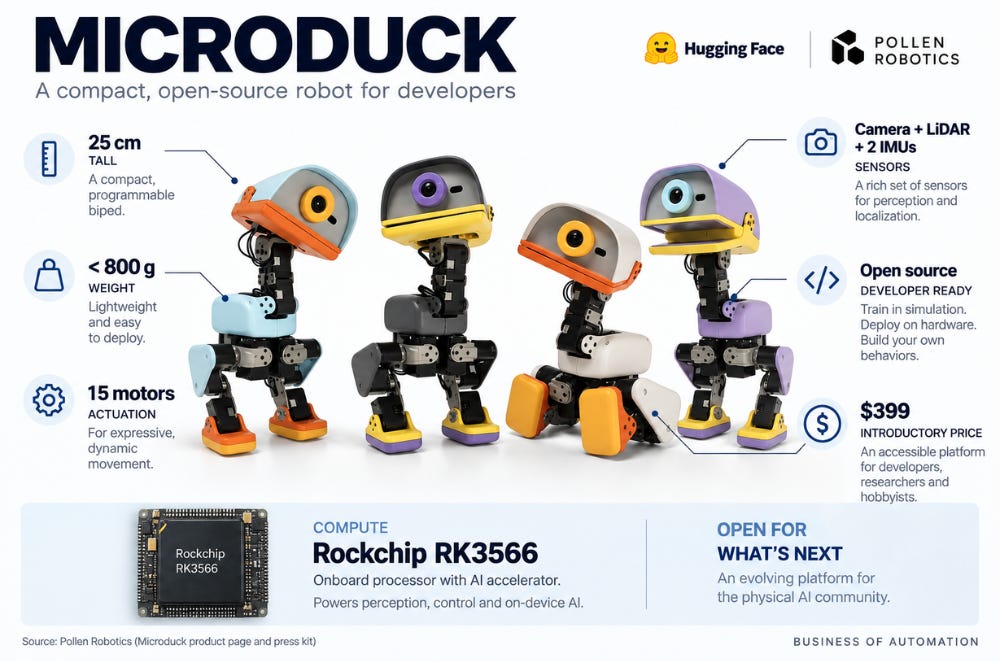
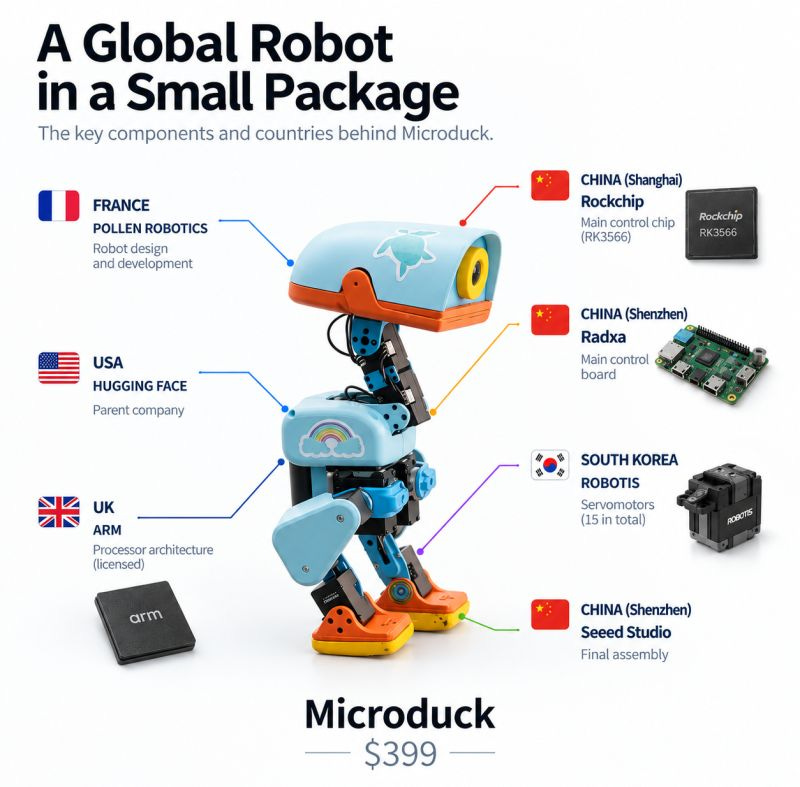
In a corporate sense, the duck now belongs to Jensen. NVIDIA agreed in September to buy Hugging Face for $12.9 billion, and Hugging Face owns Pollen Robotics, the Bordeaux startup that designed Microduck. NVIDIA says the stage ducks were trained with AI agents on its RTX Spark laptops and cloud. Yet almost nothing inside the duck is NVIDIA’s. Its brain is a Chinese chip, its muscles are Korean, most of its senses are European, and it is put together in Shenzhen. And the part most likely to decide when buyers get one is not the chip at all.
The parts list
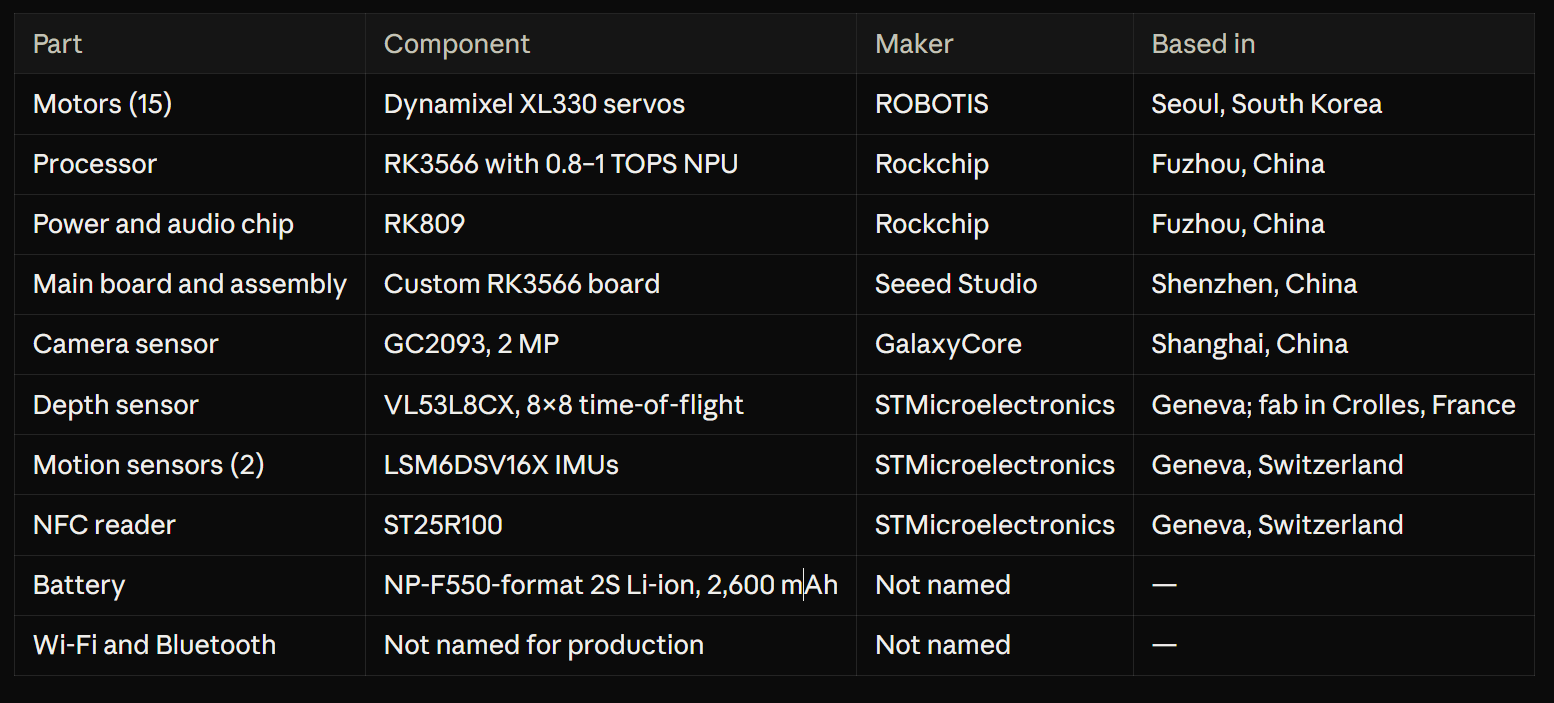
Pollen has not published a bill of materials, and its hardware design files are closed. But its robot software is open, and the code names the chips it talks to. The table below comes from that code, which describes Seeed’s production board as the “custom board’s first spin”, so later units could still change. Where the code is silent, it says so.
The brain: a budget Rockchip
Microduck thinks with a Rockchip RK3566, a quad-core Arm Cortex-A55 chip clocked up to 1.8 GHz, paired with 1 GB of RAM and 32 GB of storage. Rockchip trades on Shanghai’s A-share market, and the chip’s cores are licensed from Britain’s Arm. Pollen says it chose the part for its onboard neural processing unit, which it rates at 1 TOPS; CNX Software lists 0.8 TOPS.
Rockchip’s footprint is bigger than one chip. The development ducks ran on a Radxa Zero 3W, a cheap single-board computer from Shenzhen’s Radxa. Production units move to a custom RK3566 board from Seeed Studio, and Pollen’s code shows that board using Rockchip’s RK809 power-management chip to drive the speaker as well. Rockchip, based in Fuzhou, reported first-half 2026 revenue of 2.88 billion yuan, up about 41 percent.
This is modest silicon, the kind found in budget single-board computers. It doesn’t need to be more. On the robot, a handful of Rust daemons run a 50 Hz loop that drives the servos straight from small neural policies. The expensive part, training those policies, happens off the duck, in simulation on a PC or in the cloud. That is where NVIDIA sits in the stack: its Isaac Sim and Isaac Lab tools and RTX hardware. Pollen’s own workflow also runs the MuJoCo physics engine in a browser.
The arrangement matches what Huang promised when he bought Hugging Face: that NVIDIA compute would not be required to build on or deploy through the platform. Microduck is that promise with legs.
Rockchip’s investors noticed. After the August launch, its shares surged 10 percent one day and closed another 4.6 percent higher the next. Omdia chief analyst Lian Jye Su calls Rockchip a key edge-AI supplier, but notes its chips lack the computing headroom for complex edge AI devices. For a duck running compact walking policies, that ceiling may not matter yet. It could matter once owners start training ambitious new tricks.
The muscles: Korean servos, and the real bottleneck
The most expensive part of the duck is not Chinese. Each Microduck walks on 15 Dynamixel XL330 servos made by ROBOTIS, a KOSDAQ-listed company in Seoul. Pollen’s control code is written for the XL330 throughout, and its training stack models that servo’s friction and delay so policies learned in simulation work on the real joints. A sixteenth device on the same serial bus is a small Pollen board carrying the body’s motion sensor.
The choice is a loyal one. Pollen co-founder Matthieu Lapeyre says Dynamixel “has been used for a long time” and has proven reliable in small robots, and Pollen has put ROBOTIS motors in almost all of its products. Retail, an XL330 sells for about $27, which would put 15 of them above the duck’s $399 price. Pollen pays far less. Korea Investment & Securities valued 50,000 ducks’ worth of servos at about 15 billion won; other Korean reports put the deal near 20 billion won. That implies roughly $14 to $19 per servo, or somewhere around $210 to $285 per duck.
That is why Seeed founder Eric Pan says “there isn’t much margin in this duck.” It is also where production hits a wall. On October 26, Lapeyre visited ROBOTIS’s Seoul headquarters to sign for 750,000 actuators, enough for 50,000 ducks, and said Pollen expects to need about 1 million next year.
ROBOTIS cannot build them yet. Its annual capacity is about 500,000 units, according to Hanwha Investment & Securities, and its order backlog already topped 500,000 in September. Chief executive Kim Byoung-soo says the Seoul plant is “running at maximum capacity” and that serving Pollen means reshuffling other customers’ orders. He expects to fully handle the new demand from the second quarter of 2027. A new ROBOTIS factory in Uzbekistan is due to start in the first half of 2027, but Newspim reports it will prioritize larger actuators for humanoid robots, not the tiny XL330.
The senses: mostly European
The sensors are where Europe shows up. Four chips come from STMicroelectronics, the Franco-Italian group headquartered in Geneva.
• Depth: a VL53L8CX, the 8×8 time-of-flight sensor Pollen markets as LiDAR. It fires infrared pulses and times their return across 64 zones. ST says its FlightSense sensors are made at its 300mm wafer fab in Crolles, France.
• Balance: two LSM6DSV16X IMUs, one on a face board in the head and one on the body board. The chip fuses its own orientation readings, which spares the RK3566 that work.
• Touch: an ST25R100 NFC reader, launched in 2024 as a low-cost part, drives the antennas in the head and beak that read NFC tags.
Prototype ducks used other parts: a Bosch BMI088 motion sensor and Sony’s IMX219 camera sensor, the one in Raspberry Pi’s v2 camera. Production swapped the Sony part for a GC2093 from GalaxyCore, a fabless Shanghai firm that ranked second worldwide in image-sensor shipments in 2019. The GC2093 is a 2-megapixel, 1080p sensor with 2.8-micron pixels, the kind sold in low-cost USB webcams. Pollen’s code notes the camera tuning comes from Seeed.
Power, radio and the rest
The remaining parts are commodities, and Pollen names none of their makers.
• Battery: a removable two-cell lithium-ion pack in the NP-F550 format, 2,600 mAh, good for about an hour. Sony created the NP-F shape for camcorders, and dozens of firms now make compatible packs. That makes it one of the easiest parts to source, and lets owners swap in spares.
• Wireless: still unnamed. The prototypes used an AIC8800 Wi-Fi and Bluetooth chip from China’s AICSemi, but Pollen’s own setup scripts say that radio “is not what ships.”
• Audio: prototypes used a Texas Instruments codec. Production ducks play sound through the Rockchip RK809 and record through a microphone on the face board.
• Body: neither company has said who makes the molded shell, brackets, cables or the gamepad in the box.
Made in Shenzhen
The duck is built by Seeed Studio, the Shenzhen hardware house that has made boards and kits for makers since 2008. Bloomberg reported the arrangement at launch. Seeed founder Eric Pan later told GeekPark that Microduck’s prototype was built on Seeed’s own open-source hardware, and that Pollen had been a Seeed customer for years before Hugging Face bought it.
Seeed also builds Reachy Mini, Pollen’s desktop robot. Pan describes the split simply: Pollen focuses on “their design, their knowhow, their software,” and Seeed runs what he calls a “curated supply chain for robotics.” Going through Seeed, he says, was “probably a good deal more efficient” than Hugging Face sourcing parts itself. To hit $399, Seeed used its volume to negotiate with upstream suppliers and engineered costs out of the design. But its pitch is agile manufacturing, which it advertises as running from a single unit to more than 10,000. Microduck’s order book is already past twice that top figure.
Put together, the map is global but lopsided. The duck is designed in Bordeaux and owned, via Hugging Face, by a California chip giant. Its brain and camera come from mainland China, its sensors mostly from a Franco-Italian chipmaker, and its 15 motors from Seoul. Final assembly happens in southern China. A supply chain spread that wide is cheap and well tested. It also means the slowest supplier sets the pace.

The Christmas math
For most buyers, the answer is already in: no. Pollen launched with a promise to ship before Christmas 2026 in North America and Europe. As of October 28, the Microduck store page carries a new banner. It says production is ramping up, but current preorders should expect to ship after April 2027, first ordered, first shipped.
That leaves the before-Christmas target for the earliest August buyers, and even that depends on a first run that has not shipped yet. Some details, including camera resolution, LiDAR range and SDK languages, were still listed as provisional in Pollen’s press kit. Delangue has also posted that Pollen and Hugging Face need to hire across every function to keep up with Microduck and Reachy Mini.
The new date is not a mystery once you follow the parts. Rockchip chips and ST sensors are high-volume catalog items, and Seeed has a production line ready. The tight link is Seoul. ROBOTIS says it can fully serve Pollen from the second quarter of 2027, and Pollen’s store now promises shipments “after April 2027.” The two timelines match. Until then, every duck Pollen ships depends on how many servos ROBOTIS can shift away from its other customers.
For NVIDIA, the delay barely dents the win. Huang got a viral keynote moment for physical AI, and every duck that ships will be trained on NVIDIA’s tools. It will just do its waddling on a Chinese chip and Korean motors, probably sometime next spring.
Disclaimer: All views expressed are my own and are provided solely for informational and educational purposes. This is not investment, legal, tax, or accounting advice, nor a recommendation to buy or sell any security. While I aim for accuracy, I cannot guarantee completeness or timeliness of information. The strategies and securities discussed may not suit every investor; past performance does not predict future results, and all investments carry risk, including loss of principal.
I may hold, or have held, positions in any mentioned securities. Opinions herein are subject to change without notice. This material reflects my personal views and does not represent those of any employer or affiliated organization. Please conduct your own research and consult a licensed professional before making any investment decisions.