

Meta poured tens of billions of dollars into graphics processing units and gigawatt scale data centers. A so called Year of Efficiency somehow ended with 8,000 more job cuts while capital expenditure guidance shot up to $145 billion. The market responded with heavy skepticism for most of 2026. Meta stock spent the year trailing its Magnificent Seven peers. Shares dropped by double digits even as company revenue continued to accelerate.
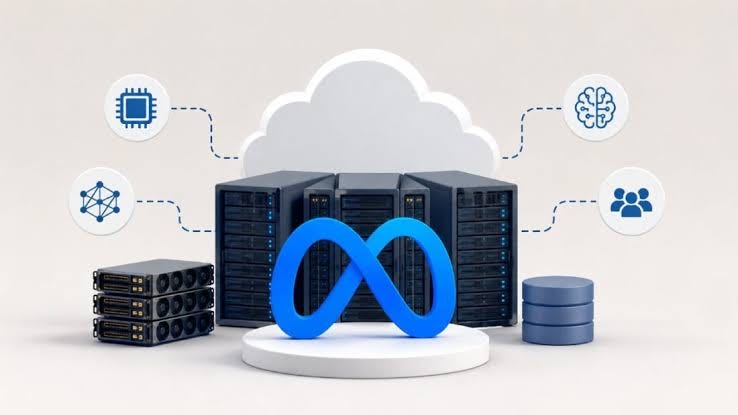
Then a July 1 Bloomberg report flipped the entire narrative overnight. The story revealed that Meta is quietly building a cloud computing business internally named Meta Compute. The goal is to rent out spare AI capacity to outside customers. This is not just a small side experiment. The effort is reportedly led by the head of infrastructure at Meta alongside president Dina Powell McCormick. Two distinct business models are on the table. One approach mirrors Amazon Bedrock where developers pay to access hosted models from Meta including the new closed weight Muse Spark. The second approach follows the CoreWeave playbook. Meta would simply sell raw GPU hours by the clock with no strings attached.
Meta shares jumped roughly 9 percent in a single trading session and closed above $612. Cloud providers like CoreWeave and Nebius took a heavy hit in response. These specialized companies exist specifically to rent out AI computing power. The market logic was clear. If Meta decides to use its massive balance sheet and in house technology to compete for a $300 billion cloud computing market, the competitive moat for specialist GPU rental companies suddenly gets much thinner.
Why Renting Out AI Capacity Makes Strategic Sense for Meta
Critics often miss a fundamental point about building infrastructure at this scale. Meta was always going to end up with excess capacity at some point. The company signed a 6 gigawatt computing agreement with AMD in February worth roughly $100 billion. Total commitments across Nvidia and AMD sit around $110 billion. Meta is also rolling out its own custom MTIA silicon chips designed with Broadcom and pushing past the 1 gigawatt mark. Computing capacity at that extreme scale does not arrive in perfectly sized increments. It arrives in massive chunks based on forward looking demand projections. Chief Financial Officer Susan Li admitted on the first quarter earnings call that these projections are frequently wrong. They are not wrong because Meta is overbuilding. They are wrong because the company continues to underestimate its own computing needs quarter after quarter even while rapidly scaling up operations.
This creates a unique paradox where Meta Compute makes perfect sense. A technology giant can easily lack enough power for its own massive AI training runs while simultaneously sitting on excess capacity that is perfect for smaller workloads. Hardware arrives in indivisible blocks. SpaceX saw a similar dynamic with its Colossus data center. The company reportedly leased out computing capacity to Anthropic and Google for a combined sum worth tens of billions annually while its own xAI division was racing to scale the Grok model.
If Meta Compute becomes a reality, the entire conversation around corporate spending changes completely. Pumping $125 billion to $145 billion a year into infrastructure suddenly looks different. It shifts from funding an unproven personal superintelligence project into a revenue generating system similar to Amazon Web Services. Analysts at Wolfe Research noted that renting out extra capacity could meaningfully boost earnings per share. That presents a much stronger financial story than simply hoping the digital advertising business will eventually absorb the heavy costs.
Bill Ackman Recognized the Infrastructure Value Early
Bill Ackman and his firm Pershing Square built a significant stake in Meta back in late November 2025. Ackman argued the stock represented a deeply discounted valuation for one of the best businesses in the world. This was a contrarian call at a time when Wall Street largely viewed heavy capital expenditure as a major risk rather than a long term asset. The timing now looks less like a lucky trade and more like excellent pattern recognition.
Ackman doubled down on his investment thesis during a Forbes Iconoclast interview on July 4. That was exactly three days after the Meta Compute story broke. His perspective was very straightforward. He stated it is genuinely uncertain which frontier AI model will ultimately win the race. Every serious artificial intelligence company still needs enormous amounts of computing power. Providing that computing power is a highly durable business model. Reports surrounding the interview noted Meta was trading at roughly 18 times forward earnings at the time. That made it the cheapest of the three major tech names in the Pershing Square portfolio, sitting below both Alphabet and Amazon. The market had priced Meta lower due to heavy skepticism that its AI spending would convert to reliable returns. Google Cloud and Amazon Web Services already operate clear toll road models that investors understand perfectly.
The rumors surrounding Meta Compute could easily close that valuation gap. Pointing to actual external revenue from cloud infrastructure changes the perception of the business. It becomes much harder for critics to dismiss the data center buildout as a very expensive science project.
Key Developments to Watch in Meta’s Cloud Strategy
None of these plans are officially confirmed yet. There is no public pricing for Meta Compute. We do not have a launch date or any official regulatory filings to review. We only have sourced reporting and past comments from Mark Zuckerberg telling shareholders that a cloud business is definitely on the table. The next real test arrives during the second quarter earnings call scheduled for July 29. That event will provide the first clear opportunity for management to confirm the plan, share new details, or walk the rumors back entirely.
Keep in mind that the core advertising engine at Meta does not actually need a cloud computing service to succeed. First quarter ad revenue grew by 33 percent. Ad impression growth went up by 19 percent and the price per ad increased by 12 percent. The company is getting significantly better at monetization completely independent of any potential GPU rental business. Meta Compute is essentially added value sitting on top of an investment thesis that was already working. That distinction likely explains why Ackman was perfectly willing to call the stock cheap well before the cloud computing story ever reached the public. The market reaction to Meta Compute might ultimately represent a confirmation of an existing success story rather than a totally new direction for the company.
Source:
Bloomberg – "Meta Is Planning a Cloud Business to Sell AI Computing Power" (July 1, 2026)
Disclaimer:
All views expressed are my own and are provided solely for informational and educational purposes. This is not investment, legal, tax, or accounting advice, nor a recommendation to buy or sell any security. While I aim for accuracy, I cannot guarantee completeness or timeliness of information. The strategies and securities discussed may not suit every investor; past performance does not predict future results, and all investments carry risk, including loss of principal.
I may hold, or have held, positions in any mentioned securities. Opinions herein are subject to change without notice. This material reflects my personal views and does not represent those of any employer or affiliated organization. Please conduct your own research and consult a licensed professional before making any investment decisions.