

The tidy read of today’s tape is “money rotating out of speculative AI into quality AI”. That’s half right. The trigger was the election. A Democratic Congress, plus a pile of local votes against data centres, makes new AI capacity slower and harder to build. Traders worked out within hours who that hurts: the companies whose whole equity story is building that capacity with borrowed money. Microsoft has the customers, the backlog and the cash, so it can wait. Meta, usually lumped into the same “quality” bucket, is the awkward exception.
The tape
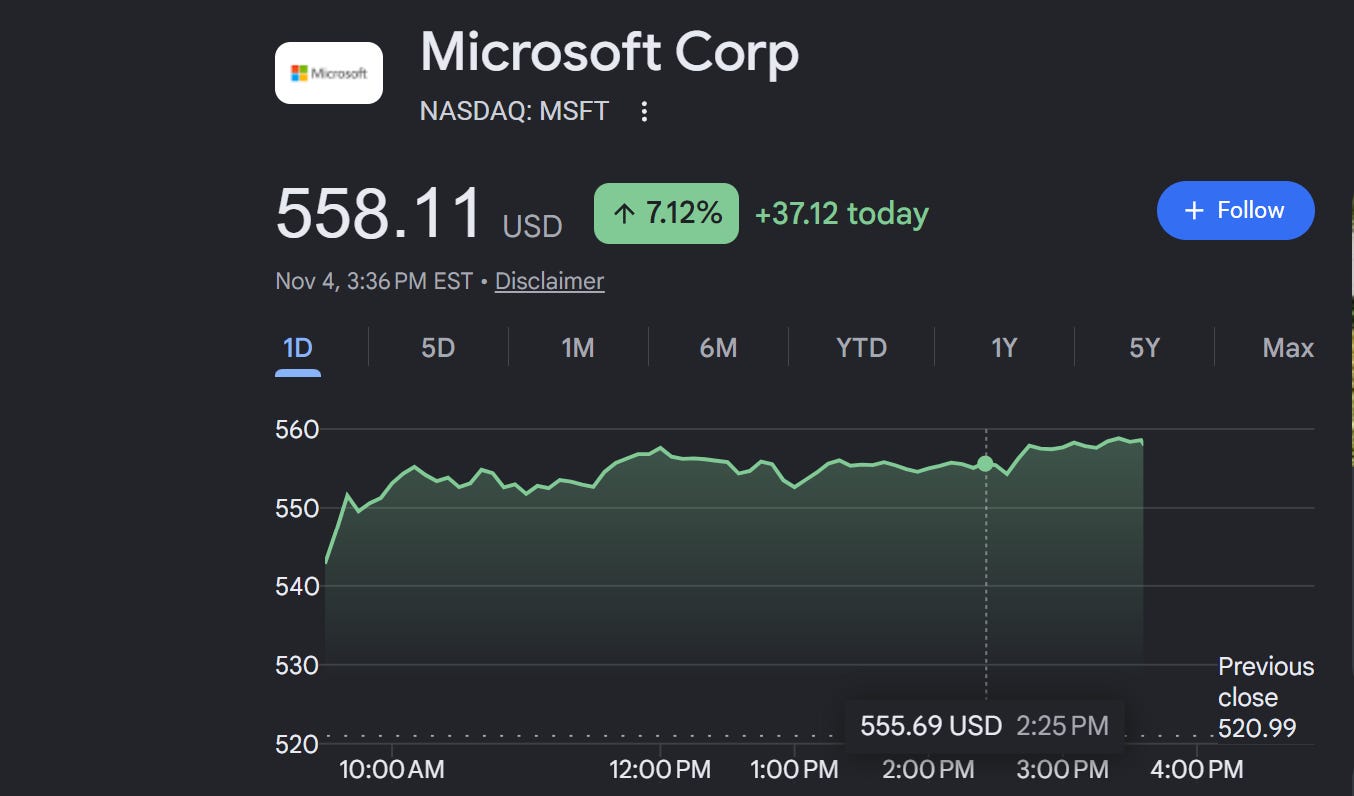
The Dow was up about 1,500 points, roughly 2.9%, on course for its best day since April 2025, after Democrats took both the House and the Senate. Big tech led. Microsoft and Amazon were up 6-7%, Apple about 6%, Alphabet 4-5%. Meta managed about 2% and Nvidia slipped.
The neoclouds went the other way. By midday CoreWeave was down 9%, IREN 11% and Nebius about 6%. CNBC put it down to Democratic wins in Texas and data centre rejections on ballots around the country. CoreWeave’s five-year credit default swaps widened to about 1,140bp, which is the bond market saying the same thing more quietly.
None of this came out of nowhere. Ballotpedia’s tally put 41 local data centre measures on Tuesday’s ballots across ten states, 17 of them calling for outright bans. All six decided earlier in the year went against development.
Why the same news splits the trade
A neocloud’s model is simple. Borrow, buy Nvidia GPUs, secure power and land, then rent the capacity to hyperscalers on long contracts. The equity is a bet on the next gigawatt, not the last one. Anything that slows permits or grid connections pushes revenue to the right while the interest keeps running. One analyst puts CoreWeave’s net debt at roughly $30bn. Musk, never one for understatement, said late last month that more than 200 neoclouds will collapse as debt markets shut them out.
Microsoft sits on the other side of those contracts. It is the customer, and last week it showed what delays look like from the buyer’s chair. Quarterly capex came in at $45.2bn against a consensus near $50.7bn because, in CFO Amy Hood’s words, “some third party capacity deliveries we expected in Q1 were delayed.” Calendar-2026 capex was trimmed to about $170bn. The neoclouds sold off after hours that night. Microsoft rose.
That is the asymmetry the market priced today. When building gets harder, the builder eats the cost. The tenant with a signed order book just spends less this quarter.
The quarter
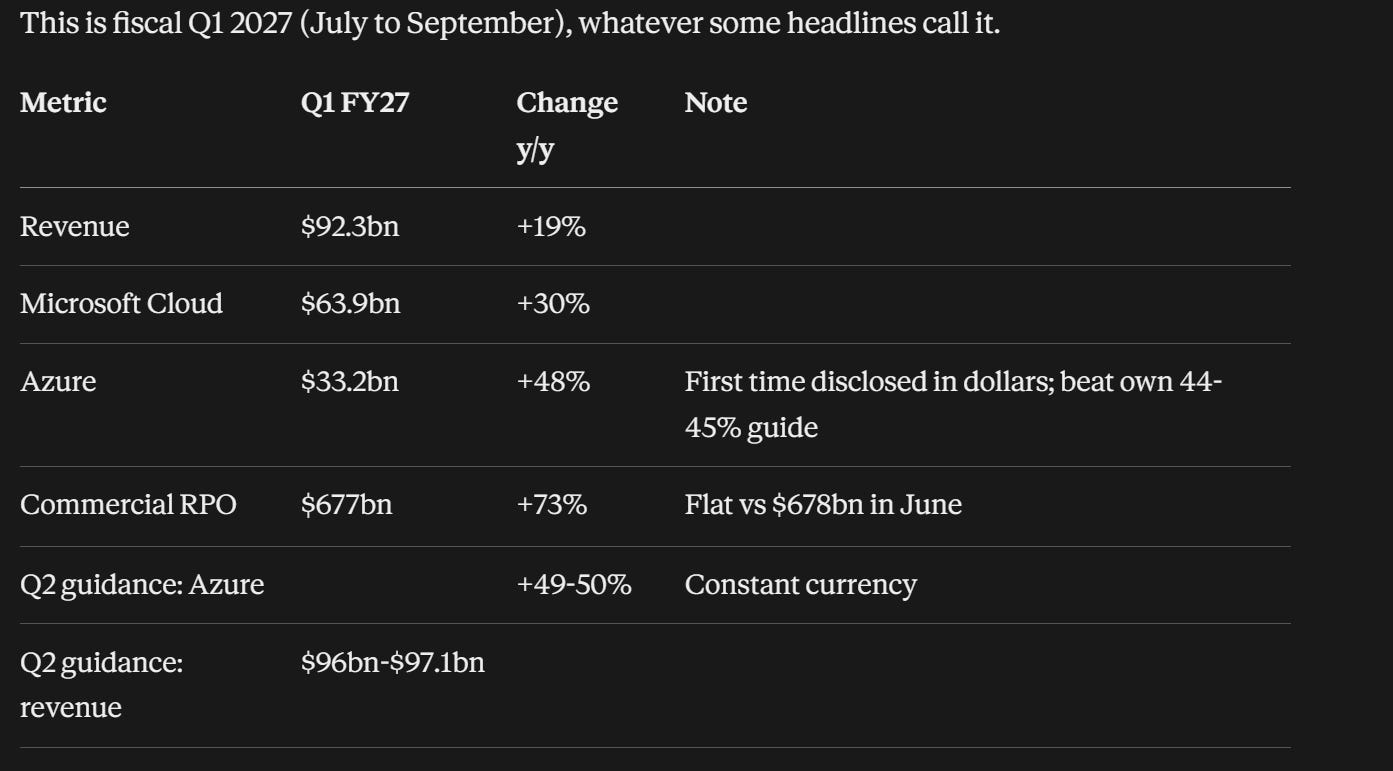
Operating cash flow was about $58bn, so the capex bill is still mostly covered from the till.
One detail the bulls skip. Commercial RPO was $678bn at the end of June, so the backlog was flat on the quarter. The 73% is mostly last winter’s mega-deals, when it jumped from $392bn to $625bn in three months. Microsoft expects to recognise about 30% within a year, so call it $200bn of near-term revenue already signed. Still enormous. Just not still accelerating.
“Quality AI” is not one trade
Amazon belongs in the conversation. AWS grew 39% to $46bn, its fastest in nearly five years, and is on a $184bn run rate. But trailing free cash flow is negative $42.4bn, capex is about $220bn this year, and Jassy says 2027 will be “meaningfully more”. The stock fell more than 6% after results last week. Today’s bid looks political, not fundamental.
Meta is the harder fit. Revenue rose 26% to $64.6bn, but capex of $34.9bn exceeded $32.8bn of operating cash flow, leaving free cash flow negative for the quarter. It hasn’t bought back a share this year. Most of that spending serves Meta’s own ad machine, so there is no external backlog to point to. A 2% gain on a day like this suggests the market knows the difference.
Of the three, Microsoft is the cleanest version of the thesis: outside customers, a contracted backlog and positive free cash flow.
Disclaimer: All views expressed are my own and are provided solely for informational and educational purposes. This is not investment, legal, tax, or accounting advice, nor a recommendation to buy or sell any security. While I aim for accuracy, I cannot guarantee completeness or timeliness of information. The strategies and securities discussed may not suit every investor; past performance does not predict future results, and all investments carry risk, including loss of principal.
I may hold, or have held, positions in any mentioned securities. Opinions herein are subject to change without notice. This material reflects my personal views and does not represent those of any employer or affiliated organization. Please conduct your own research and consult a licensed professional before making any investment decisions.