

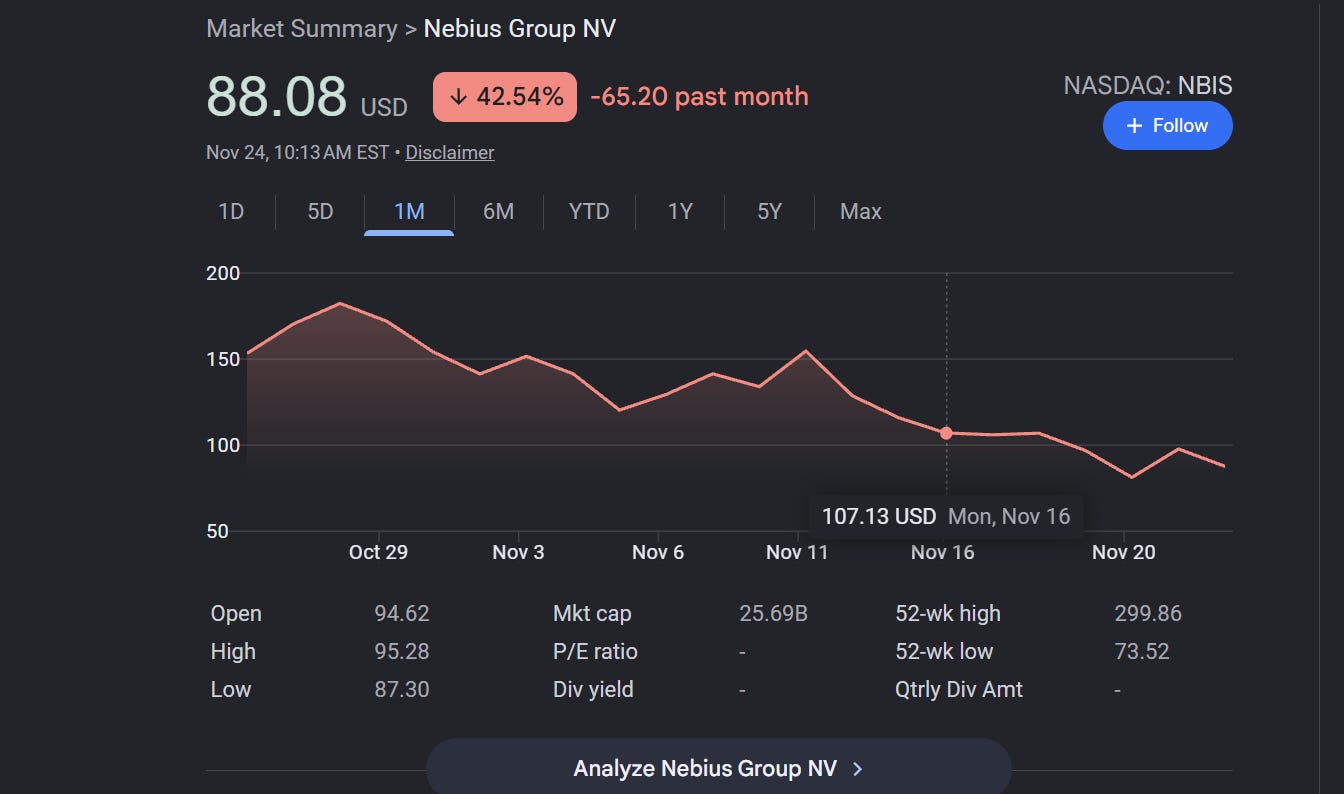
Nebius has had a bruising fortnight. Shares in the Nasdaq-listed AI cloud group closed at $154.69 on the eve of third-quarter results and ended Friday at $83.25, down 46 per cent in seven sessions. Revenue rose 571 per cent to $981mn, but power delays at a leased site in Vineland, New Jersey, pushed December revenue into 2027 and forced a cut to 2026 guidance. Investors also balked at plans to spend $40bn to $45bn next year, about 1.7 times the company’s market value.
That figure would make Nebius the biggest builder among the neoclouds; CoreWeave says its 2027 capex would stay at $37bn to $39bn if it builds only for committed contracts. What the sell-off overlooks is who is paying for the build, and what Nebius plans to sell on top of it.
The deals
The order book has been transformed in little more than a year. Microsoft signed a $17.4bn five-year contract in September 2025. Meta followed with $3bn in November, then in March committed up to $27bn over five years: $12bn of dedicated capacity from early 2027, much of it on Nvidia’s new Vera Rubin chips, plus up to $15bn for capacity other customers do not take. Days earlier Nvidia had invested $2bn in the company.
The third quarter brought a different kind of customer. Databricks, Datadog and Snowflake signed their first agreements, and Palantir named Nebius a preferred cloud partner. These are software companies that sell AI to large enterprises, which spreads the risk beyond a handful of model builders. Since July, customers have committed more than $12bn of contract value.
The terms are improving as well. Annual contract value passed $25mn per megawatt, up from $20mn to $25mn in the second quarter, and the average GPU-hour price rose by more than a fifth. More than 90 per cent of contract value signed in the quarter came with prepayments, which on those deals covered more than the full capital cost of the capacity. “Our customers are committing to us for longer, at higher prices, and they’re paying more upfront,” said Arkady Volozh, chief executive.
Two caveats apply. Meta still accounts for up to $27bn of a $38.7bn backlog, and three customers made up about 70 per cent of third-quarter revenue. That backlog rose only 3 per cent in the quarter despite the new signings, a gap the company has yet to fully explain.
The token factory
The clearest sign of Nebius’s ambition is a product most investors skim past. Token Factory, launched in November 2025 to replace Nebius AI Studio, sells inference rather than raw computing power. Customers run open-source or their own models through an API that works like OpenAI’s, paying per token instead of renting GPUs by the hour. Dedicated endpoints carry a 99.9 per cent uptime guarantee. The service competes with Microsoft’s Azure AI Foundry and Amazon’s Bedrock, putting a company worth about $24bn up against two of the world’s largest.
It is small but growing fast. Contract value rose 17-fold in the third quarter, admittedly from a low base, and the service is approaching an annual run rate of several hundred million dollars. Management says margins are better than at rival inference providers because Nebius runs on its own chips rather than rented ones.
The strategic value is greater than the revenue. Token Factory is the bottom rung of a ladder: customers start by paying per token, move to reserved capacity and end up on dedicated clusters. That is how the large cloud providers lock in customers, and it is why Volozh’s shareholder letter describes a “hyperscaler model, engineered as one system”.
Owning the ground
The model depends on control of the physical layer. Most of next year’s new gigawatt will sit on sites where, in Volozh’s words, “our own team does everything, land, power, shell, hardware, software and operations”, in Missouri, Alabama and two locations in Finland. The third quarter supported that choice: the delays were at leased sites, while owned sites ran “on track and even ahead of schedule”. CoreWeave, by contrast, has grown largely by leasing other companies’ buildings.
Funding is the open question. The finance chief expects prepayments and asset-backed loans to cover 75 to 85 per cent of 2027 spending, leaving up to about $11bn to find, after a $5.75bn convertible bond and share sales this year. At about two times next year’s forecast sales, the market is pricing Nebius as another leveraged landlord. Its customer list and Token Factory are its best evidence that it is building something more.
Disclaimer: All views expressed are my own and are provided solely for informational and educational purposes. This is not investment, legal, tax, or accounting advice, nor a recommendation to buy or sell any security. While I aim for accuracy, I cannot guarantee completeness or timeliness of information. The strategies and securities discussed may not suit every investor; past performance does not predict future results, and all investments carry risk, including loss of principal.
I may hold, or have held, positions in any mentioned securities. Opinions herein are subject to change without notice. This material reflects my personal views and does not represent those of any employer or affiliated organization. Please conduct your own research and consult a licensed professional before making any investment decisions.