

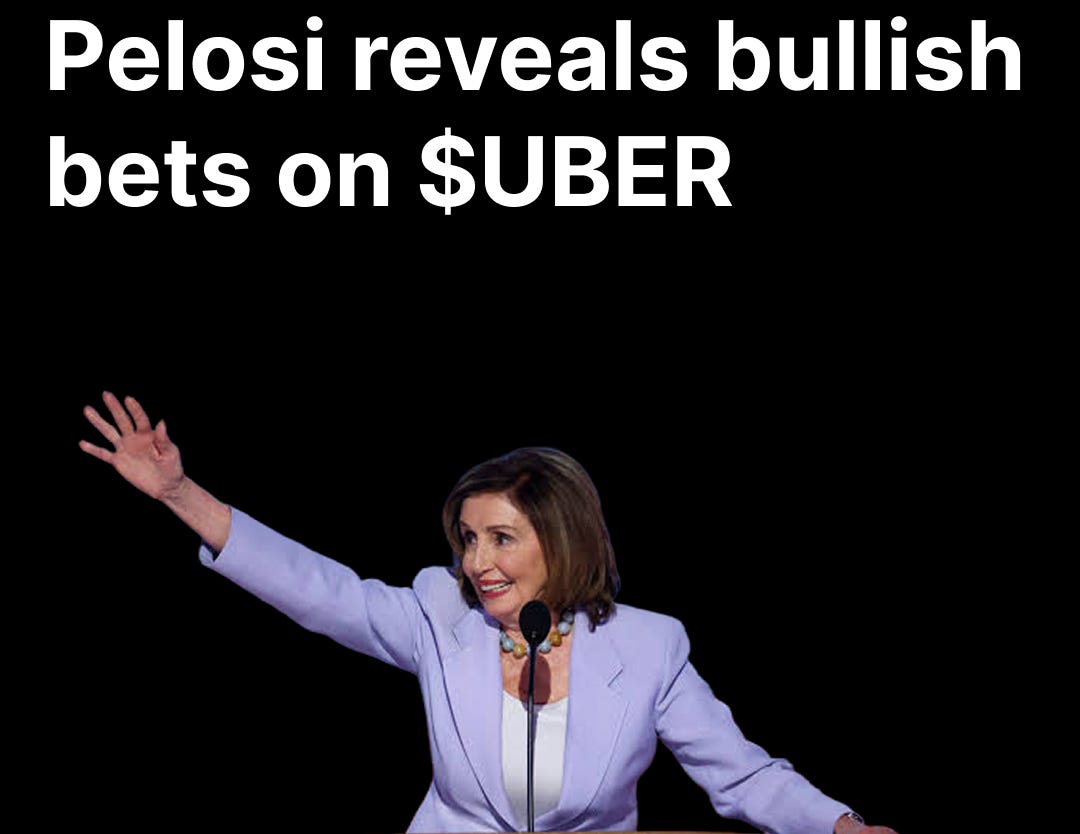
Uber has spent most of 2026 as the stock people love to worry about. Shares are down double digits for the year and sit around $74. That is well off the 52-week high near $102. Yet the company keeps posting impressive numbers. Gross bookings jumped 21% year over year. Non-GAAP earnings per share climbed 44%. Management returned a record $3 billion to shareholders in a single quarter. The market seems to be bracing for bad news while the actual data tells a different story. Nancy Pelosi’s household recently disclosed a new call option position in Uber. Let us explore the underlying business mechanics driving that kind of interest.
The Robotaxi Threat Explained
The primary fear surrounding Uber is easy to understand. Robotaxis are hitting the streets and Waymo is scaling operations fast. The worry is that human drivers will soon become obsolete. Waymo currently handles about 500,000 paid rides a week across ten cities. That is a massive jump from 250,000 just a year ago. Skeptics look at that growth chart and assume a traditional ride-hailing network will lose its market dominance.
A Supply Problem Rather Than a Demand Issue
A closer look reveals a major limitation in the autonomous vehicle narrative. Waymo is achieving explosive ride growth with a fleet of roughly 3,000 vehicles. Three thousand cars are currently serving the entire United States. Analysts tracking California ride data recently noticed growth slowing down in Waymo’s most mature markets. People still want rides, but there are simply not enough cars available. Wait times are increasing in dense urban areas. The industry faces a severe supply constraint. Winner-take-all markets rarely belong to the company with the fewest vehicles.
Uber CEO Dara Khosrowshahi addressed this reality directly during the first-quarter earnings call. When asked what holds back autonomous scaling, he pointed to fleet size, safety validation, and local regulatory approvals. The bottleneck is getting physical cars on the road in each new city. Building, insuring, financing, and deploying these fleets at scale requires massive capital and infrastructure. Uber spent the last two years quietly positioning itself as the operational solution to this exact problem.
Positioning to Win the Autonomous Vehicle Race
Uber does not actually need to invent the best self-driving technology. Management is structuring the business to generate revenue regardless of which tech company succeeds. The platform currently holds partnerships or investments touching more than 30 autonomous vehicle companies. That list includes Waymo, Zoox, Nuro, Avride, WeRide, Pony.ai, Baidu, Momenta, and Wayve. Uber also made fresh multibillion-dollar commitments to own physical fleets through Rivian and Lucid.
The company recently launched Uber Autonomous Solutions. This division offers the operational backbone for any autonomous vehicle creator that wants to avoid building physical infrastructure from scratch. Uber handles fleet management, depots, financing, and insurance. Khosrowshahi views autonomous vehicles as a trillion-dollar opportunity because his platform gets paid whether Waymo, Zoox, or a newer startup wins the market. Institutional investors seem to recognize this unique positioning.
Following the Institutional Money
Large funds continue to build significant stakes in the company. Bill Ackman made Uber the single largest position in his Pershing Square portfolio at roughly 18.5%. It now sits ahead of Brookfield. Ackman frequently praises the company for its high-quality business model and management team. David Tepper added to his Appaloosa Management stake during the first quarter. Uber also increased its own ownership in Delivery Hero to nearly 20%, showing internal conviction in the global delivery market.
Financial circles recently noticed a notable congressional disclosure. Nancy Pelosi’s household purchased 200 Uber call options on May 29. These options carry a $50 strike price and expire in March 2027. Uber traded near $74 at the time of the filing. Those options immediately held about $24 a share in intrinsic value. Congressional trading records are strictly educational data points, not guaranteed investment advice. A politician’s spouse buying a stock does not ensure future success. However, a long-dated, high-conviction bet during a period of double-digit stock decline indicates serious confidence. Someone with a nine-month time horizon viewed the recent weakness as a buying opportunity.
The Long-Term Financial Setup
The foundational business remains highly robust. The core ride-hailing and delivery segments are compounding at 20% or more in bookings growth. The Uber One membership program now boasts 50 million members and is growing 50% annually. This subscription model successfully locks in the highest-spending customers on the platform. Recent insurance cost relief is also beginning to drive accelerated trip growth within the United States.
The autonomous vehicle strategy allows the company to profit from industry-wide supply constraints instead of betting everything on a single technology. The stock currently trades at under 19 times trailing earnings. Wall Street maintains an average price target north of $100, representing more than 35% upside from current levels.
Markets frequently price in existential fears long before acknowledging solid financial results. Uber is actively solving the supply bottleneck for a massive global industry. Owning the platform that powers the entire ecosystem presents a compelling alternative to guessing which single robotaxi manufacturer will eventually dominate the streets.
Sources:
Uber Technologies, Inc. Q1 2026 Earnings Release (SEC 8-K) — https://www.sec.gov/Archives/edgar/data/0001543151/000154315126000019/uberq126earningspressrelea.htm
Uber Q1 2026 Prepared Remarks (Investor Relations) — https://s23.q4cdn.com/407969754/files/doc_earnings/2026/q1/transcript/Uber-Q1-26-Prepared-Remarks.pdf
CNBC, “Uber (UBER) 2026 Q1 earnings” — https://www.cnbc.com/2026/05/06/uber-uber-2026-q1-earnings.html
TechCrunch, “Waymo’s skyrocketing ridership in one chart” — https://techcrunch.com/2026/03/27/waymo-skyrocketing-ridership-in-one-chart/
TechCrunch, “Uber wants to be a Swiss Army Knife for robotaxis” — https://techcrunch.com/2026/02/23/uber-autonomous-solutions-av-robotaxi-delivery-robots/
Uber Investor Relations, “Uber Unveils Uber Autonomous Solutions to Accelerate Autonomous Mobility & Delivery Worldwide” — https://investor.uber.com/news-events/news/press-release-details/2026/Uber-Unveils-Uber-Autonomous-Solutions-to-Accelerate-Autonomous-Mobility--Delivery-Worldwide/default.aspx
The Motley Fool, “Billionaire Bill Ackman Is Loading Up on Uber Technologies Stock. Should You?” — https://www.fool.com/investing/2025/06/03/billionaire-bill-ackman-is-loading-up-on-uber-tech/
GuruFocus, Bill Ackman / Pershing Square Q1 2026 13F portfolio — https://www.gurufocus.com/guru/bill+ackman/current-portfolio/portfolio?view=table
Seeking Alpha, “Tracking David Tepper’s Appaloosa Management Portfolio – Q1 2026 Update” — https://seekingalpha.com/article/4908974-tracking-david-teppers-appaloosa-management-portfolio-q1-2026-update
Bloomberg, “Uber Raises Delivery Hero Stake to 19.5%, Rules Out Takeover for Now” — https://www.bloomberg.com/news/articles/2026-05-18/uber-boosts-stake-in-delivery-hero-says-no-takeover-for-now
Quiver Quantitative, Nancy Pelosi congressional trade disclosure (Uber, May 29, 2026) — https://www.quiverquant.com/congresstrading/trade/House-P000197-220
TheStreet, “Nancy Pelosi places big bets on two surging tech stocks” — https://www.thestreet.com/investing/stocks/nancy-pelosi-uber-intel-call-options
Disclaimer:
All views expressed are my own and are provided solely for informational and educational purposes. This is not investment, legal, tax, or accounting advice, nor a recommendation to buy or sell any security. While I aim for accuracy, I cannot guarantee completeness or timeliness of information. The strategies and securities discussed may not suit every investor; past performance does not predict future results, and all investments carry risk, including loss of principal.
I may hold, or have held, positions in any mentioned securities. Opinions herein are subject to change without notice. This material reflects my personal views and does not represent those of any employer or affiliated organization. Please conduct your own research and consult a licensed professional before making any investment decisions.