

Enterprise data storage has moved away from a hardware-centric model limited by mechanical constraints. It has entered a software-defined era where flash management and flexible payment options determine performance. Two different architectural philosophies stand at the center of this shift. One is the DirectFlash, subscription-based approach from Pure Storage. The other is the container-based, active-active architecture of Dell Technologies’ PowerStore.
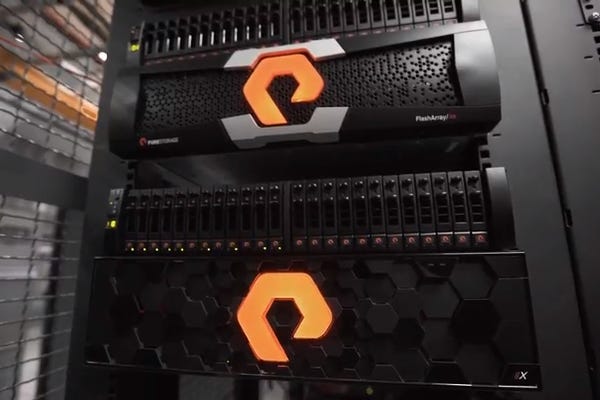
The Pure Storage Growth Story
Pure Storage began in 2009 as a pioneer in enterprise all-flash technology. Over the last five years, the company has achieved a compounded annual revenue growth rate of 15.8%. This reflects significant gains in market share against legacy vendors. The company reached a major financial milestone in fiscal year 2025 when total revenue surpassed $3 billion for the first time.
A shift from traditional hardware sales to subscription-based services fueled this growth. By the end of 2025, the subscription annual recurring revenue (ARR) for Pure Storage reached $1.7 billion. That figure represents a 21% increase year-over-year. The company now serves more than 13,000 customers. This includes 60% of the Fortune 500. Through it all, they have maintained an industry-leading Net Promoter Score (NPS) of 81.
Pure Storage Technology: The DirectFlash Distinction
The core of Pure Storage’s technology is DirectFlash®, a proprietary solution for managing flash. Competitors typically use commodity-off-the-shelf (COTS) solid-state drives (SSDs) that mimic legacy hard drives. Pure Storage takes a different path by building its own DirectFlash Modules (DFMs).
Standard SSDs use a Flash Translation Layer (FTL) inside the firmware to manage wear leveling and garbage collection. This creates “black box” heuristics that the storage operating system cannot see, which leads to unpredictable latency. Pure Storage eliminates the FTL at the drive level. This allows its Purity Operating Environment to manage NAND flash directly. The architecture offers several benefits:
Deterministic Latency: By coordinating I/O patterns globally, Pure maintains consistent latency as low as 150 microseconds.
Superior Efficiency: DFMs provide two to three times better storage density. They also consume 39% to 54% fewer watts per terabyte compared to standard SSD-based arrays.
Enhanced Reliability: Reducing firmware complexity and removing drive-level garbage collection helps DFMs achieve failure rates three to four times lower than commodity SSDs.
Future Capacity: Pure has announced a roadmap to deliver 300TB DFMs by 2026. This pace significantly outruns standard SSD capacity curves.
Pure Storage vs. Dell PowerStore: Comparing Architectures
Pure Storage focuses on proprietary media management, while Dell PowerStore uses a modern, container-based software architecture built for agility.
Controller Architecture
Dell highlights its Autonomous Active/Active Architecture. Both controllers in an appliance remain fully active and provide balanced access to drives. Dynamic Node Affinity (DNA) supports this by rebalancing workloads across nodes to stop bottlenecks. Critics and competitors often describe Pure’s architecture as Active/Passive or Active/Standby. While both controllers can accept front-end I/O, only one manages the media at a time. Pure defenders argue this is a deliberate choice to ensure 100% performance maintenance if a controller fails.Performance and Scalability
PowerStore can reach up to 4 million IOPS in a four-node cluster. It features AppsON, which lets administrators run VMware virtual machines directly on the storage appliance to lower latency. Pure Storage uses FlashArray for block and file workloads and FlashBlade for unstructured data. FlashBlade//Exa is designed specifically for AI scale. It delivers over 10 TB/s of throughput to support massive GPU environments.Data Reduction and Resiliency
Both platforms provide strong data reduction. Dell offers a 5:1 data reduction guarantee on reducible data, supported by hardware-assisted compression via Intel QuickAssist. Pure provides a Right-Size Guarantee and uses granular software-defined deduplication to remove duplicate blocks before writing them to flash. For resiliency, Dell uses the Dynamic Resiliency Engine (DRE) to allow scaling in single-drive increments. Pure relies on RAID-HA and SafeMode snapshots to protect against concurrent drive failures and ransomware.
Operational Economics: Evergreen vs. APEX
Long-term ownership models are a major point of comparison. Pure Storage’s Evergreen® subscription changed the industry by letting customers upgrade controllers and media non-disruptively. This avoids re-purchasing capacity or performing “forklift upgrades” so the storage stays perpetually modern.
Dell counters with the APEX portfolio and the Lifecycle Extension program. APEX offers cloud-like consumption for on-premises infrastructure, meaning organizations pay for what they use. Dell’s Lifecycle Extension provides flexible controller upgrade paths. However, some users note that the model from Pure offers more comprehensive media trade-in and upgrade benefits.
Expert Perspectives and Market Sentiment
Professional feedback points to distinct strengths for each vendor. Pure Storage is often praised for proactive support. The Pure1® management system frequently alerts users to potential firmware or performance issues before they cause an impact. Users describe the platform as “simple” and “rock-solid.”
Dell PowerStore is recognized for flexibility and scalability. It also integrates deeply with the broader Dell and VMware ecosystem. Pure is often viewed as a premium-priced investment, while Dell PowerStore is frequently noted for having a 25% lower initial acquisition cost for similar performance tiers. Pure argues that its Total Cost of Ownership (TCO) is superior over a decade because it eliminates data migrations and lowers power and cooling requirements.
Strategic Synthesis: Choosing the Right Path
Deciding between Pure Storage and Dell PowerStore often depends on specific organizational priorities.
Choose Pure Storage if the goal is deterministic performance, maximum energy efficiency, and a simplified lifecycle. This suits a “buy once, upgrade forever” philosophy that eliminates technical debt.
Choose Dell PowerStore if the organization needs deep virtualization integration via AppsON, a broad feature set across block and file, and the ability to scale within a massive, unified Dell ecosystem.
As the industry moves toward 2026, the battle for dominance is increasingly fought in the AI arena. Dell claims its PowerScale AI nodes offer significantly faster data ingestion. Pure asserts its FlashBlade//Exa architecture requires far less rack space and power to support equivalent NVIDIA GPU clusters. This competition ensures that both Purity and PowerStoreOS will continue to evolve as the software-defined heart of the modern data center.
Disclaimer:
All views expressed are my own and are provided solely for informational and educational purposes. This is not investment, legal, tax, or accounting advice, nor a recommendation to buy or sell any security. While I aim for accuracy, I cannot guarantee completeness or timeliness of information. The strategies and securities discussed may not suit every investor; past performance does not predict future results, and all investments carry risk, including loss of principal.
I may hold, or have held, positions in any mentioned securities. Opinions herein are subject to change without notice. This material reflects my personal views and does not represent those of any employer or affiliated organization. Please conduct your own research and consult a licensed professional before making any investment decisions.