

Tesla’s new Roadster is a merger advertisement with a steering wheel, and its timing says more about Tesla’s valuation than about its engineering.
Last Thursday, at SpaceX’s test site in McGregor, Texas, Tesla finally showed the car it first promised in 2017. It drove upside down along a ramp using suction, launched itself, barrel-rolled in midair and landed on ten cold-gas thrusters fed by roughly 250 kilograms of compressed air. Later it hopped a line of six vehicles, including a Semi cab. The “Thrust” edition takes a $250,000 deposit. Production is promised for 2028.
It was a spectacular show, but the product barely mattered. The real message was in the hardware: SpaceX parts in a Tesla body, at a SpaceX site, with a mannequin in a SpaceX suit at the wheel. Deepwater’s Gene Munster read the night the same way, as fresh evidence that Musk is impatient to combine the two companies. The question is why now.
A valuation built on two bets
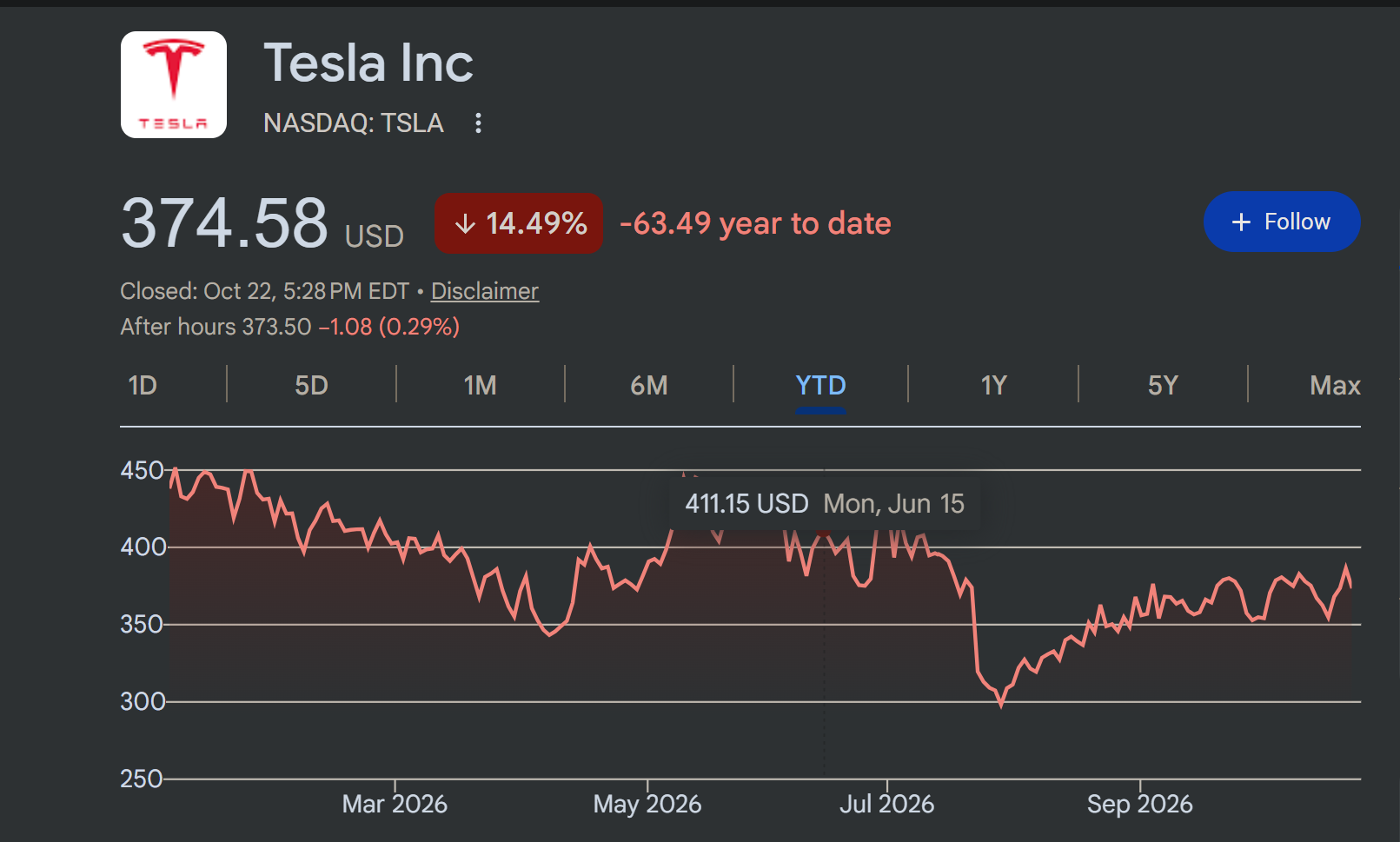
Tesla is not priced as a carmaker. By various analyst counts it trades at around 200 times expected 2026 earnings, while net income has been falling. Bank of America’s sum-of-the-parts model attributes about 45% of Tesla’s value to Robotaxi and 19% to Optimus. Strip those out and the multiple has nothing to stand on.
The first bet, autonomy, is suffering from its own success. Back in 2020, Tesla’s former Autopilot hardware chief Jim Keller argued on Lex Fridman’s podcast that driving is closer to a ballistics problem than skeptics assume: track objects, predict their paths, act. Fridman pushed back on the messy human element, but the industry has since moved toward Keller’s view.
That is good news for riders and bad news for Tesla’s moat. Tesla’s big bet was an “end-to-end” system. Instead of engineers hand-writing rules for every situation, one neural network watches millions of hours of human driving and learns to turn camera images straight into steering and braking. Once the world knows that works, it stops being a secret. Anyone with enough driving data and computing power can follow the same recipe, and the engineers who built Tesla’s version have spread across Silicon Valley. Tesla’s unsupervised robotaxis in Austin, Dallas and Houston prove the approach works. They also prove it can be copied. A solved problem becomes a commodity, and commodities do not earn 200-times multiples.
Optimus has company
The second bet, Optimus, faces rivals who are already shipping. On the April earnings call, Musk said Fremont would begin Optimus production in late July or August. By mid-July, an industry review found it had not started.
Meanwhile, Figure’s robots are on BMW’s Spartanburg line, billed by the operating hour, and its BotQ plant turns out a new unit roughly every 90 minutes. In China, Unitree shipped more than 5,500 humanoids in 2025, about a third of the global market by units, and lists its G1 on Amazon for under $18,000.
Unitree’s robots doing kung fu and backflips at this year’s Spring Festival gala looked like a stunt. Its business is still mostly sales to universities and labs, and its first-quarter profit fell by half. But stunts are how this category starts. Unitree sits inside the world’s densest supply chain for motors, actuators and batteries, backed by a deep engineering bench and state support. When the next generation of physical-AI models makes humanoid software broadly available, the winner may be whoever builds the cheapest reliable body. That race does not obviously favor Tesla.
Why merge before the repricing
If both bets are losing their edge, Tesla’s premium is worth most today. That is where SpaceX comes in. SpaceX absorbed xAI in February, then raised a record $75 billion in a June IPO that valued it at $1.77 trillion. Starlink gives it something Tesla’s story lacks: a cash-generating near-monopoly, with $1.66 billion of connectivity operating income in the second quarter alone.
Musk has stopped dismissing the idea. On Tesla’s July earnings call he cited growing overlap with SpaceX and said any combination would need a proper process. On October 14, Barclays analyst Dan Levy suggested a deal could be announced before Tesla’s annual meeting, due by December 6. Barclays sees an all-stock acquisition of Tesla by SpaceX as the likeliest structure, with an illustrative ratio of about 0.7 SpaceX shares per Tesla share.
The math explains the urgency. In an all-stock deal, Tesla’s share of the combined company depends on Tesla’s price at signing. Merge at today’s multiple and Tesla holders get a large slice of a company anchored by rockets and satellites. Wait until the market reprices autonomy and robotics, and that slice shrinks. Musk, who holds far more voting control at SpaceX than at Tesla, would also tighten his grip on the whole. The flying Roadster is the pitch to the shareholders who would have to approve it.
What would prove this wrong
This is an argument about motive, and Musk may simply love rocket cars. The thesis weakens if Tesla’s robotaxi fleets hit the 50%-plus gross margins management promises, or if Optimus reaches paying outside customers in 2027 ahead of Figure and Unitree. It also weakens if December passes without a deal.
Until then, watch the proxy filings more closely than the deposit page. No merger agreement has been confirmed. But the Roadster’s thrusters were never really pointed at the road. They were pointed at Tesla’s shareholders, and the clock they are racing is the one on Tesla’s multiple.
Disclaimer:
All views expressed are my own and are provided solely for informational and educational purposes. This is not investment, legal, tax, or accounting advice, nor a recommendation to buy or sell any security. While I aim for accuracy, I cannot guarantee completeness or timeliness of information. The strategies and securities discussed may not suit every investor; past performance does not predict future results, and all investments carry risk, including loss of principal.
I may hold, or have held, positions in any mentioned securities. Opinions herein are subject to change without notice. This material reflects my personal views and does not represent those of any employer or affiliated organization. Please conduct your own research and consult a licensed professional before making any investment decisions.