

$TCEHY
• Thesis. Tencent’s established businesses are growing operating profit at 19% on a 42% margin. Reported growth is 9% because roughly RMB 10.5 billion a quarter is being spent on new AI products.
• Valuation. At HK$421 the shares trade at about 13 times forward earnings, against a consensus target near HK$664. Investors are capitalising the cost of the AI programme and assigning little value to its output.
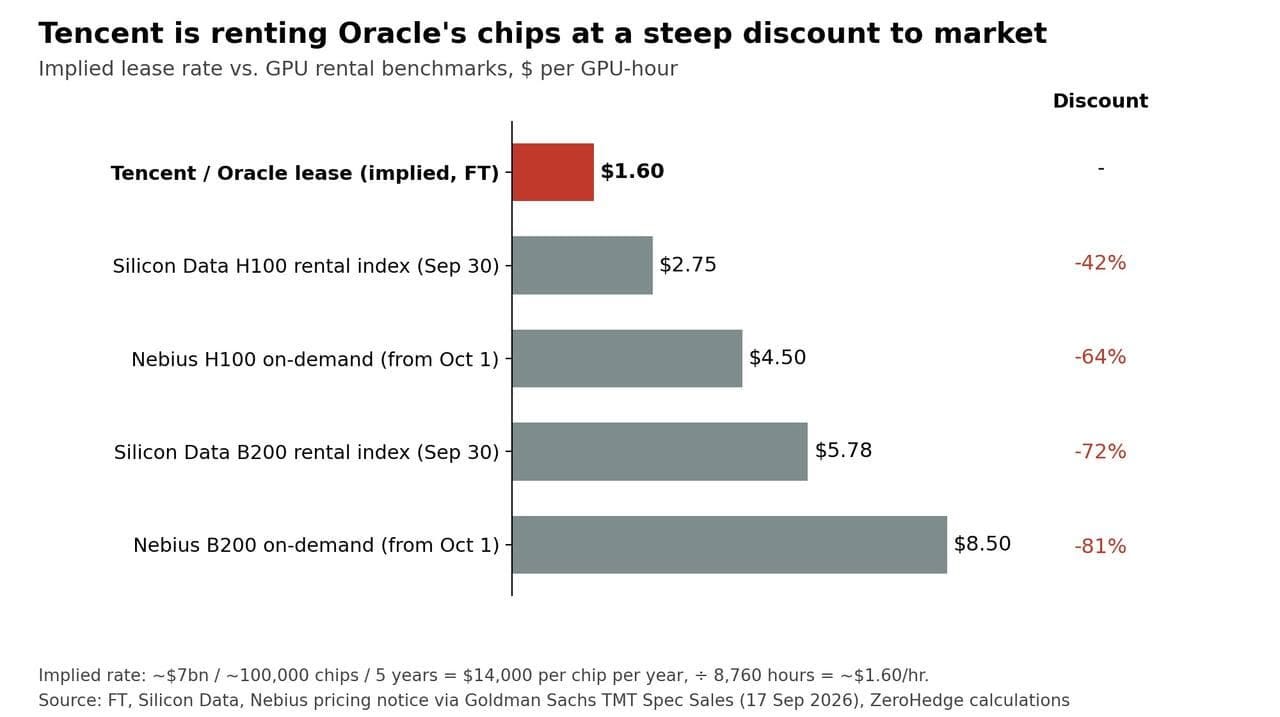
• Catalyst. A reported five-year, $7 billion lease of 100,000 chips from Oracle addresses the group’s binding constraint, compute supply, at an implied cost of about $1.60 per chip-hour.
• Precedent. Meta in October 2025: a highly profitable core, a sharp rise in capital spending, and an abrupt de-rating.
The setup
When Meta told investors last October that its spending on artificial intelligence would keep rising, its shares lost roughly 11% in a single session. Tencent is experiencing a slower version of the same repricing. The stock closed at HK$421.20 on October 2. In March it stood at HK$515, itself the result of a 6% fall on the day management said AI investment would double. Morgan Stanley lowered its target to HK$550 in August while keeping an overweight rating, and Citi’s target is HK$765. Analysts, in other words, remain constructive. It is the market that has lost patience.
The numbers
Second-quarter revenue rose 11% to RMB 204.8 billion. Operating capital expenditure reached RMB 51.8 billion, up 190% on the year and 66% on the quarter, and research spending rose 35%. Free cash flow was negative RMB 13.8 billion, though it would have been a positive RMB 37.6 billion before prepayments for compute. Net cash fell from RMB 146.9 billion to RMB 58.2 billion in three months.
Management now presents the group as two businesses, and the distinction is useful. The established franchises in games, advertising and payments earned RMB 86.1 billion of operating profit, up 19%. New AI products lost RMB 10.5 billion, compared with about RMB 8.8 billion in the first quarter. The equity is therefore a high-margin compounder attached to a large venture investment, and the share price reflects mainly the second.
On the second-quarter call, president Martin Lau argued that the spending carries “clear downside protection”: should Tencent’s own products disappoint, the capacity can be leased to others through Tencent Cloud. He said compute ordered only months earlier could already be sold at a premium of more than 30% and described the AI outlay as a two-year commitment and not a permanently rising budget. It is this last claim that skeptical investors doubt.
The catalyst: Oracle
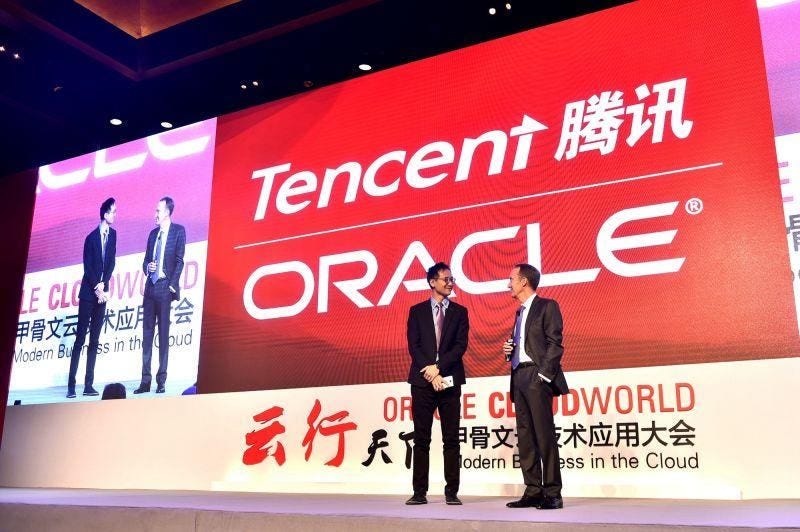
The Financial Times reported on September 30 that Tencent had agreed to lease roughly 100,000 advanced AI chips housed in Oracle data centers across Southeast Asia. The contract runs for five years and is valued at about $7 billion, with around 30% paid in advance. It is the group’s largest overseas lease. The shares have fallen since, which suggests the market has not given the agreement much weight.
The arithmetic is favorable. Spread across 100,000 chips and five years, $7 billion equates to $14,000 per chip per year, or about $1.60 per chip-hour. The entire contract costs roughly what Tencent spent on capital expenditure in a single quarter. It also secures hardware the group cannot purchase at home: US export controls prohibit the sale of such chips to Chinese buyers but, for now, do not prevent them from renting capacity abroad.
The timing matters as much as the price. Tencent’s cloud revenue growth accelerated to the low 20s in percentage terms last quarter even as management acknowledged it was short of capacity. Where supply is the limiting factor, a five-year contract for supply is itself a strategic asset.
The risk is real. Neither company has confirmed the terms, and the leasing route remains open only for as long as Washington allows it. Were that to change, about $2 billion of prepayment would be held offshore by an American counterparty.
The moat
Leased compute is valuable only to a company with products to run on it, and here Tencent is well placed. Hunyuan 3, its foundation model, is in production, with daily token usage about six times that of the preview version. A larger successor, Hunyuan 4, is due before the end of the year. WorkBuddy and CodeBuddy are the most heavily used AI productivity tools in China by monthly interactions, and management says gross margins on paying users are already comparable to those of Tencent Cloud as a whole. Xiaowei, an agent being built into Weixin, draws on the app’s payments, mini programs and 1.4 billion users, a distribution advantage no domestic rival can match. The least glamorous application is already contributing AI-driven ad targeting helped lift marketing revenue 22%.

Demand check: the peer read-across
The obvious question is whether the demand is real. Alibaba offers the clearest evidence. Its cloud unit’s external revenue grew 45% in the June quarter, the fastest pace in 22 quarters, on RMB 67.7 billion of capital expenditure. Chief executive Eddie Wu told investors that growth would accelerate further as supply increased. Both groups are describing the same condition: demand that exceeds what they can power. On current cloud demand, Alibaba ranks first and Tencent second. Alibaba’s advantage is its in-house chips. Tencent’s is distribution, and the Oracle lease is its means of closing the supply gap.
Bear case
• Spending persists. The two-year commitment becomes a standing one. Morgan Stanley already forecasts RMB 200 billion of capital expenditure in both 2026 and 2027, with earnings broadly flat through 2027.
• The model falls short. Hunyuan fails to reach the frontier, and token pricing is commoditized.
• Policy shifts. Washington closes the overseas leasing route.
• The economy weighs. Chinese consumer and advertising demand remain uneven, as management itself has noted.
• The balance sheet thins. Net cash continues to decline and the buyback is cut.
Bottom line
This is the Meta trade with a China discount applied. A highly cash-generative core is funding an expensive build, and the market is pricing the whole of the cost and little of the return. Third-quarter results in November are the next test. Three figures will matter most: the loss on new AI products, the rate of cloud growth, and whether capital expenditure eases from RMB 51.8 billion or continues to rise.
Disclaimer:
All views expressed are my own and are provided solely for informational and educational purposes. This is not investment, legal, tax, or accounting advice, nor a recommendation to buy or sell any security. While I aim for accuracy, I cannot guarantee completeness or timeliness of information. The strategies and securities discussed may not suit every investor; past performance does not predict future results, and all investments carry risk, including loss of principal.
I may hold, or have held, positions in any mentioned securities. Opinions herein are subject to change without notice. This material reflects my personal views and does not represent those of any employer or affiliated organization. Please conduct your own research and consult a licensed professional before making any investment decisions.