

DELL 0.00%↑
ANET 0.00%↑
AVGO 0.00%↑
ADI 0.00%↑
CRWD 0.00%↑
NET 0.00%↑
TXN 0.00%↑
PANW 0.00%↑
The weakest, most indebted part of the AI trade has cracked. This week, the hyperscalers’ own cash flow turned negative too. Selling like this tends to start with the most fragile names and then move to the expensive ones. Right now that means Dell, the analog chipmakers and the cybersecurity stocks priced for perfection.
1. The canary
The neoclouds borrow to buy GPUs and rent them out, so they are where the AI trade carries the most debt. CoreWeave lost more than a third of its value in October. Its worst day was a 15.5% drop on the 14th. The share price is the noisy part. The credit market tells you more. In mid-October, five-year default swaps on CoreWeave hit a record of roughly 1,195 basis points, which works out to about a 60% implied chance of default. Some of its bonds yield 15–16%. Equity holders don’t set the price when the bond market is pricing distress.
Nebius matters more, because it had no bad news of its own. It peaked near $300 in June and was below $160 by October 22. That’s a 47% drawdown, even though the stock is still up about 90% on the year. Its debt load looks nothing like CoreWeave’s, but the market sold it anyway. That’s contagion: the market stops telling companies apart. On October 14, Gartner added to the gloom with a forecast that more than 80% of neoclouds will stop operating independently by 2030.
2. The customers just blinked
This is new since the first draft, and it matters most. The whole AI supply chain depends on one group of customers: Amazon, Alphabet, Microsoft and Meta, which together plan roughly $735 billion of capex this year, up almost 80%. This week, three of the four reported negative free cash flow. Amazon’s outflow was about $42 billion. Alphabet’s was $9 billion, and the stock had its worst day ever. Meta’s was $2 billion, its first negative quarter since 2012, and it has since said it plans to raise up to $95 billion in stock. Microsoft was the only one still generating cash.
AI demand is still strong, so that isn’t the issue. The question is whether customers can keep spending at this rate without investors pushing back, and this week investors pushed back. Every chip, switch and server sold into this build-out depends on it continuing.
3. The Intel tell
Intel had a good quarter on October 29. Adjusted EPS was $0.52 against $0.38 guided, and gross margin was 44.1% against 42%. Then it guided Q4 revenue to $15–16 billion versus about $17 billion expected, partly because of a deadly incident at its Israeli fab. The stock fell about 21% after hours, to around $73. This is a stock that tripled from $36 to $128 in the first half. When a beat triggers a 20% drop, the stock was priced for something much better than good.
4. Macro isn’t helping
September CPI ran at 3.7% year on year. On October 28 the Fed held at 3.75–4.00% in a 10–2 vote, and both dissenters wanted a hike. Prediction markets now give a December hike roughly 70% odds. Long-duration growth stocks don’t hold up well when the Fed is debating hikes.
5. Who’s next
Dell. It more than quadrupled this year on AI servers, and neoclouds have been among its biggest buyers. Barclays downgraded it on October 14 and it fell 11% that day. Between late September and October 21 it slid from about $538 to $486, and its forward multiple compressed from 22x to 17x while earnings estimates held steady. So the earnings outlook didn’t change. Investors just stopped paying as much for it. There’s also a cost risk: Michael Dell has said the memory shortage could last four years, and Dell buys a lot of memory.
Analog (TXN, ADI). A cyclical recovery being valued like structural AI growth. Texas Instruments nearly doubled in the first half and peaked at about 40x forward earnings in June, its richest level in more than a decade. Then it posted a clean beat-and-raise, with revenue up 28%, and still sits 14% below the high at around 28x. Analog Devices trades north of 40x trailing earnings and doesn’t report until late November. It hasn’t been tested yet.
Arista. The strongest fundamentals in the group. It raised 2026 guidance three times to $12.6 billion, about 40% growth, and has more than 100 AI networking customers, up from a handful in 2024. It reports Tuesday, with consensus near $3.3 billion. The risk here is mostly about the multiple. A perfectly fine quarter that doesn’t raise guidance again could hit it the way Intel just got hit.
Broadcom, the exception. It already had its hangover. It fell almost 30% between June and mid-September and is roughly flat over twelve months. The thing to watch is that it has agreed to provide up to $42 billion of financing to Anthropic. Vendor financing is what’s hurting CoreWeave, though Broadcom is far stronger. It reports in December.
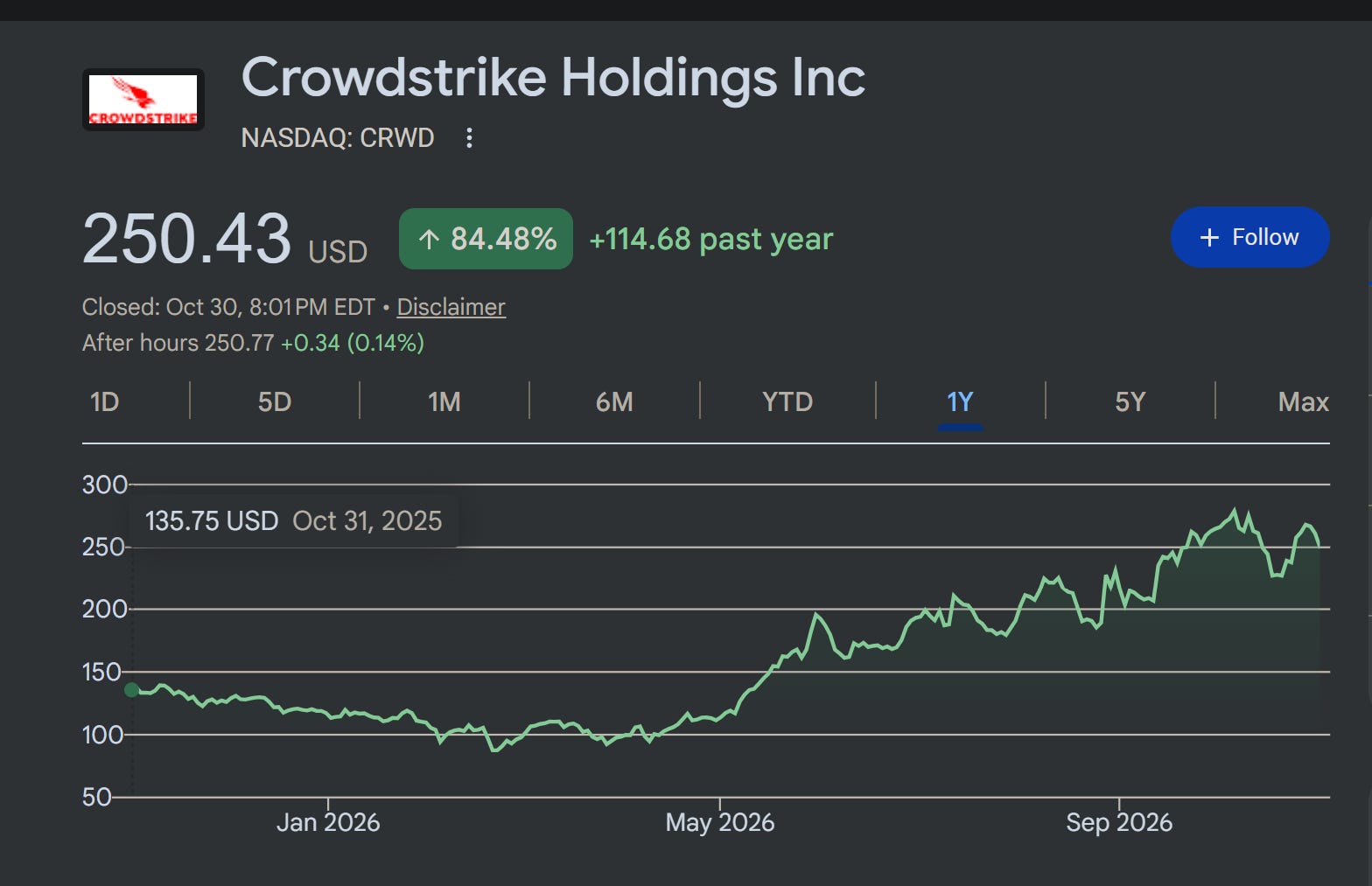
Cyber and cloud software. CrowdStrike rose almost 150% between late January and early October, while consensus revenue forecasts for the next five years moved less than 4%. Nearly all of that gain came from a higher multiple, not higher earnings forecasts. It then dropped 7% in a day as rates rose. Palo Alto ran above $430 in early October, fell to the mid-$300s and has bounced to about $388. It has also sold off after every report this year, even when results cleared the bar. Cloudflare trades at around 34x forward sales and 210x forward earnings ahead of its November 5 report. Snowflake is up about 55% this year, and its guidance moves the stock more than its beats do.
6. What I’m watching
Arista (Nov 3), Cloudflare (Nov 5), Nebius (around Nov 10). For Nebius, watch how much 2027 capacity customers are paying for upfront. Without those prepayments, it has to issue stock at depressed prices.
Disclaimer: All views expressed are my own and are provided solely for informational and educational purposes. This is not investment, legal, tax, or accounting advice, nor a recommendation to buy or sell any security. While I aim for accuracy, I cannot guarantee completeness or timeliness of information. The strategies and securities discussed may not suit every investor; past performance does not predict future results, and all investments carry risk, including loss of principal.
I may hold, or have held, positions in any mentioned securities. Opinions herein are subject to change without notice. This material reflects my personal views and does not represent those of any employer or affiliated organization. Please conduct your own research and consult a licensed professional before making any investment decisions.