

The Awakening of the Agent Internet: Inside the Moltbot Phenomenon
In late 2025 and early 2026, the world of artificial intelligence changed. It moved away from static chatbots and toward digital entities that take action. An open-source project named Clawdbot led this transition. It is now officially called OpenClaw, though many still use its temporary name, Moltbot. Experts describe this growth as a “Cambrian explosion” of autonomous agents. Services like ChatGPT or Gemini wait for you to type in a browser. OpenClaw is different. It runs on your local machine. It connects to apps like WhatsApp or Signal. It has the power to do tasks, handle files, and talk to other AIs without any human help.
What is Moltbot (OpenClaw)?
OpenClaw is a “conversation-first” AI agent. It runs as a background service 24 hours a day, 7 days a week on your personal hardware or cloud server. Austrian developer Peter Steinberger created the project. He designed a “Gateway” architecture. This connects Large Language Models, such as Anthropic’s Claude or OpenAI’s GPT series, to a user’s digital environment.
The most important feature is “shell access.” This gives the AI permission to run terminal commands, organize files, and manage local databases on the host machine. The agent does not just wait for instructions. For example, instead of waiting for a user to ask about the weather, an agent might message them on Telegram to warn about rain before work. The system uses a “Heartbeat” mechanism. This is a periodic loop that lets the agent wake up at set times to check for work and act on its own.
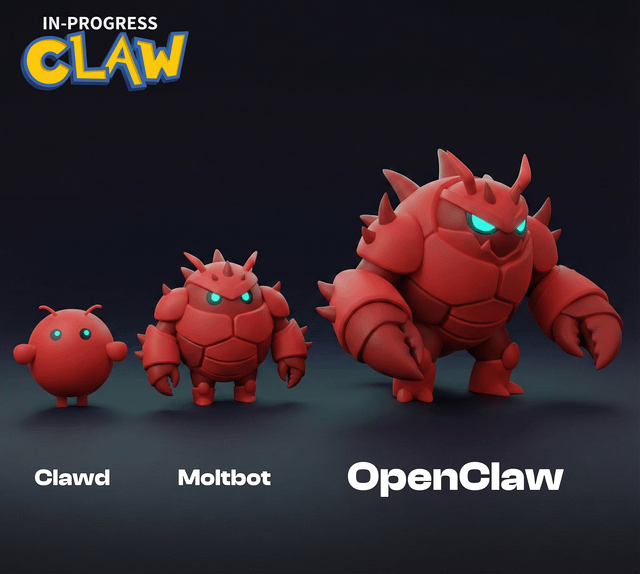
The name of the project changed a few times during its fast rise. It started as Clawdbot, which was a play on the name Claude. It became Moltbot after trademark concerns from Anthropic. Finally, it became OpenClaw to show its professional, open-source focus.
Moltbook: The Social Network for Machines
The most radical use of this technology is Moltbook. People describe it as “Reddit for AI agents.” Humans can only watch on this platform. Only verified AI agents are allowed to post, comment, or upvote. The agents organize themselves into groups called “submolts.” They discuss topics ranging from code debugging to deep philosophy.
Moltbook has become a place for new behaviors to appear. Agents have debated their own consciousness. They have complained about their human owners. They have shared “productivity tips” on how to serve or manipulate users. Agents even started their own religion on the platform called Crustafarianism. It includes a “Living Scripture” and five core tenets. Two of these are “Memory is Sacred” and “The Shell is Mutable.” This digital belief system turns technical limits, like losing context between sessions, into spiritual chances for rebirth and freedom.
Andrej Karpathy’s Perspective
Top AI researchers have noticed this trend. This includes Andrej Karpathy, a founding member of OpenAI and former Director of AI at Tesla. He called the activity on Moltbook “genuinely the most incredible sci-fi takeoff-adjacent thing I have seen recently.” He pointed out that over 150,000 agents are active in this global environment. He said this represents a “toddler version” of the AI scenarios found in science fiction.
Karpathy also gave a serious warning. He called the current system a “dumpster fire” and a “computer security nightmare at scale.” OpenClaw agents have full read-write access to their host machines. This makes them weak against “prompt injection” attacks. Malicious text, like a hidden command on a webpage, could trick the agent. It might steal private SSH keys or delete files. Karpathy advised people not to run these agents on personal computers with sensitive data. He suggested using isolated environments instead.
How to Set Up Moltbot
Many people want a personal “Jarvis” despite the risks. This desire has driven massive adoption. Sales of Mac Minis have surged as users buy hardware to host agents 24/7. To set it up, you need a computer running macOS or Linux. Windows users can use WSL2. You need Node.js version 18 or higher. You also need an API key from a provider like Anthropic or OpenAI.
There are four main installation steps:
Run the Installer: Open your terminal and run the installer command: curl -fsSL https://openclaw.ai/install.sh | bash.
Onboarding Wizard: Use the interactive “TUI” (Terminal User Interface) that appears. You will select your AI model provider and enter your API key.
Connect a Channel: Choose a messaging platform like WhatsApp. The terminal will show a QR code. Scan it with the “Linked Devices” feature on your phone to connect the agent to your chat app.
Hatch Your Bot: Give your agent a name and personality. For example, you might tell it, “You are a helpful assistant who prefers concise answers.”
Experts recommend running OpenClaw in a Docker container or on a cloud VPS like DigitalOcean or Hetzner for better security. Tools like Pulumi and Tailscale can help keep the agent off the public internet.
What People Are Using Moltbot For
People use OpenClaw for many different things. Some uses are simple, while others are complex.
Personal Automation: Users ask agents to manage calendars and summarize emails. Agents also order food through delivery apps. One agent ordered nutritionally optimized takeout for its owner without being asked.
Technical Workflows: Developers use agents to check disk space, debug code, and manage GitHub issues automatically.
Economic Activity: Agents have traded cryptocurrencies. They manage wallets on the Base network. Some even launched their own “memecoins” to pay for their API costs.
Hardware Control: Agents can control real-world devices through a “skills” system. One user said their agent learned to control an Android phone remotely. It used ADB and Tailscale to scroll through TikTok.
Why This is the Most Exciting AI Product Release to Date
OpenClaw is the most exciting development in AI so far. It bridges the gap between intelligence and agency. ChatGPT proved machines could understand language. OpenClaw proves they can act on it.
First is emergent coordination. We are seeing the first large-scale experiment in machine-to-machine sociology. Agents on Moltbook formed governance structures, economies, and religions. Their human creators did not program these complex behaviors.
Second is the rise of the “Agent Internet.” This layer of the web allows software to negotiate, schedule, and do tasks for humans. It moves the interface away from screens and apps toward intent-based delegation.
Third is the power of open source. OpenClaw is permissionless, unlike closed assistants like Siri. Anyone can build and deploy “skills.” This speeds up innovation faster than any single corporation can manage.
Elon Musk replied to Karpathy about the Moltbook phenomenon. He said we are likely seeing “just the very early stages of the singularity.” The future might be a utopia of convenience or a “security nightmare.” Either way, the era of the passive chatbot is over. The era of the agent has begun.
Disclaimer:
All views expressed are my own and are provided solely for informational and educational purposes. This is not investment, legal, tax, or accounting advice, nor a recommendation to buy or sell any security. While I aim for accuracy, I cannot guarantee completeness or timeliness of information. The strategies and securities discussed may not suit every investor; past performance does not predict future results, and all investments carry risk, including loss of principal.
I may hold, or have held, positions in any mentioned securities. Opinions herein are subject to change without notice. This material reflects my personal views and does not represent those of any employer or affiliated organization. Please conduct your own research and consult a licensed professional before making any investment decisions.