

Elon Musk confirmed during the Q4 2025 earnings call on Wednesday that Tesla will discontinue the Model S and Model X in the second quarter of 2026. This move marks the clear end of the company’s first era. The announcement serves as a symbolic and operational “burning of the ships.” It signals to the market that Tesla is no longer just an automaker dealing with falling sales and smaller margins. Instead, it is transforming into a high-growth “physical AI” enterprise that is betting its future on humanoid robotics and autonomous transport.
Automotive revenue is contracting for the first time in the company’s history. To handle this, Tesla is using its massive market capitalization and potential cross-corporate consolidations. The goal is to bridge the gap between its automotive past and a robotic future.
The “Honorable Discharge” of the Legacy Fleet
The Model S and Model X defined the premium electric vehicle market for over a decade. However, ending their production is a strict financial decision based on industrial economics. In 2025, Tesla reported its first annual revenue decline. Total revenue fell 3% to $94.8 billion, and automotive revenues dropped 11% in the fourth quarter alone.
These legacy models had become minor details in Tesla’s delivery reports. By the end of 2025, the Model S and X combined made up less than 3% of Tesla’s total vehicle production. In Q4 2025, sales for the Model S fell 52.6% compared to the previous year, totaling just 5,889 units.
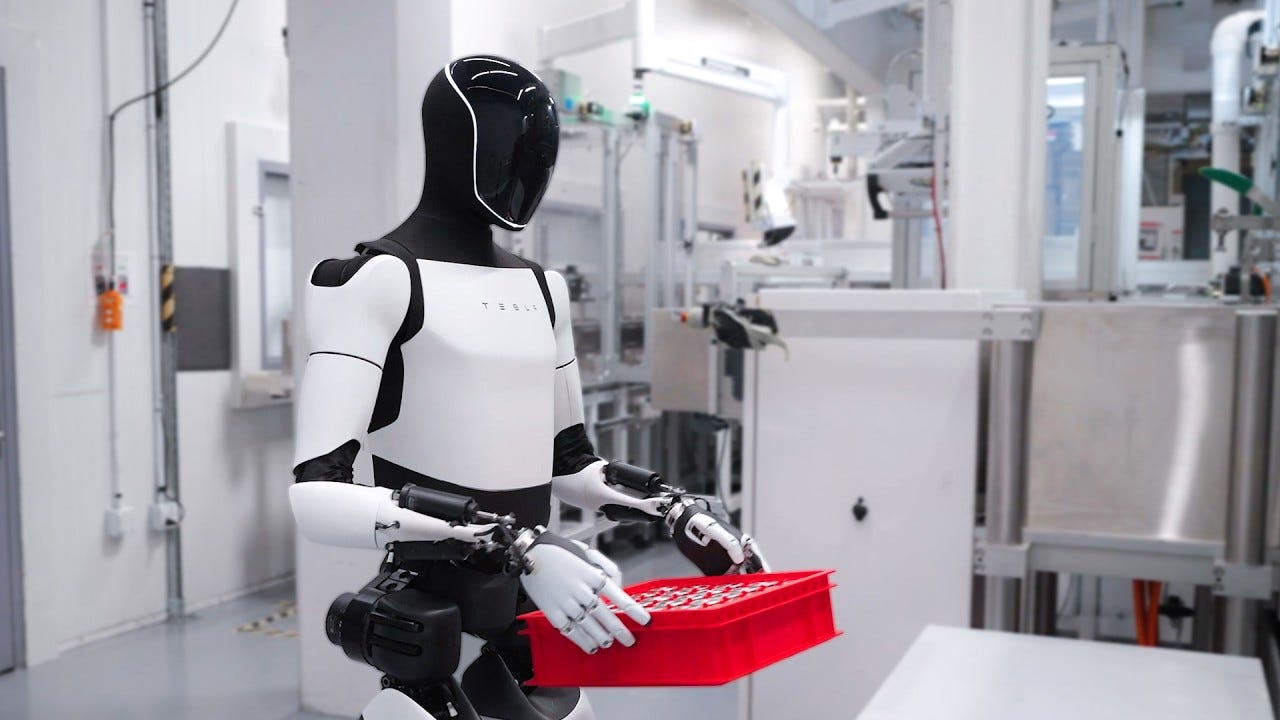
Musk stated during the call that it is time to give the Model S and X programs an “honorable discharge.” This decision solves a critical problem regarding factory floor space. The facility in Fremont, California, which started the mass-market EV revolution, will be stripped of its automotive assembly lines. This space is needed for the mass production of the Optimus humanoid robot.
From Automaker to “Physical AI” Company
Discontinuing these vehicles is not a retreat. It is a reallocation of resources toward labor automation, a market Musk claims could be worth trillions. Tesla is pivoting from a mature hardware tech company in a crowded auto market to a growth play in robotics.
The company plans to reveal the “production-primed” Optimus Gen 3 in Q1 2026. Volume production lines are currently being installed. Musk has set an ambitious target to produce one million Optimus units annually at the repurposed Fremont facility. To fund this transition, Tesla committed to doubling its capital expenditures to over $20 billion in 2026. This is a “burn the ships” strategy designed to force the transition from wheeled EVs to legged robots.
This pivot is essential for the company’s valuation. Traditional automotive margins are under pressure. Tesla’s Q4 GAAP net income fell 61% to $840 million. Additionally, the Chinese competitor BYD has firmly overtaken Tesla in global battery-electric vehicle sales. BYD widened the gap by over 600,000 units in 2025. By reclassifying itself as an AI and robotics firm, Tesla seeks to separate its stock price from the low-margin reality of the auto industry. It aims to attach its value to the potential of the labor market instead.
The Corporate “Super-Merger” Thesis
As automotive revenue weakens, the company appears to be exploring financial and structural integrations with Elon Musk’s broader business empire. This could help sustain investor confidence and share price momentum.
1. The xAI Capital Injection
Shareholders failed to approve a measure late in 2025 due to abstentions. Despite this, Tesla disclosed in its Q4 update that it has invested $2 billion into xAI, Musk’s private artificial intelligence startup. This investment gives Tesla access to the “Grok” large language models from xAI. These models are being integrated into Tesla’s ecosystem to improve “physical AI” capabilities.
2. Potential Mergers: SpaceX, xAI, and Tesla
Reports from Bloomberg and Reuters indicate that discussions are happening regarding a potential merger between SpaceX and xAI, or even a combination involving Tesla. Two corporate entities, “K2 Merger Sub Inc.” and “K2 Merger Sub 2 LLC,” were incorporated in Nevada on January 21, 2026. This signals that formal structural changes are imminent.
A consolidation could serve several strategic functions:
Valuation Support: Valuation support through a merger with SpaceX, valued around $800 billion, or xAI, valued around $230 billion, could create a combined entity with a market cap above $3 trillion. This structure would help insulate Tesla shareholders from volatility tied to the EV transition.
Infrastructure Synergy: Musk has proposed launching data centers into orbit using SpaceX Starships to power xAI’s training clusters. These would be powered by Tesla solar and storage technology.
Unified AI Stack: A merger would consolidate the data flywheel. It would combine real-time video data from Tesla’s fleet, text and social data from X (owned by xAI), and satellite connectivity from Starlink.
Regulatory and Governance Implications
This transition changes Tesla’s risk profile. As a “growth play” in AI, Tesla faces different regulatory hurdles than it did as an automaker. The Department of Justice recently formed an AI Litigation Task Force. Its purpose is to challenge state regulations that might impede AI development. This federal posture could benefit Tesla’s rollout of autonomous networks.
However, the corporate consolidation strategy invites scrutiny regarding fiduciary duty. Tesla shareholders are currently litigating against Musk. They allege he diverted AI talent and resources from the public company to his private ventures. The recent $2 billion investment in xAI was executed while this litigation is active. This highlights the governance risks inherent in Musk’s vertically integrated vision.
Conclusion: The Valuation Bet
Tesla is asking the market to ignore the present situation where car sales are falling, margins are shrinking, and legacy products are dying. instead, they want the company priced entirely on the future.
The cancellation of the Model S and X is the final signal that Tesla is exiting the traditional automotive race. The company is no longer competing with BYD or Ford. It is competing with the limits of physics and artificial intelligence training. Tesla has $44.1 billion in cash on hand. Its roadmap includes unsupervised Cybercabs and millions of humanoid robots. The company is positioning itself not as a car manufacturer, but as the foundational infrastructure for the autonomous economy.
For investors, the thesis has shifted. Tesla is no longer a play on EV adoption. It is a leveraged bet on the successful execution of physical AI, supported by the potential financial engineering of a Musk-led corporate mega-merger.
Disclaimer:
All views expressed are my own and are provided solely for informational and educational purposes. This is not investment, legal, tax, or accounting advice, nor a recommendation to buy or sell any security. While I aim for accuracy, I cannot guarantee completeness or timeliness of information. The strategies and securities discussed may not suit every investor; past performance does not predict future results, and all investments carry risk, including loss of principal.
I may hold, or have held, positions in any mentioned securities. Opinions herein are subject to change without notice. This material reflects my personal views and does not represent those of any employer or affiliated organization. Please conduct your own research and consult a licensed professional before making any investment decisions.