

$AUOTY - AUO CORP
HIMX 0.00%↑
ticker: 2454 TWE - MEDIATEK
ticker: 2382 TWE - QUANTA COMPUTER
A massive shift is happening in the hardware world right now. Many observers are currently looking the wrong way. While global markets debate which software company will win the artificial intelligence race, Taiwan has quietly completed a much more physical project. The small island has built a fully self-contained supply chain for augmented reality glasses. The process does not rely on scattered continents or outside chipmakers. It is completely sovereign and highly efficient.
Four specific companies make this possible. AUO builds the complex waveguides that direct light to your eye. Himax provides the tiny displays and smart sensors. Quanta puts the final devices together at a massive scale. MediaTek designs the processors that run everything on a tiny battery. These companies do not compete with one another. They operate like a highly synchronized machine, and that machine is just starting to warm up.
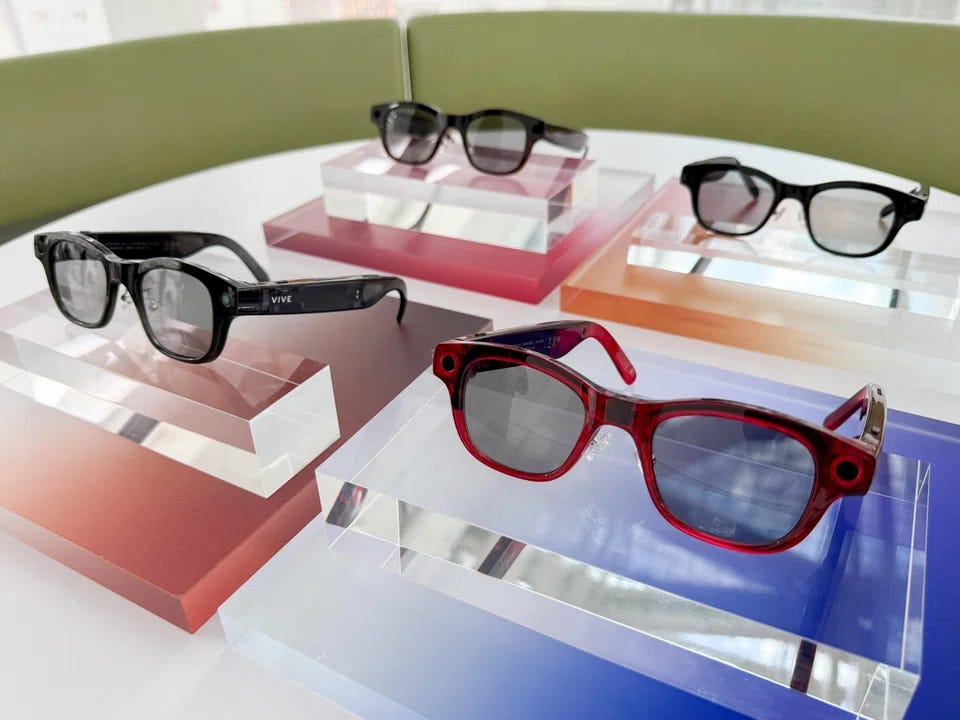
The Surging Global Demand for AR and Smart Glasses
You must look at consumer demand to understand the scale of this supply chain. The smart glasses market grew 211% in 2025 according to IDC. Meta shipped a reported 7 million units of its Ray-Ban smart glasses last year. That specific product does not even feature a visual display yet. Qualcomm highlighted higher consumer demand for AI smart glasses during its fourth-quarter 2025 earnings call. The company secured 19 new design contracts across brands like Meta, Xiaomi, and Samsung. Snap recently signed a multi-year deal with Qualcomm to launch consumer AR glasses in 2026. Google, Samsung, and Apple are all speeding up their own timelines.
AUO Corporation: Mastering the Complex Waveguide
Many people still view AUO Corporation (TWSE: 2409) as a traditional television and monitor screen maker. That perspective is several years out of date. AUO now manufactures high-efficiency waveguides for AR glasses. A waveguide takes a digital image and moves it seamlessly into your natural field of vision. It sounds simple to describe. It is actually incredibly difficult to manufacture. The glass must be thin enough to look normal, bright enough for outdoor use, and perfectly precise to prevent visual distortion.
AUO successfully combined all three traits. The company worked with Himax to reveal a new waveguide platform at CES 2026. The technology offers a slim design, sharp resolution, bright colors, and very low power usage. AUO also created a unique way for separate chips to communicate faster while keeping manufacturing costs down. The financial shift is already visible. AUO reached profitability in 2025 with a net income of TWD 6.8 billion. Management stated during their late 2025 earnings call that high-margin specialty products will drive the majority of their revenue by 2030.
Himax Technologies: The Three Pillars of AR Hardware
Himax Technologies (NASDAQ: HIMX) brings deep technical expertise to the table. The company controls three distinct technologies that make it essential to the AR ecosystem.
First, Himax builds the actual screen inside the glasses. The newest Himax Front-lit LCoS microdisplay hits 400,000 nits of brightness. It weighs just 0.2 grams and takes up less space than a fingernail. No competitor has matched this combination of brightness and power efficiency. Global tech companies are actively testing it right now.
Second, Himax uses a special nanoimprint process to manufacture wafer-level optics. This WLO method allows them to produce complex waveguide lenses with high precision at semiconductor scale. Costs drop as production volume goes up. The company is also using this same optical expertise to help build data center infrastructure alongside its partner FOCI.
Third, Himax provides the WiseEye AI sensor. This component gives smart glasses their intelligence. It handles object recognition, navigation, and eye tracking while using barely any power. A standard smartphone battery holds 5,000 milliamp-hours. AR glasses might only hold 250. Saving every drop of power is a massive competitive advantage. Himax and AUO officially announced their partnership at CES 2026 to bring these specific technologies together.
Quanta Computer: Scaling AR Assembly for the World
Quanta Computer (TWSE: 2382) serves as the quiet giant in this group. It spent decades building a reputation as the top laptop manufacturer for brands like Apple, Dell, and HP. Now, Quanta is positioning itself to assemble the next generation of wearable computers.
The company recently invested $20 million into Vuzix. Vuzix is a prominent American waveguide and smart glasses manufacturer. Quanta structured the investment in three specific stages. Vuzix only received the money after hitting strict production and yield targets. A massive manufacturer like Quanta taking these steps shows serious intent. They are doing intense due diligence to prepare for scaling AR glasses from a few thousand units to millions.
A booming server business currently funds this expansion. Quanta saw its AI server revenue jump 50.5% in 2025. Those server orders are already secured through 2027, giving the company plenty of financial runway to wait for the AR market to mature.
MediaTek: Processing Power for the Next Generation
MediaTek (TWSE: 2454) serves as the main architect for the processing power. The company reported full-year 2025 revenue of NT$596 billion. That marks a 12.3% increase from the previous year. The powerful Dimensity 9500 chip drives much of this success.
MediaTek is currently working directly with Meta to build a custom AR processor. They will not offer this specific chip to any other brand. The goal is to deliver flagship computing power without draining the tiny battery inside a pair of glasses. MediaTek showed off a working prototype at MWC 2026. The glasses used the Dimensity 9500 chip to run multimodal artificial intelligence features completely offline.
The company’s smart edge division covers wearables and computing. That segment grew 26% year-over-year in the second quarter of 2025. MediaTek also leads the market in Wi-Fi 7 technology. Fast connectivity is crucial for smart glasses to communicate with the cloud, and MediaTek generated over $3 billion in connectivity revenue in 2025 alone.
A Fully Unified Supply Chain
You can draw a straight and clear line through this entire process. MediaTek designs the main processor. TSMC manufactures that chip. Himax provides the tiny displays, optical lenses, and smart sensors. AUO builds the high-efficiency waveguide panels. Quanta puts all the pieces together into a finished product.
Every single step happens in Taiwan. The ecosystem does not depend on outside suppliers to build the core technology. Thirty years of careful ecosystem development and focused industrial growth made this tight integration possible.
The Hardware Inflection Point
The current state of AR glasses looks very similar to the smartphone market in 2006. The foundational technology works. Consumer demand is clearly visible. The supply chain is completely assembled. True mass production is the only missing piece, and it is coming soon.
Himax leadership expects wearable revenues to become a primary growth driver over the next few years. AUO is completely shifting its business model toward these exact specialty products by 2030. Quanta has the cash flow from servers to fund massive new assembly lines. MediaTek holds an exclusive chip deal with the biggest smart glasses brand in the world. Taiwan is not waiting for the augmented reality shift to happen. The factories are already built and waiting for the signal to start.
Disclaimer:
All views expressed are my own and are provided solely for informational and educational purposes. This is not investment, legal, tax, or accounting advice, nor a recommendation to buy or sell any security. While I aim for accuracy, I cannot guarantee completeness or timeliness of information. The strategies and securities discussed may not suit every investor; past performance does not predict future results, and all investments carry risk, including loss of principal.
I may hold, or have held, positions in any mentioned securities. Opinions herein are subject to change without notice. This material reflects my personal views and does not represent those of any employer or affiliated organization. Please conduct your own research and consult a licensed professional before making any investment decisions.