

CRWV 0.00%↑
NBIS 0.00%↑
IREN 0.00%↑
The week the bond market blinked
For most of 2026, credit markets lent CoreWeave whatever it asked for. This week they stopped. On Wednesday, October 14, the company’s unsecured bonds fell to prices that usually signal distress, pushing yields past 15%.
Thursday was worse. The 9.75% notes due 2031 yielded 15.78%, some bonds traded near 79 cents on the dollar, and five-year credit default swaps hit a record 1,194.5 basis points. At that level, swaps price in better than a 60% chance of default within five years.
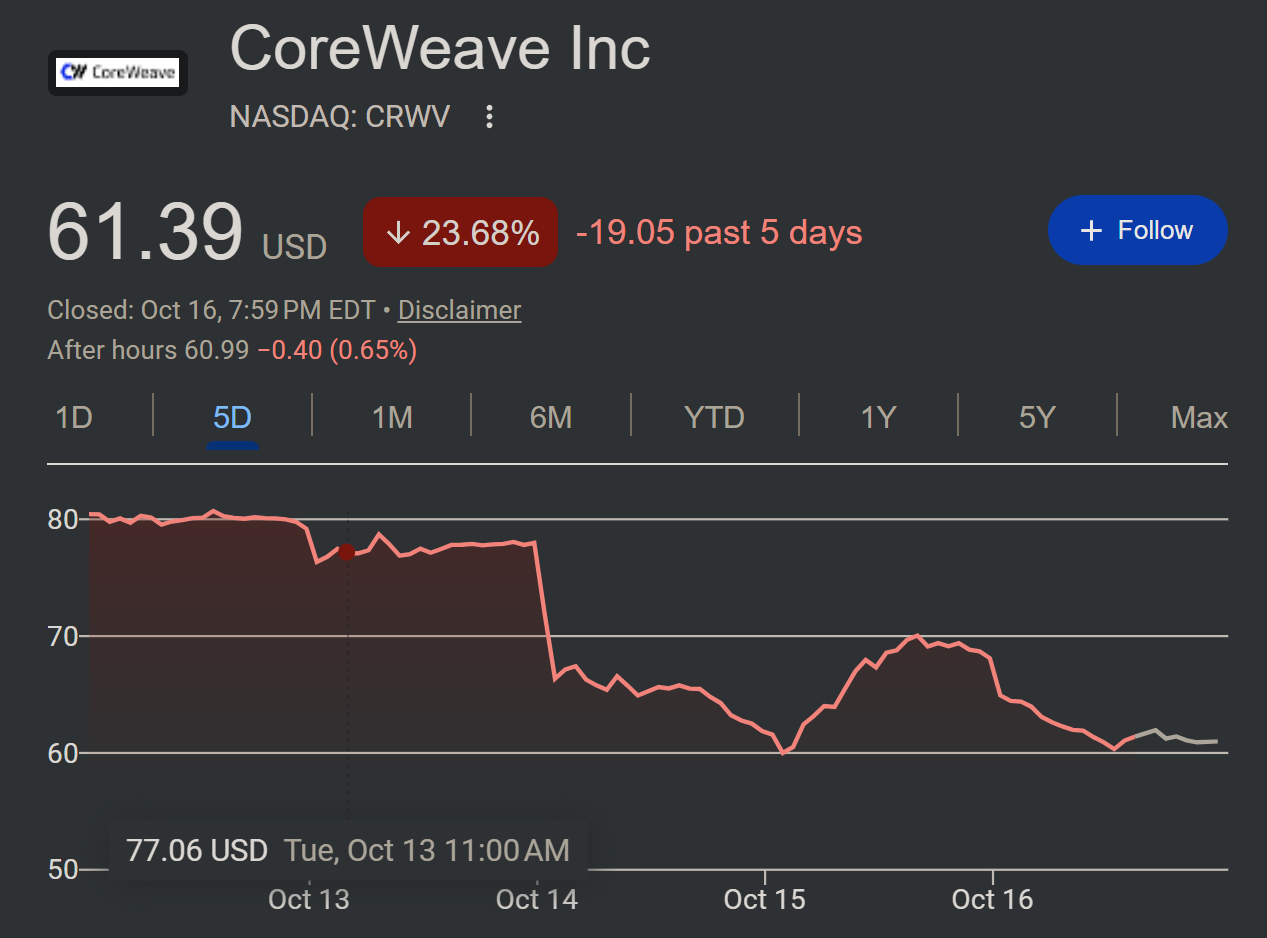
The stock followed the bonds. CoreWeave closed Wednesday at $65.78, down 15.5%, its worst day since going public. It bounced Thursday, then fell about 11% more on Friday. Chamath Palihapitiya flagged the yields online; Elon Musk replied “yikes.”
CEO Mike Intrator told staff in an internal memo that the market was behaving irrationally and that CoreWeave’s contract backlog more than covers its debt. He may be right about the backlog. But the bond market isn’t pricing demand. It is pricing the treadmill: the need for CoreWeave, and every neocloud built on its model, to borrow ever more, ever faster, at whatever rate the market sets that week.
How the treadmill works
The neocloud model is easy to state. Sign a multi-year capacity contract with a hyperscaler or AI lab. Borrow against that contract and the Nvidia GPUs it will run on, typically at 60–70% of the hardware’s value. Build the data center, then repay the loan from the rent.
The catch is that growth means running the loop faster than it pays down. CoreWeave guides 2026 capital spending of $35–39 billion against revenue of $12.4–13.2 billion. Its debt and lease obligations reached about $52 billion at the end of June, up from roughly $15 billion of debt a year earlier. It held about $5.5 billion in cash. Roughly $4.4 billion comes due by the end of this year and $6.2 billion in 2027.
The collateral makes the loop tighter than it looks. GPUs lose value as each new Nvidia generation ships, so a lender’s security shrinks while the loan is outstanding. Rental rates for older chips have fallen as supply caught up with the 2023–24 shortage. A neocloud therefore has to keep refinancing on good terms. That works only while rates hold still and investors stay keen. In the past month, neither has.
Why rates broke the rhythm
The Federal Reserve raised its benchmark rate a quarter point on September 16, to 3.75–4.00%. It was the first hike since July 2023 and the first move under Chair Kevin Warsh, and most officials pencilled in one more before year end. Long yields had already climbed: the 10-year Treasury touched about 5.17% in late September, its highest since 2007.
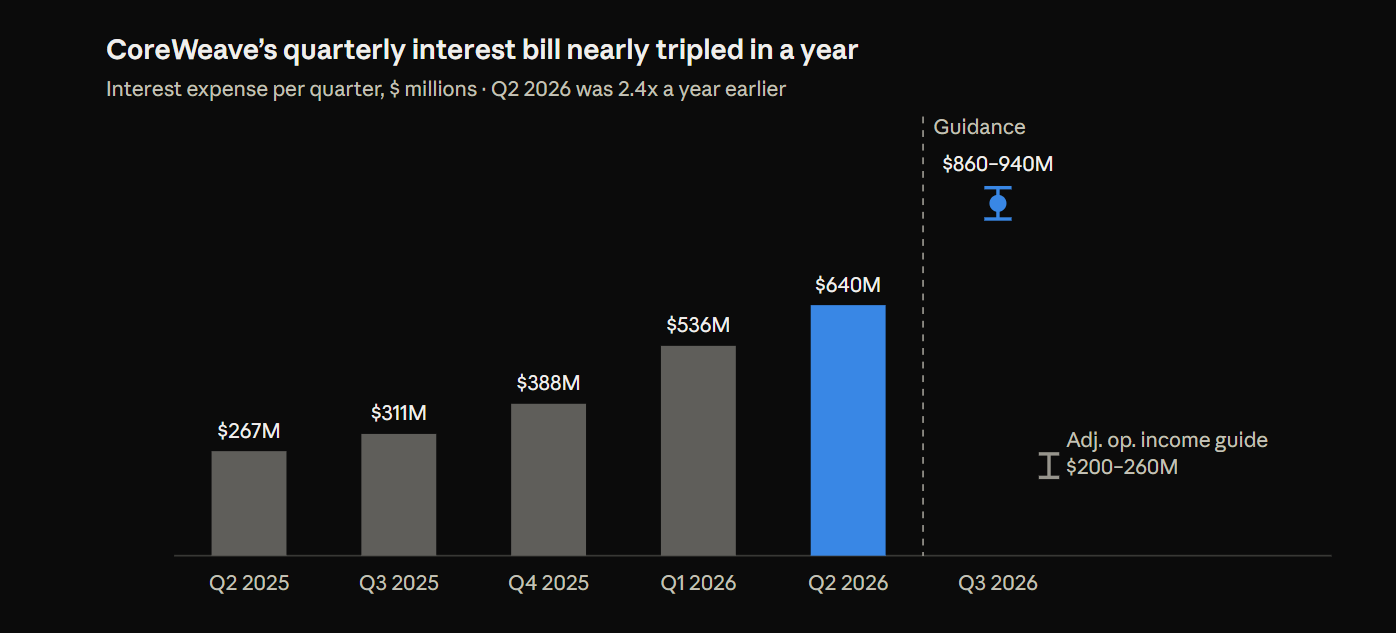
Higher base rates are not CoreWeave’s main problem on their own. Its filings put the cost of a one-point rise on its floating-rate debt at roughly $30 million a year. The damage comes from how much it has already borrowed, and from the price of everything it still needs to borrow.
Interest expense has risen every quarter, and the third-quarter guide is roughly four times guided adjusted operating income. CoreWeave lost $626 million in the second quarter on record revenue, close to what it paid its lenders.
New money now costs more too. The 2031 notes carry a 9.75% coupon but trade to yield nearly 16%, and any fresh unsecured issue would have to pay something similar. The treadmill is speeding up just as each step gets more expensive.
It isn’t just CoreWeave
The rout landed in a week already primed for doubt. Five days earlier, on October 9, the Nvidia-backed Australian neocloud Firmus pulled its planned ASX listing, which had aimed to raise about $5 billion. Investors balked at a balance sheet expected to carry roughly $30 billion of debt against a 2028 operating-earnings forecast of $5 billion. Firmus is now exploring a $2–3 billion private round. Days later, Blackstone-backed AirTrunk delayed its own Singapore IPO.
Then on October 14, the same day CoreWeave’s bonds broke, Gartner published a blunt forecast. It expects AI providers to spend nearly $1 trillion on infrastructure in 2026 and another $6 trillion from 2027 to 2030. It sees AI revenue attributable to those data centers reaching only about $3.6 trillion by 2030, against roughly $8.5 trillion needed to justify the spending. More than $3.5 trillion of assets could face write-downs. Its headline for this industry: by 2030, more than 80% of neocloud providers will cease to operate independently.
The spillover showed up fast. Nebius, IREN and Dell sold off. Oracle fell nearly 9%, with its 2032 notes yielding about 7.24%. By Friday, Bloomberg was reporting that junk-bond buyers were increasingly shutting out tech startups seeking financing. That matters more than any one company’s share price. High-yield debt is the fuel the smaller neoclouds run on.
CoreWeave’s case, and why it spooked bondholders
The bull case is not imaginary. Second-quarter revenue was $2.6 billion, up 112% from a year earlier. The contracted backlog reached $104.2 billion, before more than $25 billion of new commitments signed early in the third quarter. Co-founder Brannin McBee says nearly all of CoreWeave’s 2027 capacity is already sold. Even skeptical analysts concede that demand for the compute is real.
Management’s answer to the financing problem is to borrow against its customers’ credit rather than its own. In March, CoreWeave closed an $8.5 billion loan secured by GPUs and a Meta contract that Moody’s rated A3. It was the first loan of its kind to reach investment grade. In a Financial Times interview published October 14, McBee said the goal is to make more chip-backed debt investment grade, and eventually the company itself. That would open the door to insurance-company money, a pool he described as “unlimited.”
Bondholders heard something else. The plan meant still more borrowing. And if the best contracts and newest chips are pledged to ring-fenced, investment-grade vehicles, less is left for unsecured creditors at the parent. Bloomberg tied Thursday’s record swap spreads directly to the insurer talk. The strategy may well lower CoreWeave’s average cost of capital. It does so by putting the unsecured bonds further back in line.
Independent landlords, or tenants’ subsidiaries?
The likeliest answer is that most neoclouds will keep their own names while ceding the economics to someone bigger. There are three ways that happens, and they are already under way.
Owned by the tenant’s credit. The cheapest neocloud money is now priced off the customer, not the neocloud. On October 1, Lambda closed a $1 billion GPU-backed loan at a 6.78% fixed rate, rated investment grade and tied to a Microsoft leasing deal. CoreWeave’s own unsecured paper yields more than twice that. The gap is the market’s price for the neocloud’s name. When the tenant’s balance sheet sets the cost of capital, the landlord keeps a thin operating spread, and the tenant holds the leverage at renewal. Microsoft alone accounted for roughly two-thirds of CoreWeave’s 2025 revenue.
Owned by the supplier. On July 1, Nvidia launched what it calls the AI Compute Partnership. It agrees to rent back a neocloud’s unused GPUs at a fixed rate, and in return takes a share of the cloud revenue on that capacity. Firmus and Sharon AI were among the first takers. Nvidia already holds roughly 9.3% of Nebius and has a $6.3 billion capacity agreement with CoreWeave. The backstop makes clusters bankable. It also makes Nvidia supplier, guarantor, customer of last resort and equity holder at once, which looks less like independence than a franchise.
Owned outright. Gartner’s “cease independent operations” explicitly includes being acquired. Hyperscalers are the obvious buyers: Alphabet, Amazon, Meta and Oracle had issued more than $228 billion of bonds this year at investment-grade rates. But they rent from neoclouds partly to move fast and keep capital spending off their own books. Buying a heavily indebted landlord would undo both benefits. A distressed sale of data centers, power contracts and GPU fleets at a discount is the more plausible path, along with neoclouds buying each other, as Nscale did when it agreed to acquire Anyscale.
CoreWeave itself is an unlikely takeover target, though not because it is too big to buy. A buyer would inherit its liabilities and its contracts with rivals like Meta, who would not want their compute owned by a competitor. Its realistic future is to borrow against its tenants’ credit: independent on paper, but increasingly a financing conduit for its customers’ contracts. The smaller operators, running on junk debt and IPO hopes, are the ones more likely to end up leaning on Nvidia’s backstop or sold off in pieces.
What to watch
The bear case is not that AI demand disappears. It is that the cost of financing it reprices faster than contracts can absorb. A few markers will show which way this goes:
• The Fed, October 27–28. A second hike would raise the floor under every refinancing; a pause would buy time.
• CoreWeave’s year-end maturities. About $4.4 billion falls due by December 31. Whether it rolls that debt, and at what price, is the cleanest test of market access.
• Its next earnings report. Watch interest expense against operating income, and whether capital spending guidance holds or gets cut.
• Credit spreads. Five-year swaps near 1,200 basis points and unsecured yields near 16% need to stabilize before cheap funding returns. Any widening in investment-grade hyperscaler spreads would mean the worry is spreading up the ladder.
• The pipeline of neocloud deals. Firmus’s private round, the IPO plans of Lambda and Nscale, and take-up of Nvidia’s backstop will show who can still raise money on their own name.
If those markers turn, CoreWeave’s bonds will look like the buying opportunity of the cycle. If they don’t, Gartner’s 80% may prove conservative, and the AI-compute landlords will end up working for the companies that pay their rent.
Disclaimer:
All views expressed are my own and are provided solely for informational and educational purposes. This is not investment, legal, tax, or accounting advice, nor a recommendation to buy or sell any security. While I aim for accuracy, I cannot guarantee completeness or timeliness of information. The strategies and securities discussed may not suit every investor; past performance does not predict future results, and all investments carry risk, including loss of principal.
I may hold, or have held, positions in any mentioned securities. Opinions herein are subject to change without notice. This material reflects my personal views and does not represent those of any employer or affiliated organization. Please conduct your own research and consult a licensed professional before making any investment decisions.