

AMD 0.00%↑
NVDA 0.00%↑
DOCN 0.00%↑
Advanced Micro Devices (AMD) is trying a new way to sell its artificial intelligence hardware. The company wants to challenge Nvidia’s hold on the market. Instead of just selling equipment, AMD is forming financial partnerships based on company stock. People in the industry call this a “buy a GPU, get a share for free” approach. AMD hopes this strategy will guarantee large-scale use of its Instinct accelerators for AI training and inference. By tying the financial success of major AI developers to its own stock value, AMD is changing how AI infrastructure is funded.
The OpenAI Partnership and a $100 Billion Goal
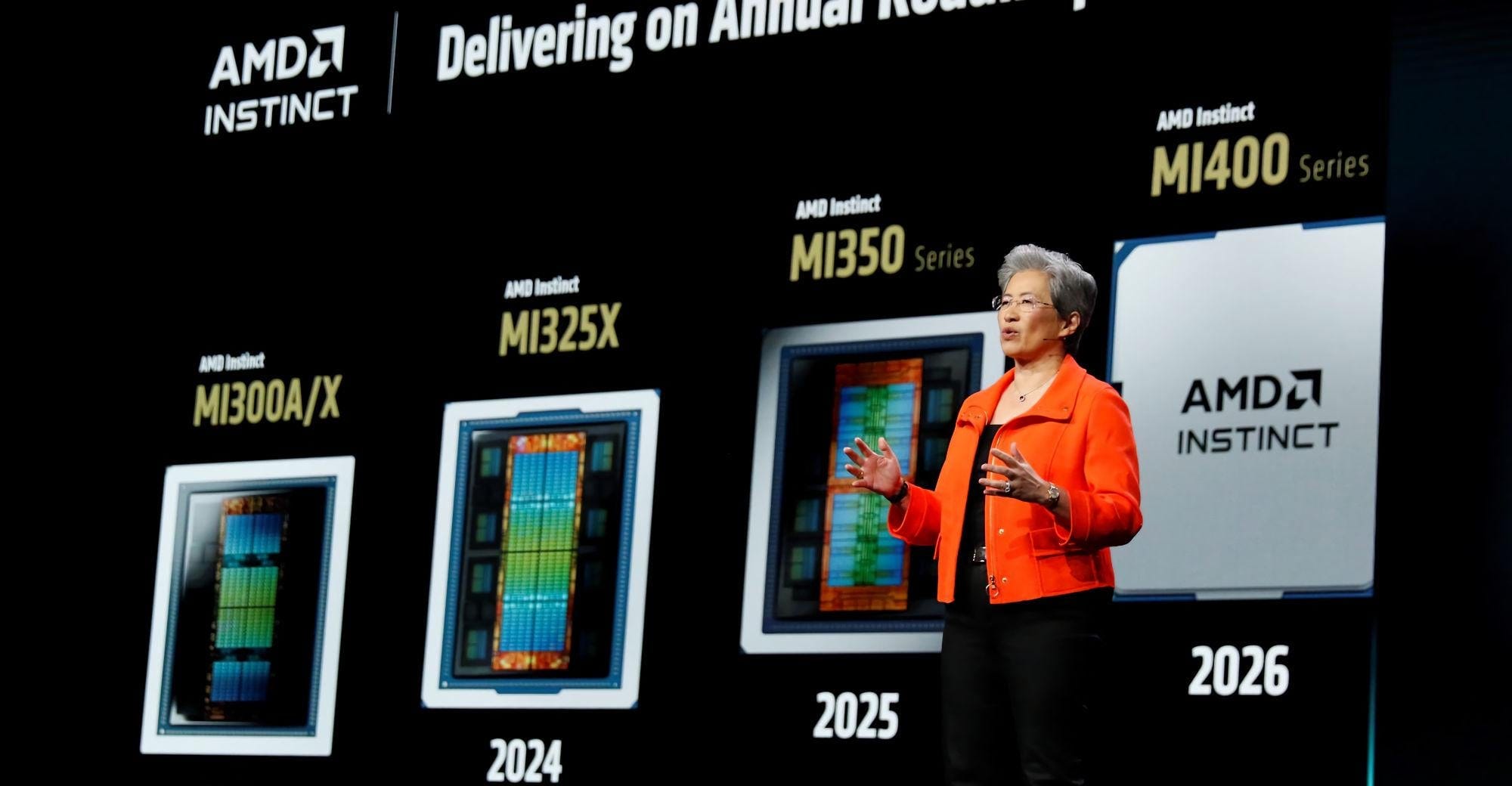
This new strategy relies heavily on a major partnership with OpenAI. The two companies signed a multi-year agreement covering several generations of hardware. Under this deal, OpenAI will set up to 6 gigawatts of AMD Instinct GPUs. The rollout begins in the second half of 2026 with the new MI450 series. This scale of deployment could bring AMD up to $90 billion in cumulative hardware revenue.
To encourage this level of commitment, AMD gave OpenAI a performance-based warrant. This allows OpenAI to buy up to 160 million shares of AMD common stock. That amount equals roughly 10% of the company. The strike price is set at just $0.01 per share. However, OpenAI only earns these shares if specific goals are met. The AI company needs to push its deployments toward that 6-gigawatt ceiling. At the same time, AMD’s stock price must sequentially hit targets up to $600 per share. This setup means OpenAI makes money directly from the market value it builds by using AMD equipment.
The Meta Partnership for Scalable Inference
AMD created a similar agreement with Meta Platforms. This deal also includes a 6-gigawatt supply of hardware and is valued between $60 billion and $100 billion over five years. Meta will receive up to 160 million performance-based warrants under the exact same vesting rules. This connects Mark Zuckerberg’s AI plans directly to AMD’s silicon products.
Meta is focusing this partnership on finding cost-effective ways to run AI inference for its billions of users. The companies are working closely together on hardware, systems, and software. They will use custom MI450-based GPUs alongside EPYC “Venice” CPUs inside AMD’s Helios rack-scale architecture. Because of the stock incentive, Meta is motivated to use its own engineers to optimize its software for AMD’s ROCm platform. This includes Meta’s natively developed PyTorch framework and its large Llama models. When Meta improves the open-source PyTorch system for AMD hardware, it becomes much easier for other companies to use AMD chips.
Addressing Software Weakness with PyTorch and Tinygrad
For a long time, software was the main hurdle for AMD. Nvidia built a strong advantage over two decades with its CUDA platform. Meanwhile, AMD’s open-source system, called ROCm, dealt with fragmented support, software bugs, and a lack of maturity.
That situation is changing today. PyTorch has greatly improved its native support for AMD chips. Developers no longer need to rely on complex custom builds. They can simply use standard installation commands to download PyTorch wheel variants built directly for ROCm. This makes the initial setup very similar to using Nvidia.
Independent tools are also helping close the software gap. George Hotz created a framework called tinygrad. It skips the heavy layers of standard graphics drivers and connects directly to the PCIe BAR. This method exposes the raw processing power of the AMD hardware. Hotz noted that AMD’s software felt “hopeless” three years ago. Now, he says standard AI workloads “just work” on AMD’s MI300X and MI350X chips. Constant software updates, combined with money and feedback from companies like Meta and OpenAI, are gradually wearing down Nvidia’s software advantage.
DigitalOcean and Smaller Developers
While OpenAI and Meta handle massive computing needs, AMD is also targeting smaller developers through DigitalOcean. Small-to-medium businesses and AI startups often find enterprise cloud services too complicated and expensive. To solve this, DigitalOcean added AMD Instinct MI300X and MI350X GPUs to its Agentic Inference Cloud.
This partnership offers small developers a clear, usage-based pricing model. It is significantly cheaper than renting Nvidia H100 instances. DigitalOcean built an optimized environment for open-source models, focusing mainly on inference, which is the stage where models actually operate. For example, an AI entertainment startup named Character.ai moved its billion-query-per-day workload to DigitalOcean’s AMD servers. After moving, Character.ai doubled its throughput and reduced its cost per token by 50%. For startups, AMD hardware can deliver strong unit economics without the need to navigate Nvidia’s supply constraints.
The Instinct MI450 and Next-Generation Hardware
Looking at the hardware itself, AMD designed the upcoming Instinct MI450 series to bypass Nvidia’s Blackwell generation. The goal is to compete directly with Nvidia’s future “Vera Rubin” architecture.
The MI450 brings several technical updates. TSMC will manufacture the chip using its cutting-edge 2nm-class (N2) node. This gives AMD a production advantage over Nvidia’s Rubin GPUs, which will use an older 3nm node. The MI450 will include up to 432 GB of next-generation HBM4 memory. It will also deliver 19.6 TB/s of memory bandwidth. By comparison, Nvidia’s Rubin R100 is expected to have 384 GB of memory. In terms of computing power, the MI450 is projected to reach up to 40 PFLOPS of FP4 performance.
These hardware specifications have forced Nvidia to adjust its plans. Industry reports show that Nvidia hastily redesigned its VR200 Rubin GPU in response. The company increased the chip’s Total Graphics Power (TGP) to 2300W and boosted its memory bandwidth just to keep a narrow lead over AMD.
By mixing 2nm silicon with a stock-based business model, AMD is doing more than providing an alternative to Nvidia. The company is actively changing how the artificial intelligence industry handles its technology and finances.
Disclaimer:
All views expressed are my own and are provided solely for informational and educational purposes. This is not investment, legal, tax, or accounting advice, nor a recommendation to buy or sell any security. While I aim for accuracy, I cannot guarantee completeness or timeliness of information. The strategies and securities discussed may not suit every investor; past performance does not predict future results, and all investments carry risk, including loss of principal.
I may hold, or have held, positions in any mentioned securities. Opinions herein are subject to change without notice. This material reflects my personal views and does not represent those of any employer or affiliated organization. Please conduct your own research and consult a licensed professional before making any investment decisions.