

VECO 0.00%↑
ACLS 0.00%↑
Veeco Instruments (NASDAQ: VECO) has grown from a specialized supplier into a quiet giant of the semiconductor world. The company is now a vital building block for global artificial intelligence and power electronics.
Veeco solves tough materials engineering problems using a few highly specific technologies. These include Ion Beam Deposition (IBD), Laser Spike Annealing (LSA), and Metal-Organic Chemical Vapor Deposition (MOCVD). Today, chipmakers cannot build advanced node processors, High Bandwidth Memory (HBM), or new silicon photonics without them.
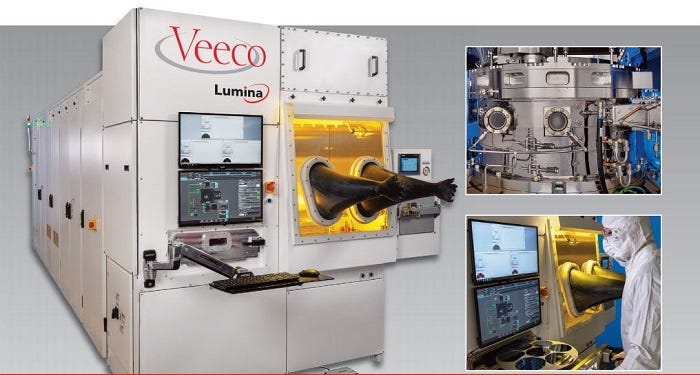
Building a High-Tech Advantage
Veeco built its competitive edge around the heavy demands of modern computing. AI, virtual reality, and autonomous systems require massive processing power. Veeco meets this need with tools like its IBD technology, which creates extreme ultraviolet (EUV) mask blanks. As chip manufacturing enters the ultra-tiny “Angstrom Era,” every EUV machine needs these mask blanks. Veeco holds a virtual monopoly in this essential step.
In the early stages of chip making, Veeco’s LSA systems are just as critical. They help manufacturers build Gate-All-Around (GAA) transistors at the microscopic 3nm and 2nm levels. This technology offers precise heat control. It activates silicon materials without damaging the fragile structures around them.
On top of that, Veeco uses its MOCVD and Molecular Beam Epitaxy (MBE) systems to shape the compound semiconductor market. These tools help produce the Gallium Nitride (GaN) and Silicon Carbide (SiC) chips that power electric vehicles and 5G networks.
AI and the Photonics Boom
The main engine behind Veeco’s current growth is the worldwide rush to build AI infrastructure. CEO Bill Miller highlighted this shift during the first quarter earnings call in 2026. He noted that Veeco executed well as the industry entered a transformational period, entirely driven by the rapid expansion of AI data centers and high performance computing. You can see this demand surging in two main areas: silicon photonics and advanced packaging.
Data centers are starting to replace heavy copper wiring with light based optical connections. This change requires Indium Phosphide (InP) lasers to hit the high speeds and massive bandwidths that AI demands. Veeco recently secured a major win here. The company booked over $250 million in orders for MOCVD, wet processing, and its Spectre IBD systems to help manufacture these lasers.
Miller expects the addressable market for indium phosphide lasers to reach $700 million by 2030. The Spectre IBD system plays a starring role in this space because it provides the exact precision needed to coat the highly reflective facets on these lasers.
Meanwhile, as traditional chip scaling slows down, manufacturers are stacking chips to boost performance. They use advanced packaging techniques like 2.5D, 3D stacking, and hybrid bonding. This trend has created massive demand for Veeco’s wet processing and lithography tools among High Bandwidth Memory makers. In the first quarter of 2026, the company reported its advanced packaging business more than doubled compared to the previous year.
Scaling Up to Meet Demand
Buyers are lining up for these tools. Veeco finished 2025 with a record semiconductor backlog of $555 million, marking a 35% jump from the year before. That momentum remains strong in 2026. The company is completely booked through the year for its data storage IBD equipment.
To keep pace, Veeco is rapidly building out its factory floors. Miller announced plans to increase Spectre IBD capacity by roughly ten times its current level by early 2027. He also mentioned they are looking at future needs and might potentially double that capacity again. At the same time, Veeco is using outsourced partners in Southeast Asia to expand its wet processing output.
The Axcelis Merger
Another massive shift is happening behind the scenes. Veeco is working through a pending $4.4 billion merger with Axcelis Technologies, a deal first announced in late 2025. This move will create the fourth largest semiconductor equipment maker based in the United States.
It pairs Veeco’s AI related tools with Axcelis’s leadership in ion implantation for power semiconductors. Together, they will offer a comprehensive lineup that competitors will find very hard to replace. By May 2026, shareholders had approved the merger. The companies are simply waiting for final regulatory clearance in China and expect the deal to close in the second half of the year.
Navigating Export Roadblocks
The path forward does have a few bumps. Veeco is dealing with strict U.S. export policies and slower business in China. During the first quarter of 2026, sales to China dropped 72% year over year to just $20.0 million.
CFO John Kiernan clarified the situation on a recent call. He explained that declining mature node business in China is a clear headwind, yet strength in AI areas more than offsets the loss. Still, regulations create daily friction. Recently, a $15 million customs hold at the Port of San Francisco delayed two LSA systems bound for China. This hold temporarily impacted the company’s recognized revenue.
Looking Ahead
Veeco Instruments steps into the middle of 2026 as an essential engine for the tech world. Geopolitical tension and shifting cycles in data storage remain part of the landscape. Yet, the company’s heavy involvement in AI data centers and silicon photonics provides a clear, steady road ahead.
Veeco recently reaffirmed its 2026 revenue guidance of $740 million to $800 million. With a transformative merger on the horizon, the company is securing its place in the global digital economy. As Bill Miller concluded, Veeco is well positioned for durable, multi year growth driven by AI infrastructure and high performance computing.
Disclaimer:
All views expressed are my own and are provided solely for informational and educational purposes. This is not investment, legal, tax, or accounting advice, nor a recommendation to buy or sell any security. While I aim for accuracy, I cannot guarantee completeness or timeliness of information. The strategies and securities discussed may not suit every investor; past performance does not predict future results, and all investments carry risk, including loss of principal.
I may hold, or have held, positions in any mentioned securities. Opinions herein are subject to change without notice. This material reflects my personal views and does not represent those of any employer or affiliated organization. Please conduct your own research and consult a licensed professional before making any investment decisions.