

META 0.00%↑
AAPL 0.00%↑
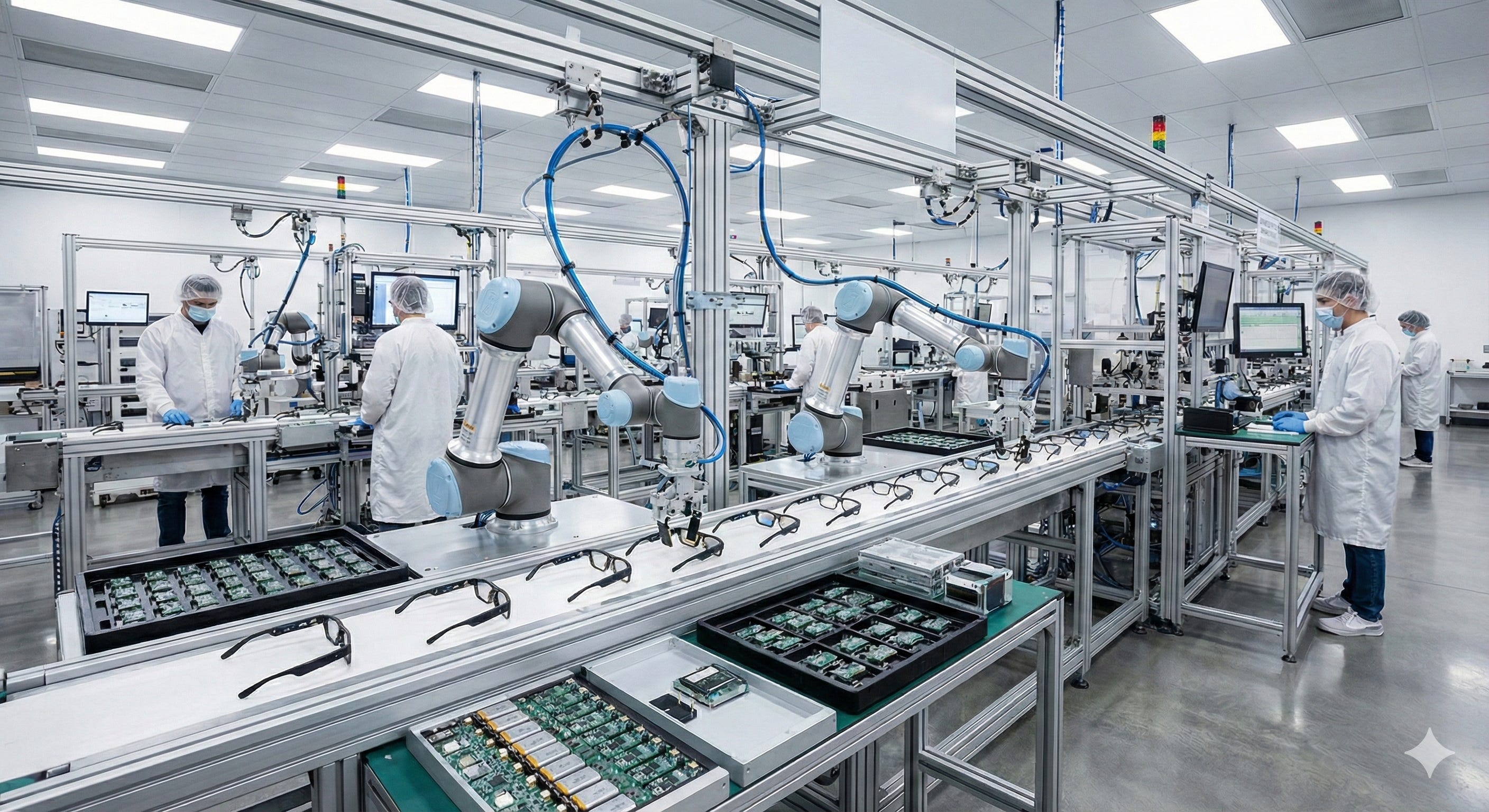
The first wave of consumer AR glasses is finally arriving. Surprisingly, it relies on a display technology that first appeared thirty years ago. Industry experts expected this exact move. When Meta released the Ray-Ban Meta Display in late 2025, they skipped the futuristic MicroLED screens shown in their Orion prototype. Instead, they chose Liquid Crystal on Silicon, commonly known as LCoS. To see why one of the biggest tech companies made this call, we need to look at the tiny hardware sitting right next to your eye.
The Hidden Engineering Challenge Inside AR Frames
An AR display is a complete optical system. Engineers call it a light engine. It generates an image, pushes it through a see-through lens called a waveguide, and projects it into your eye. Every piece must fit inside a tiny volume without making the glasses heavy.
People naturally assume MicroLED is the smallest option because the chips are microscopic. Edward Tang, CEO of Avegant, recently detailed why the opposite is true today. A complete MicroLED system often takes up significantly more physical space than an LCoS engine. The bulk comes from six specific layers of hidden hardware required to make MicroLED work.
First, MicroLED pixels vary in brightness and color right off the factory line. Engineers fix this with “demura” memory chips that correct the image pixel by pixel. These chips add cost, heat, and extra wiring. LCoS does not need this because its liquid crystal layer is one uniform, continuous film.
Second, full color MicroLED engines currently use three separate monochrome panels for red, green, and blue. Each panel gets hot and requires its own dedicated heat sink.
Third, combining those three colors requires an X-cube dichroic prism. This is a glass block made of four wedges bonded together. It merges the three color beams into a single output. Building it is expensive, and engineers must align the three panels to the cube across six microscopic axes. LCoS produces full color sequentially on a single panel, so the bulky prism is entirely unnecessary.
Fourth, MicroLED panels are highly reflective. When light exits the engine and hits the lens, up to 20 percent of it bounces straight back into the display. This creates a ghost image visible to the wearer. The easiest fix is to physically tilt the entire optical engine at an angle inside the glasses. For a 30 degree field of view, the engine must tilt over 15 degrees. This geometric penalty consumes awkward space inside the frame. Avegant’s LCoS design has ghost mitigation built in, allowing the engine to sit straight.
Fifth, MicroLEDs shoot light in all directions like a bare light bulb. Waveguide lenses only accept light from narrow angles. This physics problem, known as an étendue mismatch, causes a massive 94 percent light loss in a typical system. Engineers add micro lenses over every pixel to help steer the light, but these lenses must be spaced far apart to work. This forces the overall panel to become physically wider.
Finally, running three separate panels requires large flex cables and connectors threaded through the temple of the glasses. LCoS uses one panel and one connection.
The compound effect of these six layers is massive. A MicroLED system like the JBD Hummingbird I advertises a volume of 0.4 cubic centimeters. Once you add the heat sinks, memory chips, and optical corrections, the real world volume swells past 2cc. That is more than five times the original size.
LCoS avoids all of this. Avegant’s AG-30L3 light engine, launched in January 2026, fits a complete color display system into 0.7cc. That is roughly the size of a sugar cube. It delivers an 800 by 800 resolution and pushes 1,000 nits of brightness into the eye using only 150 milliwatts of power. It weighs just 1.4 grams.
Why Tech Giants Chose Mature Silicon First
Meta and Google both chose LCoS for their current AR hardware based on manufacturing readiness. Meta Reality Labs vice president Jason Hartlove labeled LCoS as “Ready Technology” on an internal roadmap shown at a late 2025 conference. He called MicroLED “Anticipated Technology.”
The Ray-Ban Meta Display uses an LCoS panel from OmniVision and a Lumus reflective waveguide. It provides a 600 by 600 resolution and 5,000 nits of brightness. Users get six hours of battery life to see notifications and navigation arrows. The glasses cost $799 and look exactly like standard eyewear.
Factories know how to build LCoS efficiently. Yields are highly predictable. MicroLED is currently fighting difficult factory battles, like moving millions of chips smaller than 10 microns with flawless precision. Meta tried to speed up MicroLED production with an exclusive deal with Plessey Semiconductors in 2020. Production defects stalled the project. Meta switched back to LCoS for its near term products. Haylo VC bought Plessey in August 2025, and Meta is now testing MicroLED chips from ams OSRAM.
The Secret Factories Building the Next Generation
The current and future tech generations are moving forward in parallel. Foxconn, Apple’s primary manufacturing partner, announced a deal with Porotech in December 2024. Foxconn is building a MicroLED wafer processing line in Taichung, Taiwan. Mass production targets the fourth quarter of 2025. Foxconn publicly called AR a promising growth area, a move industry insiders view as a direct reference to Apple.
Production is also ramping up rapidly in China. Jade Bird Display, known as JBD, is expanding a $92 million facility in Hefei to produce 120 million 0.13 inch panels every year. Their Roadrunner platform achieves a 2.5 micron pixel pitch and 10,160 pixels per inch. JBD closed a massive funding round in late 2025, with mass production expanding in the second half of 2026.
The Breakthrough That Changes Everything
The billions of dollars pouring into MicroLED right now are aimed at eliminating those six layers of bulk. Porotech and JBD are building native full color microdisplays. A single chip replaces three separate panels. One chip means the X-cube prism disappears entirely. Three sets of flex cables become one. Three heat sinks shrink down to one small thermal solution.
Better factory growth processes will eventually eliminate the need for demura memory. Advanced anti reflective coatings will stop light from bouncing off the lens, allowing engineers to remove the awkward 15 degree engine tilt.
Once those engineering hurdles clear, MicroLED becomes untouchable. The raw brightness is staggering. While LCoS relies on clever illumination to fight the sun, MicroLED offers millions of nits natively. JBD built a 2 million nit full color microdisplay. TCL CSOT showed off a 4 million nit AR panel.
Power efficiency will also transform daily use. LCoS backlights run continuously, simply blocking light to create dark areas. MicroLED pixels only draw power based on their individual brightness. A black pixel uses zero power. Since AR content mostly consists of digital elements floating on a clear background, MicroLED will save massive amounts of battery life. The emitters are made of inorganic gallium nitride, meaning they will easily survive over 100,000 hours of use without burn in.
A New Vision for the Decade Ahead
Yole Group display analyst Raphaël Mermet-Lyaudoz expects the AR smart glasses market to hit 40 million units by 2031. The technology that dominates that scale will be the one factories can build cheaply and reliably by 2028.
The AR glasses available in 2025 and 2026 will run on LCoS. Meta’s Artemis glasses arriving in 2027 will feature a glass waveguide and a 50 degree field of view using LCoS. Engineers made the right call for hardware that must look normal and cost under $1,000 today.
The transition window will open between 2027 and 2028. Foxconn, JBD, and ams OSRAM are pushing hard to mature the MicroLED supply chain. LCoS rules the present because it fits the frames we wear right now. Once factories figure out how to strip away the bulky prisms and heat sinks from MicroLED, the industry will pivot. The massive new production lines rising in Taiwan and China show that the hardware world is already preparing for that day.
Disclaimer:
All views expressed are my own and are provided solely for informational and educational purposes. This is not investment, legal, tax, or accounting advice, nor a recommendation to buy or sell any security. While I aim for accuracy, I cannot guarantee completeness or timeliness of information. The strategies and securities discussed may not suit every investor; past performance does not predict future results, and all investments carry risk, including loss of principal.
I may hold, or have held, positions in any mentioned securities. Opinions herein are subject to change without notice. This material reflects my personal views and does not represent those of any employer or affiliated organization. Please conduct your own research and consult a licensed professional before making any investment decisions.