

The solar industry has long been a graveyard for capital. For two decades, investors have watched panel manufacturers race to the bottom, crushing margins in a desperate bid for market share. In 2026, the smart money has stopped looking at the panels. It is looking at what holds them up. Nextracker (NXT), the Fremont-based leader in solar tracker technology, has quietly become the industrial backbone of the renewable energy transition. With a fortress balance sheet and a technological moat that competitors are struggling to cross, the stock represents a rare convergence of growth and stability in a notoriously volatile sector.
As global markets digest the recent geopolitical tremors in South America and the ongoing reindustrialisation of the United States, Nextracker stands apart. It is not selling a commodity. It is selling yield. For investors seeking exposure to the energy transition without the commodity risk of silicon modules, Nextracker is the conviction buy of the year.
The Intelligent Steel Thesis
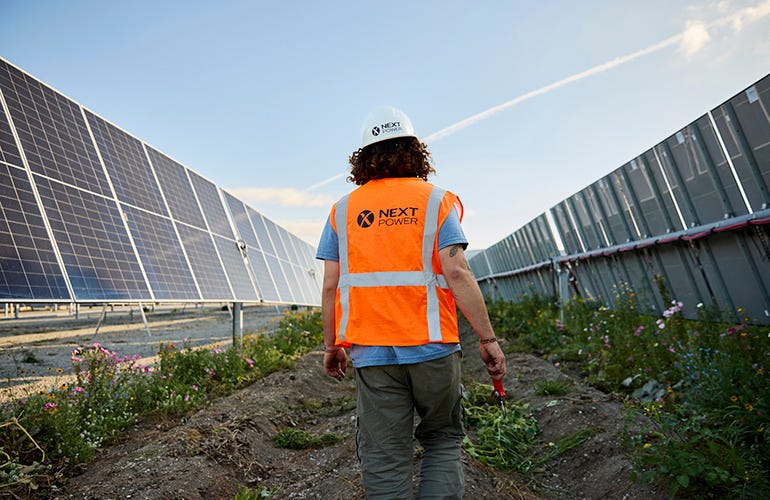
To understand the Nextracker advantage, one must discard the notion that a solar tracker is merely a steel pipe. A tracker is a robotic system that allows solar panels to follow the sun from east to west, generating up to 30 per cent more energy than fixed structures. Nextracker dominates this space not because it bends metal better than its rivals, but because it writes better code.
The company’s flagship software, TrueCapture, has altered the economics of solar development. By using machine learning to adjust the angle of individual rows, accounting for cloud cover, fog, and uneven terrain, Nextracker squeezes incremental electrons out of every photon. In an era of high interest rates, where project developers are desperate for every basis point of internal rate of return, this software is not a luxury. It is a necessity.
The fiscal 2025 results, which saw revenue climb 18 per cent to $3 billion, validated this hardware plus software strategy. The backlog now sits above $4.5 billion, providing a level of revenue visibility that is the envy of the industrial sector. This is not speculative growth. These are signed contracts with some of the largest utilities and developers on the planet.
The Ojjo Dividend
The true masterstroke of the last eighteen months lies below the ground. The mid 2024 acquisition of Ojjo, a specialist in foundation technology, is now paying dividends that the market has arguably yet to fully price in.
Solar projects are increasingly being pushed to difficult sites with rocky soil or steep grades. Historically, this required expensive grading and large amounts of steel remediation. By integrating Ojjo’s truss foundation technology, Nextracker now offers a unified solution that lowers the civil engineering costs for its customers.
This integration has created a flywheel effect. Developers using Nextracker do not just get a tracker. They get a cheaper installation process. This structural cost advantage protects Nextracker’s market share against cheaper Chinese competitors who can ship steel but cannot solve geotechnical headaches.
The Supply Chain Fortress
The geopolitical landscape of 2026 is defined by fragmentation, yet Nextracker has turned supply chain localisation into a competitive weapon. While peers scrambled to bypass trade barriers, Nextracker spent the last three years building a domestic manufacturing network in the United States.
This foresight has allowed the company to maximise the 45X advanced manufacturing tax credits provided by the Inflation Reduction Act. These credits are not merely icing on the cake. They are a substantial contributor to margin expansion. The company has also achieved full domestic content capability, insulating it from the tariff wars that continue to plague the solar module market.
The story is not solely American. The company’s growth in India and the Middle East shows its model travels well. In India, where the company recently surpassed 10 gigawatts of deployment, Nextracker has built local manufacturing scale that mirrors its US strategy. As Saudi Arabia and India continue their aggressive solar build outs this year, Nextracker is increasingly the partner of choice.
Valuation and Verdict
Critics will point to the cyclical nature of solar construction as a risk. They are missing the shift in the business model. With the Bentek acquisition now fully integrated, Nextracker is capturing more value per project by supplying the electrical balance of systems, the wiring and connectors, alongside its trackers. It is moving from a component supplier to a platform company.
Trading at a reasonable multiple relative to its earnings growth, the stock offers a margin of safety that is rare in high growth industrials. The company has zero debt and more than $700 million in cash, a war chest that allows it to keep acquiring technology while buying back shares.
The energy transition is moving from a phase of idealism to one of industrial execution. In this new phase, efficiency is the only metric that matters. Nextracker provides the efficiency that makes solar projects bankable. For the investor looking to own the rails on which the solar boom is running, Nextracker is the essential holding.
Bullish
NXT 0.00%↑
Disclaimer:
All views expressed are my own and are provided solely for informational and educational purposes. This is not investment, legal, tax, or accounting advice, nor a recommendation to buy or sell any security. While I aim for accuracy, I cannot guarantee completeness or timeliness of information. The strategies and securities discussed may not suit every investor; past performance does not predict future results, and all investments carry risk, including loss of principal.
I may hold, or have held, positions in any mentioned securities. Opinions herein are subject to change without notice. This material reflects my personal views and does not represent those of any employer or affiliated organization. Please conduct your own research and consult a licensed professional before making any investment decisions.