

AUO Corporation (TWSE: 2409)
Ennostar (TWSE: 3714)
A quiet battle is happening inside every major AI datacenter today. It relies on photons rather than silicon. Hyperscalers are building out AI accelerators at an unprecedented pace. Moving data between GPUs and HBM memory stacks is now a massive physical challenge. Copper carried that data for decades. Lasers took over next. Now two Taiwanese companies are betting the future relies on MicroLEDs.
AUO Corporation (TWSE: 2409) and its subsidiary Ennostar (TWSE: 3714) are bringing their display manufacturing expertise directly into AI infrastructure. Their core thesis is bold. They believe the laser based optical interconnects inside today’s co-packaged optics (CPO) architectures are fundamentally the wrong tool for the job.
If their bet works out, the technological payoff will be massive. If they are wrong, they will have spent years and billions of NT dollars chasing a dead end. The clock is actively ticking.
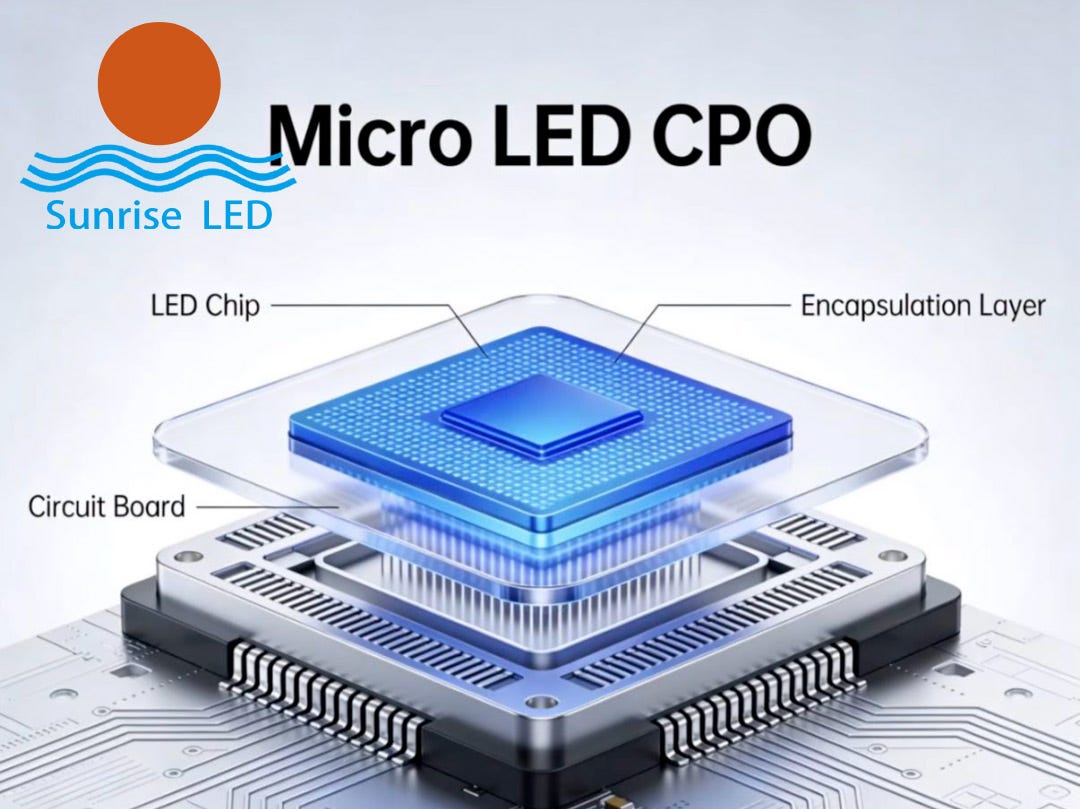
The Problem with Laser Optical Interconnects
Copper cables are cheap, reliable, and highly energy efficient. Physics limits their reach to roughly two meters. AI clusters now scale to tens of thousands of GPUs communicating at the exact same time. Copper physically cannot bridge the gaps inside a single server rack or between adjacent racks. That limitation forced the tech industry to adopt optical interconnects. Vertical Cavity Surface Emitting Lasers (VCSELs) and Distributed Feedback (DFB) lasers quickly became the backbone of pluggable optical transceivers.
Lasers introduce severe compromises at the boundary between the chip and the package. They operate above a constant threshold current. That means they draw power continuously regardless of whether any data is moving. They are highly sensitive to temperature variations and struggle with the intense heat generated by modern AI application specific integrated circuits (ASICs). Making them function reliably requires heavy digital signal processing (DSP), clock and data recovery (CDR), and forward error correction (FEC). All of these components add latency and increase power overhead. A report from Microsoft Research shows that lasers fail at rates up to 100 times higher than copper. A high failure rate creates systemic operational risks for companies running 100,000 GPU training clusters.
Hardware engineers tried to solve these issues by moving the optics closer to the chip. Co-packaged optics (CPO) integrates the optical engine directly onto the same package as the ASIC. CPO strips away pluggable transceiver modules to improve power efficiency by 3.5 times and boost reliability by 10 times compared to older architectures. Moving a laser closer to the processor does not change the fundamental physics. The heat sensitivity, the threshold current drain, and the reliability problems simply follow the laser right into the new package.
AUO and Ennostar view those persistent failures as an open door.
Why MicroLEDs Change the Hardware Paradigm
MicroLEDs do not lase. That structural difference is the foundation of the entire technology shift.
Standard LEDs operate without a threshold current. Engineers can modulate them directly from zero. The drive current drops as low as the receiver signal to noise ratio allows. Power consumption scales exactly with the data load instead of draining continuously at idle. Avicena presented compelling results at SC25 in November 2025. They drove 4 Gbps per lane at 100µA per LED. That achieved an incredible 80 femtojoules per bit in transmit energy. That number sits a full order of magnitude below the several picojoules per bit range required by laser based optical interconnects.
The thermal properties offer equal promise. MicroLEDs can push data across tens of meters. They easily survive temperature fluctuations and environmental dust that frequently disrupt laser fed fiber optical cables. Avicena even demonstrated an optical link running flawlessly at 235°C. Absolutely no commercial laser would survive that heat.
Density creates another distinct advantage. Manufacturers can monolithically integrate thousands of light sources directly onto HBM or GPU dies. The pitch between these sources sits in the micrometer range to maximize data transmission density per unit area. Engineers call this a wide and slow architecture. It swaps out a few fast, narrow laser channels for thousands of parallel, low speed MicroLED channels. Using directly modulated MicroLEDs eliminates the need for complex DSP and achieves up to 50% lower power consumption than conventional VCSEL based active optical cables (AOCs).
Hardware developers are starting to call laser configurations CPO 1.0 and MicroLED systems CPO 2.0. The first was just a packaging update. The second fundamentally rewrites how components interact.
The AUO and Ennostar Vertical Supply Chain
AUO is currently preparing to enter the co-packaged optics market for next generation AI servers. The company is using its deep roots in the display supply chain to build a fully vertically integrated system. They are combining the MicroLED manufacturing resources of Ennostar with advanced receiver technology from Tyntek. These are not three separate companies negotiating in boardrooms. They operate as a single integrated supply chain driven by a shared strategic vision. Paul Peng serves as chairman for both AUO and Ennostar.
The group is launching MicroLED CPO components built on glass RDL interposers in Taiwan. That specific manufacturing choice allows customers to adopt the hardware without investing in dedicated mass transfer equipment. Scaling MicroLEDs traditionally required highly exotic and expensive mass transfer tooling. The glass RDL interposer completely bypasses that massive financial barrier.
AUO Chief Technology Officer Liao Wei-lung explained the timeline at a recent news conference. He noted, “We believe micro LED-based CPO is very suitable for data transmission of cables of up to 10 meters. We are collaborating with AI supply chains and sending samples to customers. We are excited about the opportunity.”
Chairman Paul Peng added that the company expects optical communication modules to become a primary driver of future revenue and corporate profits.
Ennostar Chief Financial Officer Alan Wang confirmed the aggressive timeline during the Q4 2025 earnings call. He stated the company is ramping up MicroLED production right now and expects the technology to be a key growth driver through 2026 and beyond. Ennostar enters 2026 entirely debt free. Their net cash balance sheet keeps operations light and agile. The company expects operations to improve gradually throughout 2026 as they focus on long term, stable profitability.
Validation From Tech Industry Giants
Major players are already acting on these hardware breakthroughs.
A collaborative engineering team from MediaTek, Microsoft Research, and other core suppliers finalized a design for a next generation Active Optical Cable in March 2026. Miniaturized MicroLED light sources power the entire assembly. MediaTek and Microsoft formally announced they expect to commercialize the technology alongside industry partners by the end of 2027.
Andrew Tsai serves as the Associate Vice President of the Advanced R&D Center at Ennostar. He detailed the specific market need, saying, “Driven by the rapid evolution of AI computing architectures, data transmission demand is growing exponentially. Ennostar has strategically deployed three core optical source technologies to precisely address communication challenges across different transmission distances.”
TrendForce released detailed projections showing MicroLED co-packaged optics scaling rapidly in the second half of 2028. Analysts expect the specific market sector to hit $848 million by 2030. The global supply chain supporting this growth will include major names like Microsoft, MediaTek, Credo (Hyperlume), Avicena, AUO, Ennostar, and ams OSRAM.
The power savings documented by TrendForce are striking. Analysts estimate that MicroLED CPO architectures can push overall power consumption down to a mere 5% of traditional copper cable solutions. The total power draw could plummet by nearly 20 times to sit at approximately 1.6W.
Real Risks and the 2028 Timeline
None of these technical advantages guarantee commercial dominance. TrendForce points out that defining product specifications and completing strict customer sample validations will take considerable time. The estimated 2028 commercialization window gives competing technologies years to evolve. Silicon photonics could deeply entrench itself into the data center. VCSEL architectures might improve significantly. An entirely unannounced technology could suddenly emerge.
Ennostar also faces current financial realities. The company reported a net loss of NT$2.7 billion for the full year of 2025. Their immediate revenue still relies heavily on commodity LED chips built for televisions and consumer devices. The MicroLED CPO thesis plays out between 2028 and 2030 rather than tomorrow morning.
Competitors are pushing back hard. Coherent, ams OSRAM, and Lumentum are aggressively pursuing their own VCSEL based wide and slow CPO architectures. Those designs attempt to solve the same thermal and power problems while presenting a slightly lower manufacturing risk for buyers.
The Display Heritage Advantage
The market frequently dismisses AUO and Ennostar simply because they are legacy display companies. Financial analysts rarely price them as foundational AI infrastructure plays. Their combined market capitalization looks tiny compared to the optical giants who have already experienced massive valuations based entirely on early CPO enthusiasm.
That legacy display heritage provides a massive structural moat. TrendForce researchers note that Taiwanese optoelectronics manufacturers hold incredibly strong capabilities in MicroLED fabrication, mature optical design, and precise light field control. Those specific legacy skills position them perfectly to develop MicroLEDs as a highly efficient and cost effective light source for optical communications.
Lasers controlled datacenter interconnects for two solid decades. They are incredibly fast, deeply understood by engineers, and firmly entrenched in the hardware supply chain. The staggering energy bill attached to modern AI infrastructure is forcing companies to rethink everything. MicroLEDs do not need to capture the entire global interconnect market to succeed. They simply need to win the short reach, high scale interconnect layer directly inside the AI server racks.
Disclaimer:
All views expressed are my own and are provided solely for informational and educational purposes. This is not investment, legal, tax, or accounting advice, nor a recommendation to buy or sell any security. While I aim for accuracy, I cannot guarantee completeness or timeliness of information. The strategies and securities discussed may not suit every investor; past performance does not predict future results, and all investments carry risk, including loss of principal.
I may hold, or have held, positions in any mentioned securities. Opinions herein are subject to change without notice. This material reflects my personal views and does not represent those of any employer or affiliated organization. Please conduct your own research and consult a licensed professional before making any investment decisions.