

FSLR 0.00%↑
NXT 0.00%↑
TE 0.00%↑
TAN 0.00%↑
A fascinating shift is happening in American solar energy right now. The current administration has slashed subsidies, introduced heavy tariffs, and signed the One Big Beautiful Bill Act to accelerate a green energy phase-out. These specific moves are actively forcing the creation of a deeply resilient, highly innovative, and fully domestic solar sector. We are looking at a strict market consolidation phase where weak companies disappear and strong operations capture the remaining demand.
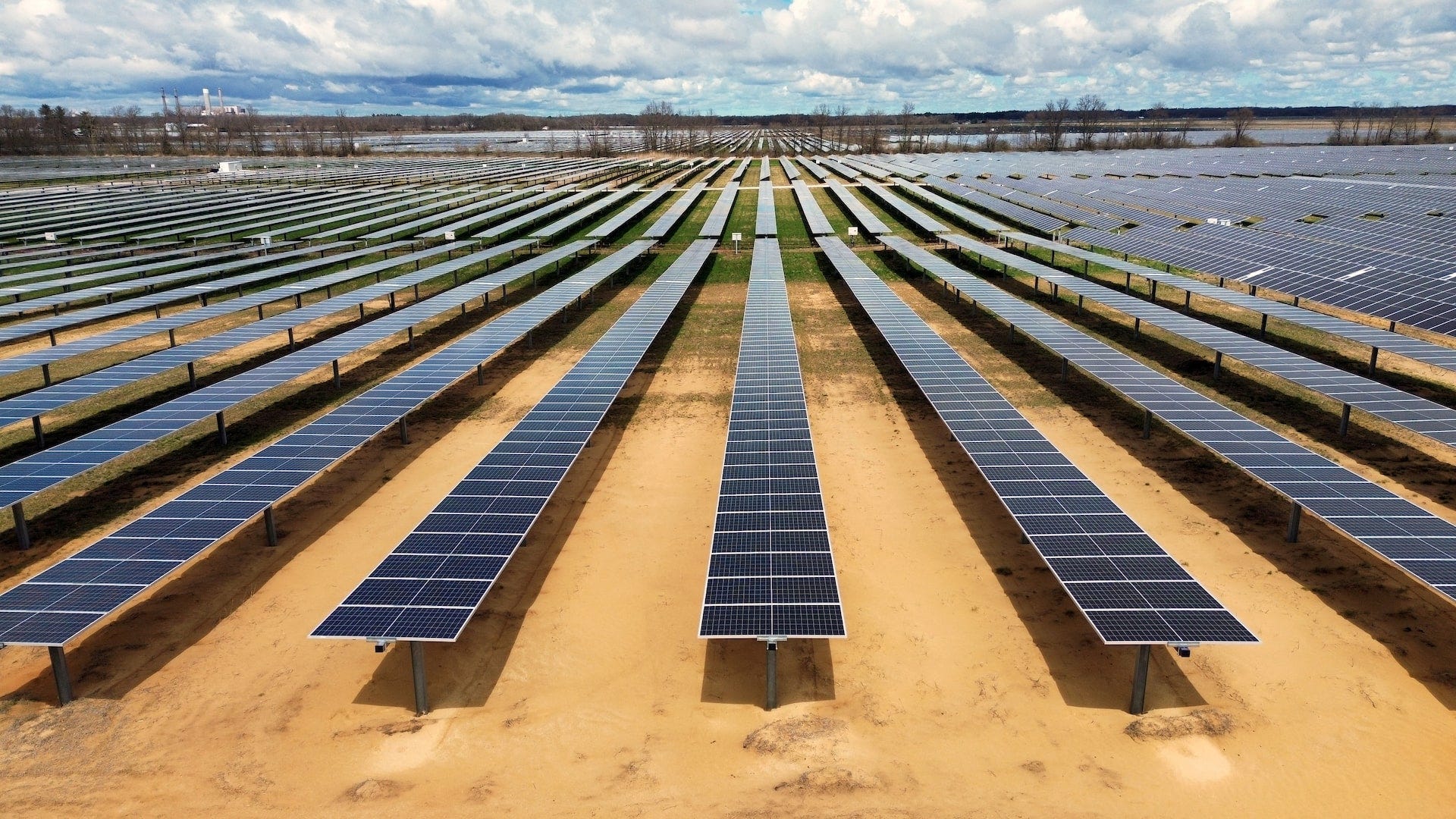
Market Consolidation and the End of Subsidy Reliance
US solar installations dropped 14% in 2025. Utility-scale solar fell by 16%, and community solar plummeted 25%. Congress passed the One Big Beautiful Bill Act last July to phase out green energy subsidies. The Solar Energy Industries Association called this a significant policy shift for the entire sector.
Companies relying heavily on government support are facing severe financial pressure. The residential solar market took a massive hit when the 30% federal tax credit for customer-owned systems vanished at the end of 2025. Forecasts point to an 18% drop for residential installations in 2026.
Harsh market environments naturally clear the field. We saw the exact same pattern with Chinese solar manufacturers in 2025. The top five Chinese solar companies (LONGi, Tongwei, JA Solar, TCL Zhonghuan, and Aiko Solar) projected combined losses of $4.1 to $4.7 billion for the year. They previously survived by flooding the market with subsidized panels priced between $0.07 and $0.09 per watt. China eventually removed export subsidies, and the US imposed tariffs reaching up to 3,500% on Southeast Asian transshipment routes. Over 40 Chinese solar firms delisted, went bankrupt, or were sold since 2024. The US market is undergoing a similar purification process today.
First Solar (FSLR) Benefits From Deep Domestic Roots
First Solar perfectly illustrates this market shift. The company reported record Q1 2026 revenue of $1.0 billion, representing a 24% year-over-year increase. They achieved a 47% gross margin and $520 million in adjusted EBITDA. That performance beat the top end of their own guidance range. First Solar is running its US facilities at 96% utilization.
The success comes from structural advantages rather than short-term market cycles. First Solar uses proprietary Cadmium Telluride (CdTe) thin-film technology. They own and control the entire manufacturing process from end to end, as noted in their 2025 Annual Report. They do not rely on silicon from Chinese polysilicon supply chains. CdTe panels perform better in high heat and low light. They also require less energy to manufacture.
The company recently launched the CuRe semiconductor platform at its Perrysburg, Ohio facility. This technology is expected to produce up to 8% more lifetime specific energy yield than competing crystalline silicon TOPCon modules. Utility-scale buyers pay close attention to that kind of baseline performance increase.
First Solar also benefits from the Section 45X advanced manufacturing tax credit. This credit added $1.6 billion to the company’s gross margin in 2025. Foreign competitors cannot access these funds. US factories are fully booked for 2026. CEO Mark Widmar explained on the Q1 2026 earnings call that customers place growing value on differentiated technology, a domestic manufacturing footprint, and independence from foreign supply chains.
Nextracker (NXT) Captures Surging Grid Demand
First Solar builds the panels, and Nextracker makes those panels significantly more efficient. Nextracker has reigned as the top global solar tracker manufacturer for ten straight years. They combine hardware with advanced software like TrueCapture yield management and the NX Horizon Hail Pro series. These systems turn static solar panels into intelligent energy assets that track the sun for maximum daily output.
Nextracker reached $864 million in Q1 FY2026 revenue, marking a 20% year-over-year increase. The company raised its full-year FY2026 guidance to a range of $3.425 to $3.5 billion in revenue, with adjusted EBITDA projected between $810 and $830 million. They also reported a massive $4.75 billion backlog. Sequential quarter-over-quarter growth shows accelerating demand for premium tracker systems built with domestic materials.
A major catalyst for this growth is the rapid expansion of AI data centers. Data center energy consumption is expanding at a 12% compound annual growth rate. Capacity market clearing prices in the PJM grid region jumped over tenfold between the 2024 to 2025 and 2026 to 2027 delivery years. The national average residential electricity rate climbed to 17.45 cents per kWh in January 2026, marking a 9.5% year-over-year increase. Utility-scale solar remains the fastest and most cost-effective way to add bulk power to the grid. The market currently prices many solar stocks as policy-dependent entities. The underlying numbers actually point to critical infrastructure companies serving a massive electricity supercycle.
T1 Energy (TE) and the Push for American Silicon Solar
First Solar represents established domestic dominance. T1 Energy (NYSE: TE) operates as an aggressive new market entrant. Until early 2025, T1 operated as FREYR Battery, a Norwegian battery SPAC. The company executed a massive transaction in December 2024 and pivoted directly into US solar module manufacturing. They rebranded, moved their focus to Texas, and set out to build a fully vertically integrated silicon-based solar supply chain entirely on American soil. They want to control everything from polysilicon to the finished module.
The physical footprint is expanding quickly. T1 operates G1_Dallas in Wilmer, Texas. This is a fully functional 5 GW module factory employing over 1,200 workers. The company is actively building G2_Austin, a 2.1 GW solar cell fabrication plant in Rockdale, Texas. Concrete foundation work is underway, and they target initial cell production for Q4 2026. CEO Daniel Barcelo stated on the Q1 2026 earnings call that T1 aims to power America with scalable, reliable, low-cost energy.
T1 secured hard contracts to back up these goals. They locked in American-made polysilicon from Hemlock Semiconductor, solar wafers from Corning’s Michigan campus, and domestic steel frames from Nextracker. When G2 comes online in the second half of 2026, T1 expects to produce modules using exclusively US-manufactured components. Navigating Foreign Entity of Concern (FEOC) rules, domestic content bonuses, and Section 232 tariff investigations requires a domestic supply chain. T1 is building that protective moat right now.
The Q1 2026 financials show rapid transition. Revenue hit $177.65 million compared to $53.45 million the year before. That 232% surge reflects the scaling of G1_Dallas. Adjusted EBITDA reached a record $9.1 million for the quarter. Gross margins widened to 17%, up roughly ten percentage points from the prior quarter. Net income from continuing operations reached $3.9 million, marking their first operating profit. The company maintained its 2026 production guidance of 3.1 to 4.2 GW from G1_Dallas. Once the 2.1 GW G2 facility fully integrates with the 5 GW G1 capacity, management projects an annualized run-rate adjusted EBITDA of $375 to $450 million for 2027.
Regulatory Hurdles and Market Volatility
The path forward involves significant turbulence. In late May 2026, short-seller Fuzzy Panda Research released a report accusing T1 Energy of maintaining undisclosed ties to Chinese solar company Trina Solar through a Singapore-based entity named Evervolt. The central issue revolves around intellectual property. Fuzzy Panda alleges that T1 transferred IP to Evervolt in a way that violates FEOC rules. They point to February 2026 IRS guidance establishing a July 4, 2025 deadline for IP licensing agreements. If T1 missed that deadline, they could lose eligibility for the Section 45X manufacturing tax credits holding up their financial model.
T1 pushed back heavily against these claims. They detailed a comprehensive set of FEOC compliance actions completed in late 2025 and early 2026. These steps included amending corporate charter limits on FEOC equity, removing Trina Solar’s right to appoint covered officers, executing the IP transfer to Evervolt, and buying non-FEOC certified cells for 2026 production. T1 also completed a $160 million sale of Section 45X tax credits to an investment-grade US buyer in December 2025. That transaction shows at least one major US financial player feels confident in T1’s tax credit eligibility.
Resolving this regulatory dispute is a massive binary event for the stock. The ongoing Section 232 investigation into foreign polysilicon adds another variable. Management noted that new tariffs on foreign materials could increase domestic pricing, which heavily favors T1 due to their US polysilicon supply agreements. If T1 clears the FEOC hurdle and brings G2_Austin online in Q4 2026, they will offer exactly what the US market needs. Management indicated that indicative demand for G1 and G2 offtake contracts already exceeds their anticipated production capacity for 2027 and 2028.
Invesco Solar ETF (TAN) Navigates Sector Volatility
Investors looking for broad exposure often turn to the Invesco Solar ETF (TAN). You have to understand the specific dynamics of this fund. TAN holds shares in highly profitable survivors as well as weaker players that still rely heavily on friendly policy environments. The 52-week range of the ETF highlights this ongoing volatility. Prices have swung from under $26 to nearly $50. Market consolidation should ultimately benefit TAN over time. As weaker companies fade out, the index will naturally shift its weight toward the most innovative and resilient businesses. The immediate future will likely remain noisy.
The Infrastructure of the Next Economy
Stripping away government subsidies forces companies to survive on the strength of their technology and market demand. The current US solar environment looks very similar to the tech sector in 2000 and 2001. The market is clearing out speculative froth and rewarding companies with genuine intellectual property and strong domestic operations.
The Lawrence Berkeley National Laboratory expects electricity demand from AI data centers to reach between 325 and 580 TWh by 2028. Tech companies and utilities need fast solutions to power these facilities. Solar provides rapid deployment capabilities compared to other major energy projects. Companies possessing domestic manufacturing power, clear intellectual property, and zero exposure to unstable foreign supply chains are positioning themselves at the center of the American energy grid. The strict policies intended to dial back renewable energy might actually force the US solar industry to become permanent and entirely self-sufficient.
Disclaimer:
All views expressed are my own and are provided solely for informational and educational purposes. This is not investment, legal, tax, or accounting advice, nor a recommendation to buy or sell any security. While I aim for accuracy, I cannot guarantee completeness or timeliness of information. The strategies and securities discussed may not suit every investor; past performance does not predict future results, and all investments carry risk, including loss of principal.
I may hold, or have held, positions in any mentioned securities. Opinions herein are subject to change without notice. This material reflects my personal views and does not represent those of any employer or affiliated organization. Please conduct your own research and consult a licensed professional before making any investment decisions.