

Nvidia executive Edward Lee praised GlobalFoundries in a press release back in early 2022. He noted their new silicon photonics platform would boost high performance computing and enable breakthrough advances. Most investors simply ignored the comment. Back then, the public viewed GlobalFoundries as a company that had lost the advanced logic chip race to TSMC and Samsung. People thought the company was just making the best of a bad situation in specialty chips. Ignoring that quote was a miscalculation.
Four years later, the company has doubled down on that exact specialty focus. They have built a complete photonics manufacturing system that no competitor has managed to copy. Understanding why this gives them an advantage requires looking past standard corporate updates and diving directly into the hardware.
The Core Manufacturing Challenge
Silicon photonics is the science of building chips that guide light instead of electricity using standard silicon wafers. The main hurdle is that optical components like modulators and light detectors need completely different materials and shapes than standard electronic transistors. For years, the industry solved this by building optical circuits on dedicated assembly lines and then gluing them to electronic chips later. This packaging process is complex and expensive.
The massive growth of AI data centers makes that old method physically and financially impossible. A single rack of powerful processors like the H100 demands so much data that standard copper wires cannot keep up. Copper simply uses too much power and generates too much heat. Industry experts now expect that by 2030, roughly 70 percent of networking ports in massive data centers will rely on light. Every new computing cluster is designed around this reality. The manufacturer that can print optical components and high speed electronics on the exact same piece of silicon stands to win a massive amount of business.
Printing Light and Logic Together
Most factories build silicon photonics on specialized 180 nanometer or 90 nanometer production lines. The resulting optical devices work well, but they must be attached to separate electronic chips. Every connection between two separate chips adds cost, takes up physical space, and weakens the data signal.
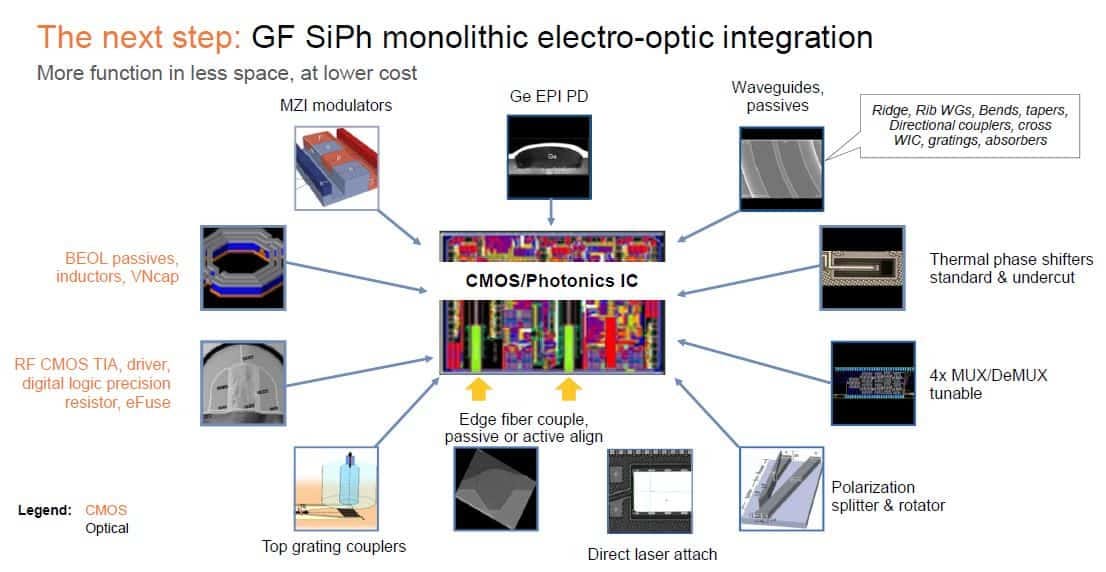
GlobalFoundries takes a different route with its GF Fotonix platform. The company builds these chips using a 45 nanometer process at its factory in Malta, New York. The optical and electronic components live on the exact same piece of silicon. They go through the same manufacturing steps on large 300 millimeter wafers. Engineers call this single chip approach monolithic integration.
The real advantage hides in the microscopic details. Internal technical documents show this monolithic approach reduces interconnect capacitance fivefold. That physical change alone adds 10 gigahertz of bandwidth. GlobalFoundries also uses components called microring resonators. These tiny parts hit 80 gigahertz of bandwidth while remaining 100 times smaller than the standard Mach-Zehnder modulators most competitors use. In a cramped chip environment where every millimeter costs money and power, this massive size reduction is a huge economic advantage. The platform also natively supports both coarse and dense wavelength division multiplexing. Customers do not have to fight the hardware to build the specific network architecture they want.
The Critical High Speed Infrastructure
This optical technology relies heavily on another specialized manufacturing process. GlobalFoundries operates a factory in Burlington, Vermont that produces silicon germanium components. These high speed analog parts are absolutely vital for massive networks.
Every single optical connection in a data center requires transimpedance amplifiers and drivers. These parts translate electrical signals from the computer into light signals for the network, and then back again. GlobalFoundries holds industry leading speed ratings for these specific parts. Faster parts mean cleaner signal conversion, less background noise, and less lost data. This difference dictates whether a network link runs flawlessly at 200 gigabits per lane or struggles to get past 100.
In May 2026, CEO Tim Breen mentioned that the Vermont factory is fully booked well into 2027. Customers are even discussing upfront payments just to secure their place in line. Companies only offer advance payments when they absolutely cannot find the technology anywhere else.
Meeting the New Industry Standard
In May 2026, GlobalFoundries released a new platform called SCALE. This system handles co-packaged optics, meaning the optical components are built directly into the main chip package. SCALE is the first platform certified to meet a new industry standard created in March 2026. A group including AMD, Broadcom, Nvidia, Meta, Microsoft, and OpenAI wrote that standard based largely on what GlobalFoundries had already proven was technically possible.
A key feature of SCALE is how cleanly it moves light from the chip into the fiber optic cable. Older methods often lost signal quality depending on the exact color or wavelength of the light. GlobalFoundries solved this with a flat insertion loss profile. The system can handle four wavelengths of light per fiber and scale up to eight or more without needing a total redesign.
This level of performance requires incredibly advanced packaging techniques. The company relies on methods like hybrid bonding and through-silicon vias. They spent more than ten years perfecting these manufacturing tricks, starting when co-packaged optics were still just a theoretical concept. The result is a system that competitors will spend years trying to copy.
Comparing the Foundry Landscape
The list of companies that can actually manufacture this technology is short, and the technical gaps between them are wide.
GlobalFoundries builds everything on one chip, meets the newest industry standards, handles its own advanced packaging, and processes large 300 millimeter wafers in New York and Singapore.
TSMC offers a competing system called COUPE. TSMC is famous for its excellent packaging technology, but COUPE still relies on stacking a separate electronic chip on top of an optical chip. They are targeting high volume production in 2026, but their product does not yet meet the new industry standards that GlobalFoundries already exceeds.
Tower Semiconductor is a serious player but uses separate chips for electronics and optics. Their analog parts are fast but sit slightly behind the top speeds out of Vermont. They are also still building out their in-house packaging capabilities.
Samsung remains several years behind. They are publicly aiming for a complete packaged optics solution by 2029.
From Digital File to Finished Product
In late 2025, GlobalFoundries purchased two companies. One was Advanced Micro Foundry in Singapore, and the other was InfiniLink in Cairo. These purchases completed a massive puzzle. A customer can now hand over a basic digital circuit design file and receive a fully tested, finished optical module in return.
Nobody else offers this complete chain. InfiniLink helps speed up the initial chip design with in-house technology. The factories in New York and Singapore print the wafers. The Vermont factory provides the high speed amplifiers. The packaging teams attach the fiber optics. Finally, a completed optical engine rolls off the line ready to be installed in a data center.
Defending Fifteen Years of Research
Intellectual property is heavily guarded in this space. In March 2026, GlobalFoundries sued Tower Semiconductor in Texas and at the U.S. International Trade Commission. The lawsuit claims Tower violated 11 patents covering analog, radio frequency, and photonics manufacturing. GlobalFoundries holds more than 8,000 patents, while Tower holds fewer than 500.
GlobalFoundries is asking the trade commission to ban Tower from importing the products in question. Tower manufactures a large portion of its optical chips at a facility in Japan. If a ban takes effect, major U.S. cloud companies would face a sudden supply shock. GlobalFoundries would be the only manufacturer capable of stepping in at the required scale.
A Strategy Shift That Paid Off
Back in 2018, GlobalFoundries made the difficult decision to stop competing in the race to build the absolute smallest logic chips. They redirected their capital toward specialty technologies like radio frequency, power management, and silicon photonics. Observers called it a retreat at the time.
Looking back, it was a highly accurate prediction of where the hardware market was heading. The AI boom created a projected 34 billion dollar market for optical chips. GlobalFoundries spent the quiet years building every single layer needed to serve that market. They perfected the single chip designs, the microscopic light resonators, the high speed analog components, and the advanced packaging. While competitors scramble to assemble these pieces today, GlobalFoundries already has the entire system running at scale.
Disclaimer:
All views expressed are my own and are provided solely for informational and educational purposes. This is not investment, legal, tax, or accounting advice, nor a recommendation to buy or sell any security. While I aim for accuracy, I cannot guarantee completeness or timeliness of information. The strategies and securities discussed may not suit every investor; past performance does not predict future results, and all investments carry risk, including loss of principal.
I may hold, or have held, positions in any mentioned securities. Opinions herein are subject to change without notice. This material reflects my personal views and does not represent those of any employer or affiliated organization. Please conduct your own research and consult a licensed professional before making any investment decisions.