

TSM 0.00%↑
NVDA 0.00%↑
MU 0.00%↑
SNDK 0.00%↑
NVDA 0.00%↑
SKHY 0.00%↑
AMD 0.00%↑
INTC 0.00%↑
ASML 0.00%↑
Asian chip markets are taking a direct hit as Chinese tech companies close the gap across every layer of the artificial intelligence stack at the exact same time.
A Historic Drop in Asian Semiconductor Markets
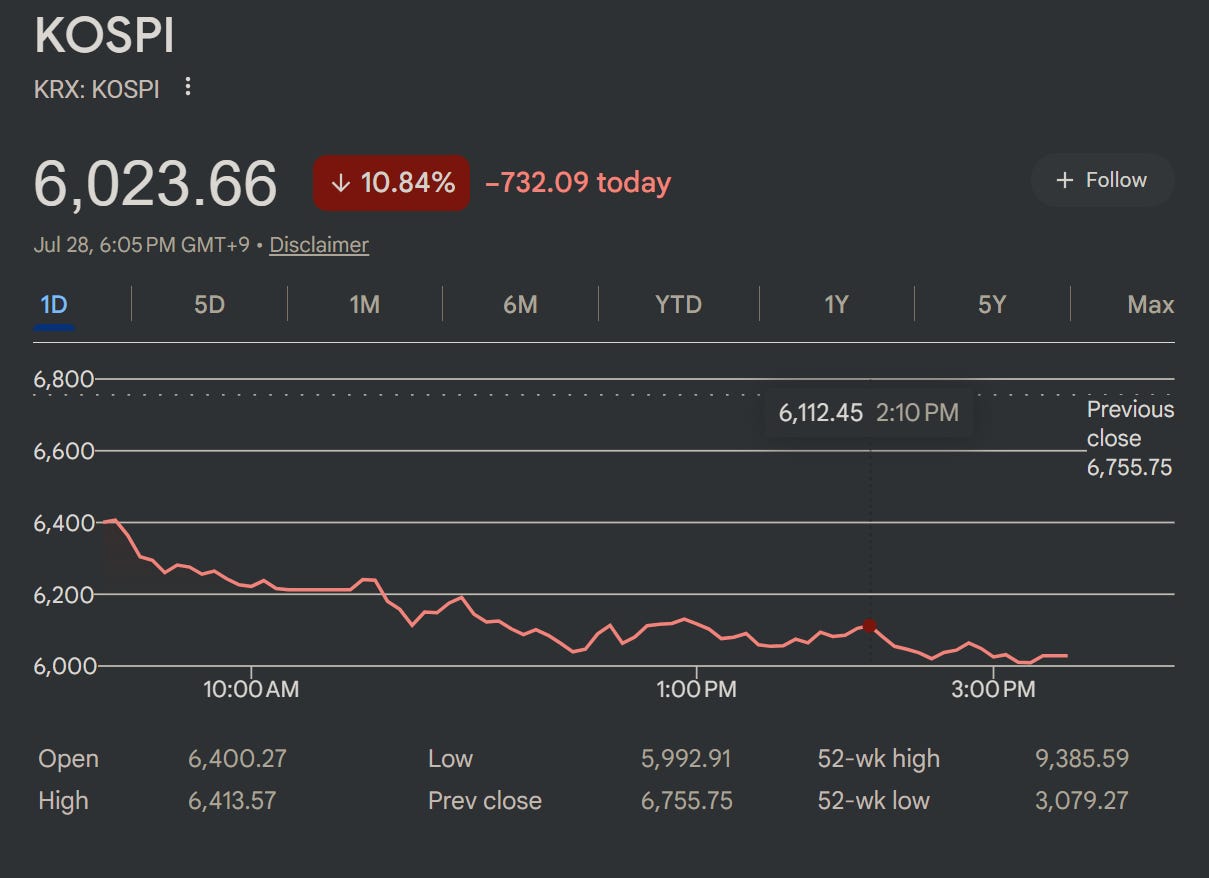
On Tuesday, July 28, South Korea’s KOSPI index plummeted 10.8 percent. That marked its worst single day drop since the early conflicts between the U.S. and Iran in March. Samsung Electronics closed down 13.4 percent, recording its steepest one day fall in nearly twenty years. SK Hynix dropped 14.7 percent. These two tech giants make up almost half of the index. When they stumble, the entire Seoul exchange falls with them.
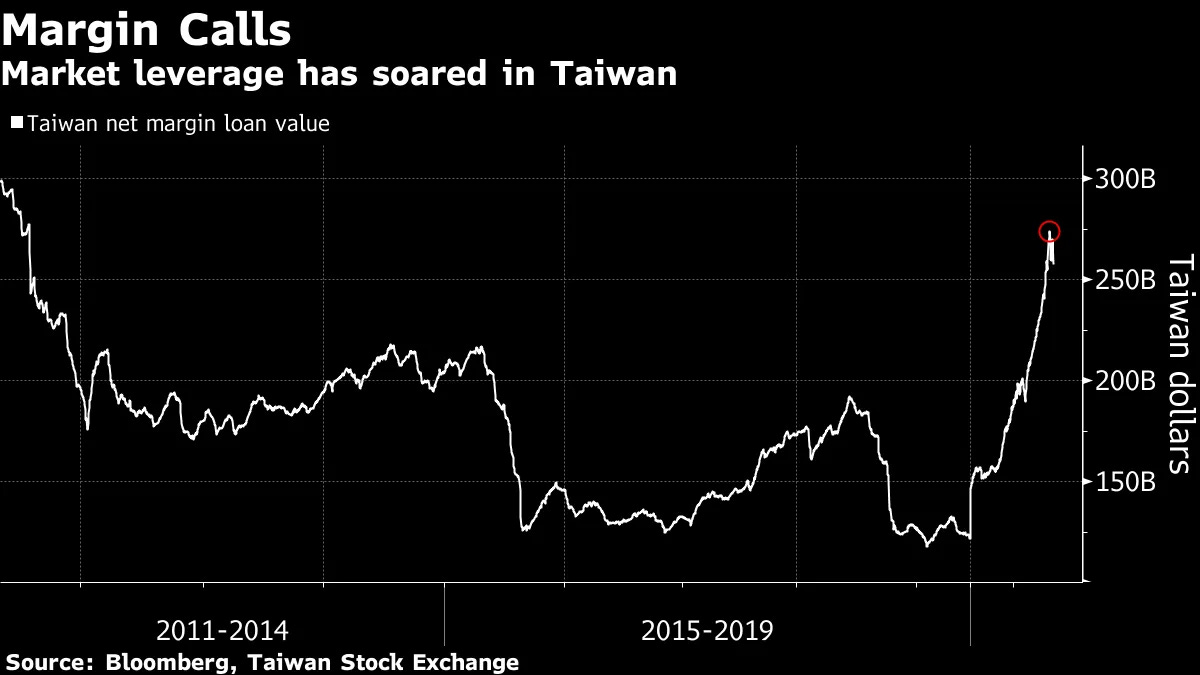
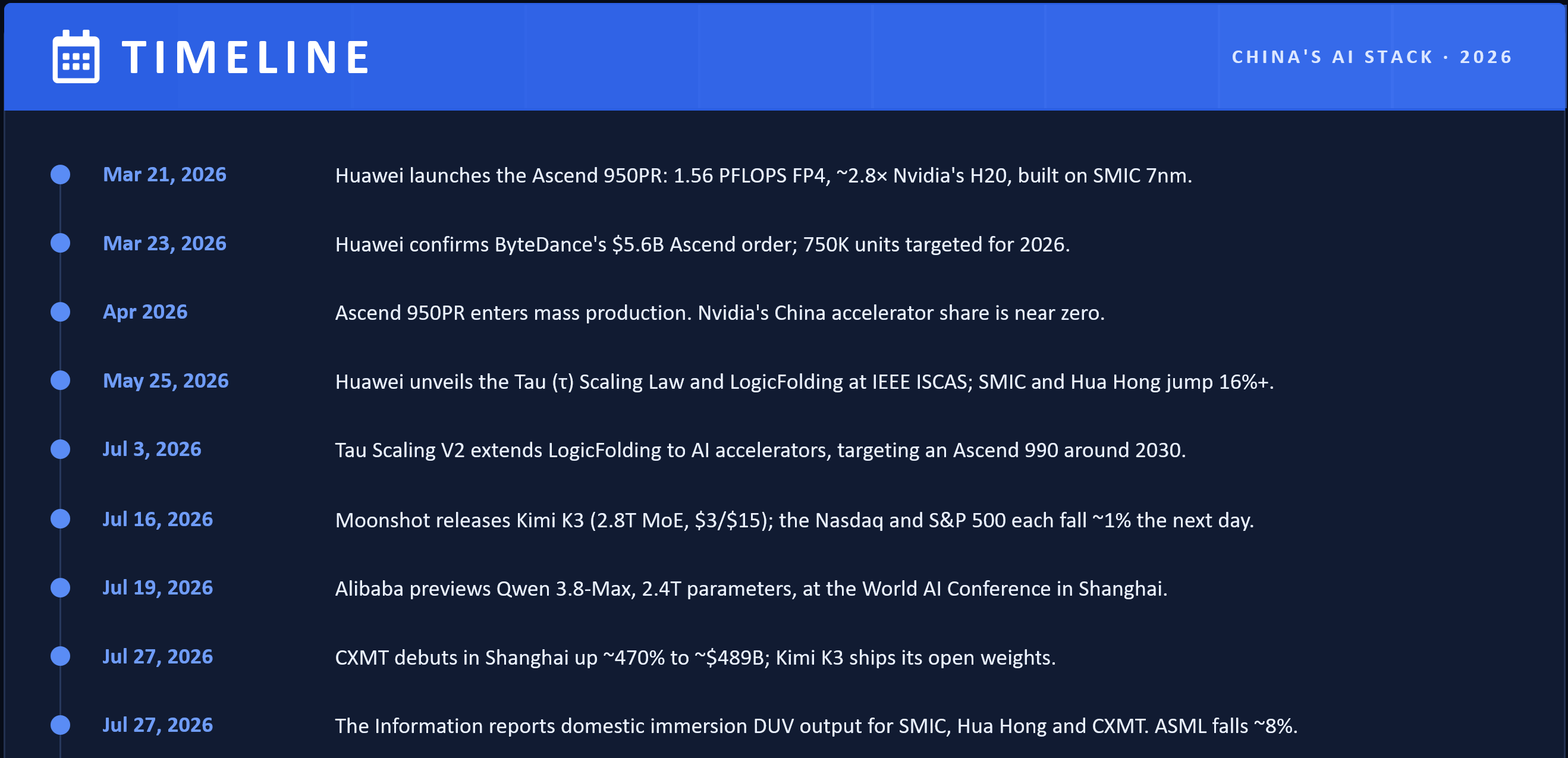
The shockwaves quickly spread across the region. Taiwan’s TAIEX index shed 2,030 points to close at 41,603. That 4.65 percent drop ranks as the third largest single day point decline in its history. Japan’s Kioxia fell 18.3 percent, and MediaTek lost nearly 10 percent. A Bloomberg gauge tracking Asian semiconductor shares slumped 7.5 percent for its worst day since April 2025. Over in the United States, the Nasdaq 100 fell 1.8 percent and edged closer to a market correction. The Philadelphia Semiconductor Index logged a fourth straight losing session. ASML had already taken a rough 8 percent hit the day before.
A New Contender in Deep Ultraviolet Lithography
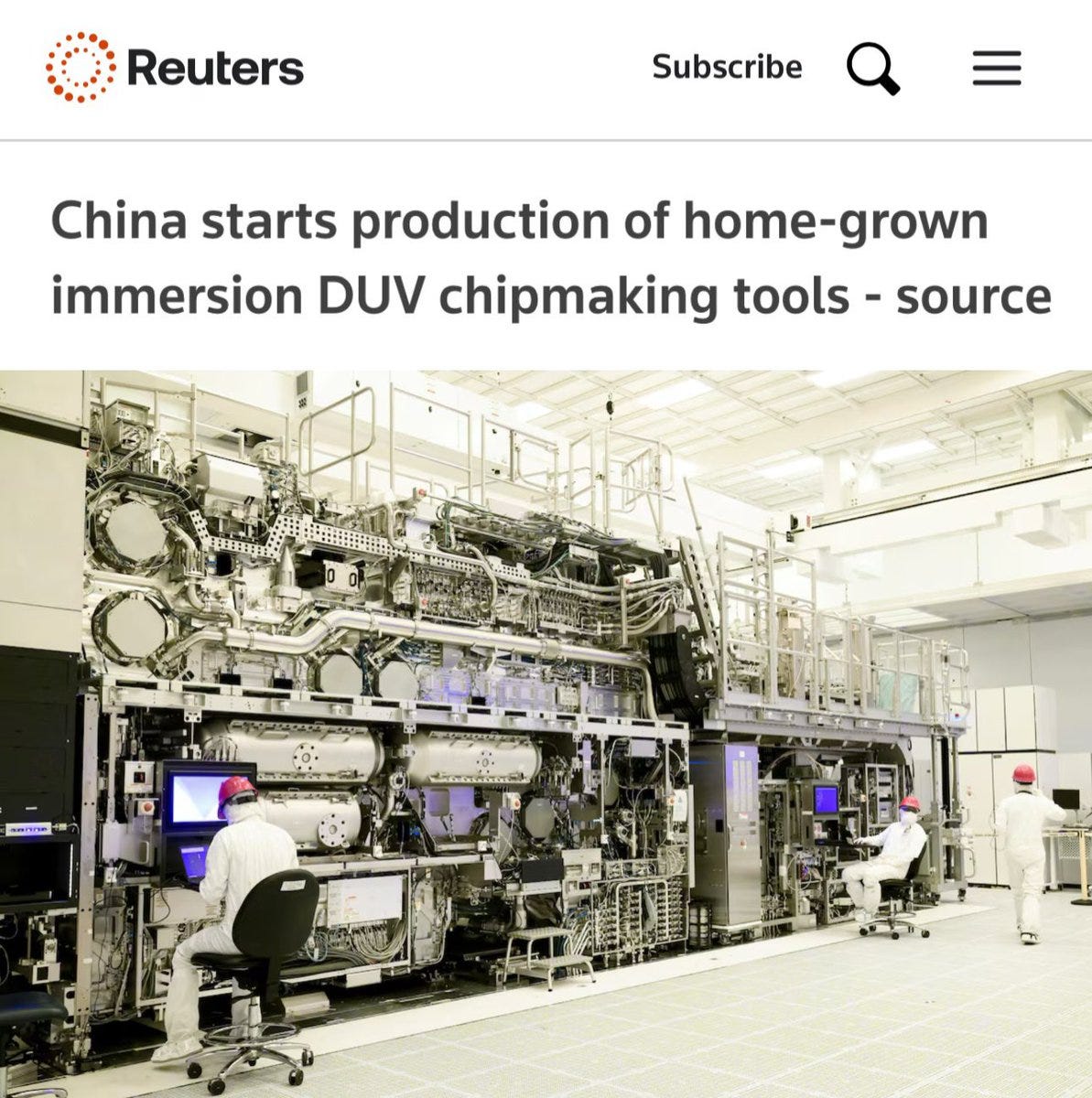
A report in The Information sparked the initial market panic. A state backed company in Shanghai has started manufacturing domestically developed immersion deep ultraviolet lithography machines. Reuters later identified the producer as Shanghai Aishengna Electronic Technology Group. This little known state owned entity absorbed engineering teams from several Chinese lithography startups. One of those startups is Shanghai Yuliangsheng Technology. SMIC has reportedly been testing their tools since September 2025.
Looking at the raw numbers makes the market reaction look a bit extreme. The production plan calls for roughly five machines in 2026 and about twenty in 2027. These early units will go to SMIC, Hua Hong, and ChangXin Memory Technologies for initial line qualification. For context, ASML shipped 131 immersion systems in 2025 and holds around 98.7 percent of that specific market. Critical components inside the new Chinese tools still rely on suppliers in Japan.
Analysts at SemiAnalysis pointed out several massive hurdles for the newcomer. Tool performance, fleet reliability, the surrounding supply chain ecosystem, and the tough economics of competing against fully depreciated ASML machines all create heavy friction. Scaling the actual production of these complex machines remains the most underestimated challenge. Qualifying an unfamiliar lithography tool for a mass production line takes months at a bare minimum.
Rebuilding the AI Architecture from the Ground Up
Market participants reacted so strongly because a complete technological stack has been forming from the bottom up over the past eighteen months.
On May 25 at the IEEE International Symposium on Circuits and Systems in Shanghai, Huawei executive He Tingbo revealed the Tau Scaling Law. A Chinese firm has now proposed a guiding principle for global semiconductor development for the very first time. The strategy ignores the traditional race to shrink physical transistors. Huawei aims to compress signal delay across the entire computing stack using a three dimensional architecture called LogicFolding. The company claims 55 percent higher transistor density and 41 percent better power efficiency without needing extreme ultraviolet lithography equipment.
Huawei says it has already designed and mass produced 381 chips using this framework. They project achieving 1.4 nanometer equivalent density by 2031. A follow up paper released on July 3 extended this roadmap from mobile chips to AI accelerators. They are targeting an Ascend 990 chip around 2030. TSMC and Intel aim to hit a true 1.4 nanometer node around 2029. Huawei remains behind the cutting edge. The company claims it can approach the frontier through creative design at older nodes, rendering equipment restrictions a necessary but insufficient roadblock.
![News] Huawei Expands Tau Scaling Law V2 Paper, Highlighting LogicFolding Path to Ascend AI Chips in 2030](https://substackcdn.com/image/fetch/$s_!W7ZG!,f_auto,q_auto:good,fl_progressive:steep/https%3A%2F%2Fsubstack-post-media.s3.amazonaws.com%2Fpublic%2Fimages%2F28ec3fc4-f2f8-4de0-bded-1d4db3a8cb5d_7200x3768.jpeg "News] Huawei Expands Tau Scaling Law V2 Paper, Highlighting LogicFolding Path to Ascend AI Chips in 2030")
Rolling Out Powerful AI Accelerators
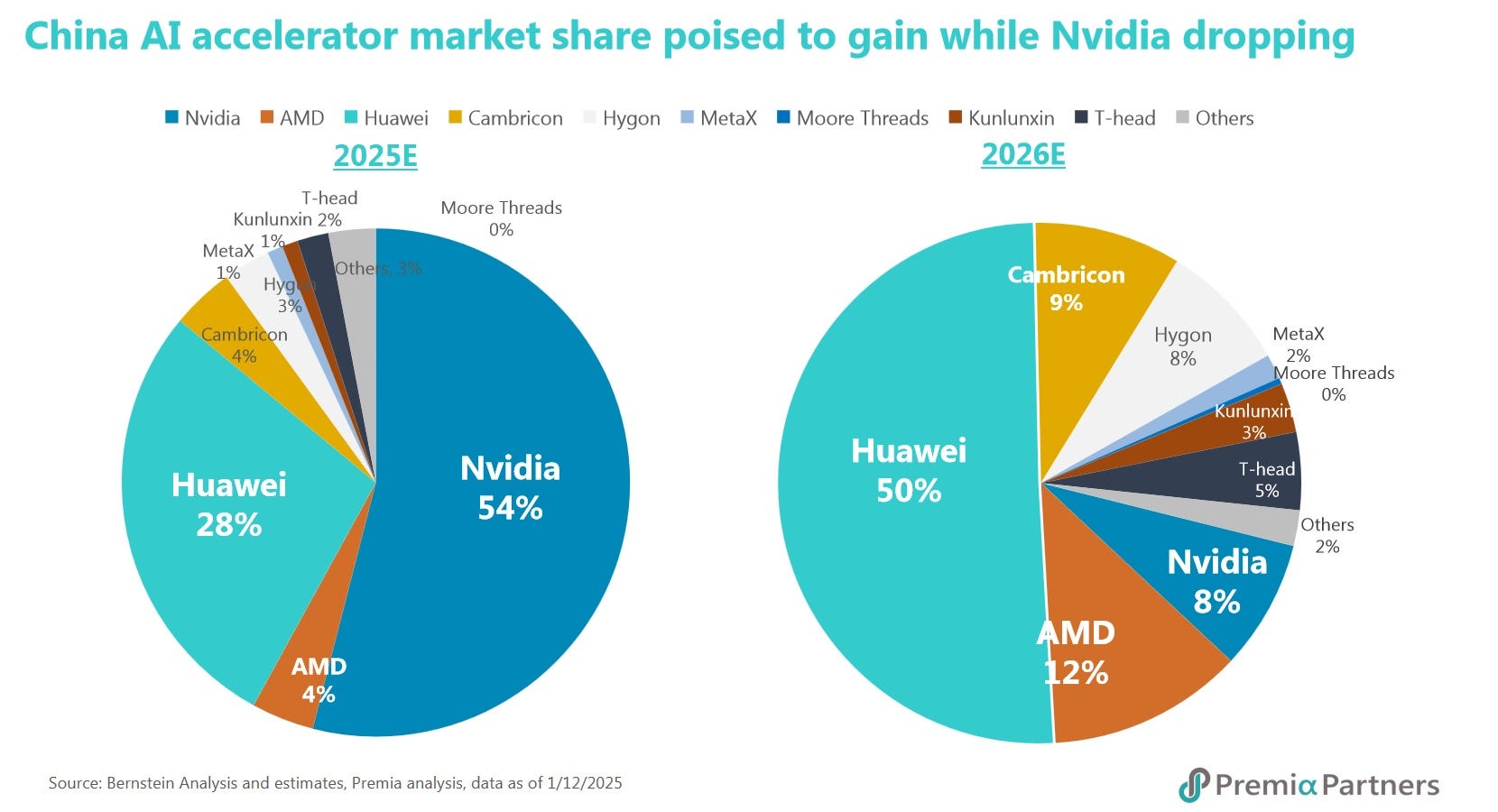
The Ascend 950PR launched in March using the SMIC 7 nanometer DUV process. It delivers about 1.56 PFLOPS of FP4 computing power. That equals roughly 2.8 times the throughput of the H20. The H20 was the most capable Nvidia part China could legally buy before Nvidia saw its Chinese market share drop to almost zero. Huawei chose a monolithic die design rather than using smaller connected chiplets. That engineering choice completely bypasses any dependence on TSMC packaging technology.
Major buyers are lining up to acquire the hardware. ByteDance committed 5.6 billion dollars. Alibaba Cloud and Tencent placed massive orders. Huawei targets 750,000 units this year. Reports indicate they will sell Ascend 950 series parts and Atlas 950 SuperPods into South Korea during the fourth quarter. They are stepping directly into Nvidia territory.
Massive Growth in the Memory Sector
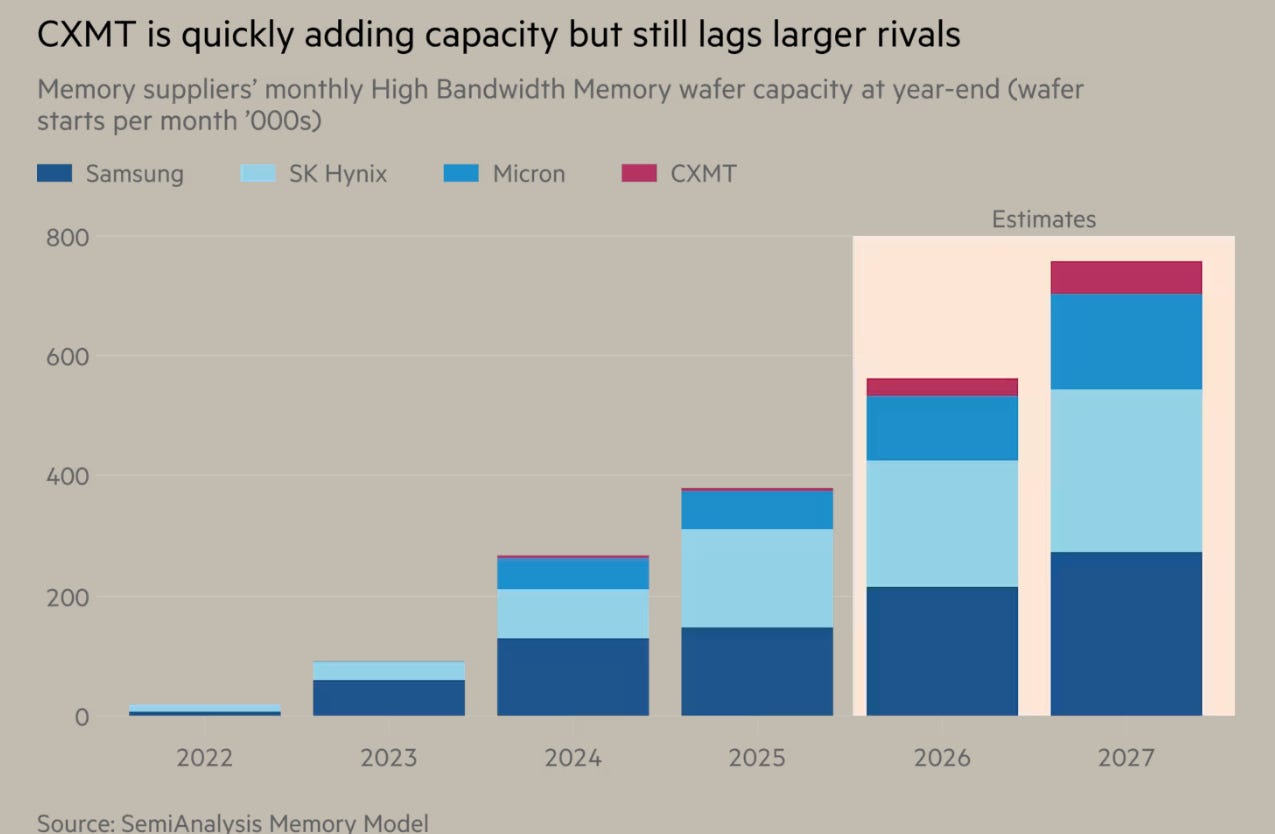
CXMT listed in Shanghai on July 27 in mainland China’s largest IPO in years. The company raised 8.56 billion dollars and its stock surged roughly 470 percent on debut. The market capitalization sits near 489 billion dollars. Revenue reached 50.8 billion yuan in the first quarter alone, jumping more than 700 percent year over year. CXMT holds between 8 and 10 percent of the global DRAM market. Projections show the company ending 2026 at around 350,000 wafer starts per month. That puts them in close range of Micron, which handles between 375,000 and 385,000 starts.
Pushing Boundaries with Large Language Models
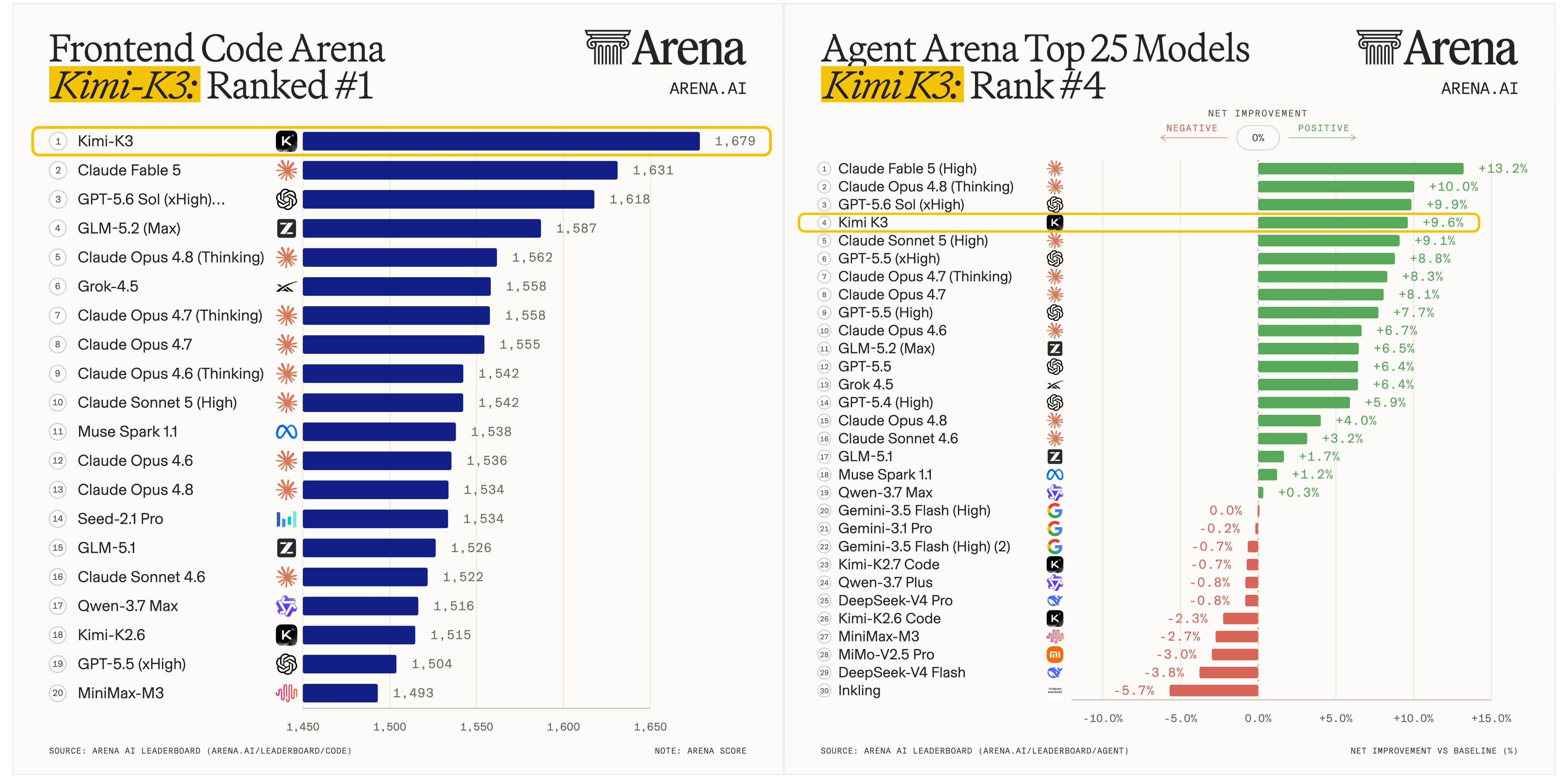
Moonshot released the Kimi K3 model on July 16. It features 2.8 trillion parameters, a mixture of experts architecture, and a one million token context window. The model took the top spot on the Arena Frontend Code leaderboard and ranked fourth on the Artificial Analysis Intelligence Index. The pricing sits at $3 for input and $15 for output per million tokens. That makes it several times cheaper than top tier Western alternatives. The model weights shipped on July 27. Alibaba previewed the Qwen 3.8-Max at the World AI Conference in Shanghai just three days later. That model boasts 2.4 trillion parameters.
The Perfect Storm for Legacy Chip Giants
Design methods, raw silicon, memory chips, AI models, and the physical tools required to print the silicon all advanced at the same time.
South Korea and Taiwan took heavy market damage because their local exchanges rely on highly concentrated tech sectors. Their premier companies are heavily exposed to the exact market segments Chinese competitors can reach right now. Han Ji-young of Kiwoom noted the new DUV equipment headlines sparked fears of aggressive Chinese memory expansion. CXMT competes directly in commodity DRAM today. The biggest three memory makers abandoned conventional DRAM to chase high bandwidth memory margins. CXMT gladly filled that void. DDR5 contract prices roughly doubled quarter over quarter during the first quarter. Investors are pricing a temporary supply gap as a permanent market shift.
Current Limits of the Chinese Expansion
The negative outlook for Western and allied chipmakers still has strict boundaries. CXMT faces a cost per bit that runs more than 30 percent higher than established industry leaders. Their high bandwidth memory technology lags one to two generations behind. Mass production of HBM3E is not targeted until 2027, and under 2 percent of current capacity is allocated to it today. Samsung and SK Hynix have the flexibility to swing their massive capacity back to commodity DRAM within a few quarters at much better costs. Financial markets also shook off the DeepSeek tech scare very quickly back in January 2025.
The Final Repricing
Investors are not declaring a final victory for the Chinese semiconductor industry. They are aggressively repricing a monopoly premium. The market previously assumed that ASML, TSMC, and the Korean memory duopoly faced absolutely no credible substitutes at any price point. That assumption is fading right as anxiety grows over how the global AI buildout will actually be financed. Mixing a sudden lack of monopoly safety with shaky funding narratives creates brutal trading days like Tuesday.
Disclaimer:
All views expressed are my own and are provided solely for informational and educational purposes. This is not investment, legal, tax, or accounting advice, nor a recommendation to buy or sell any security. While I aim for accuracy, I cannot guarantee completeness or timeliness of information. The strategies and securities discussed may not suit every investor; past performance does not predict future results, and all investments carry risk, including loss of principal.
I may hold, or have held, positions in any mentioned securities. Opinions herein are subject to change without notice. This material reflects my personal views and does not represent those of any employer or affiliated organization. Please conduct your own research and consult a licensed professional before making any investment decisions.